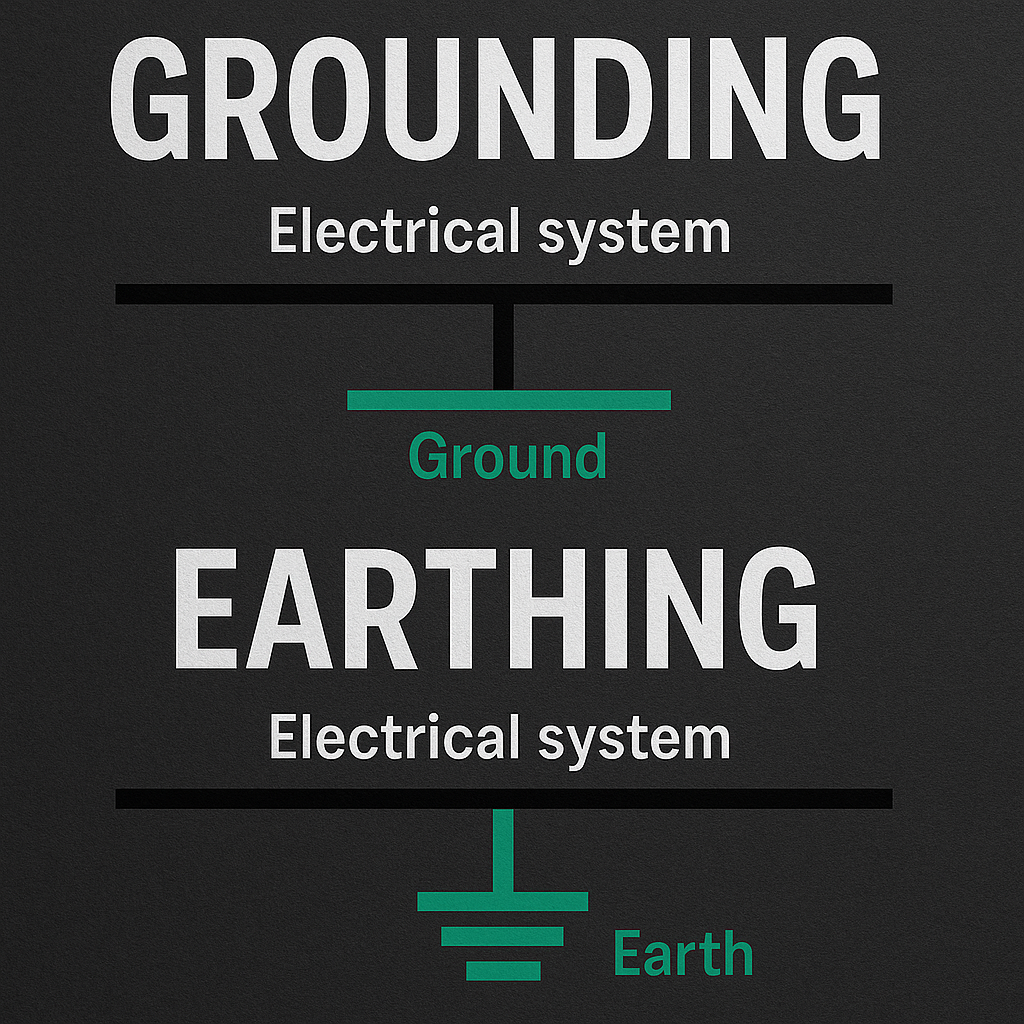

A ground wire does not make electric current disappear into the planet. In a typical grounded electrical system, protective bonding helps establish a fault-current path back to the source so protection can operate. Earth connections and equipment bonding have related but distinct jobs.
Current needs a complete circuit back to its source
A fault from a live conductor to an accessible metal case can create a dangerous potential. An intended protective path connects the case into the system protection arrangement. In common grounded systems, a low-impedance metallic return path helps enough fault current flow for the relevant protective device to disconnect promptly. The details depend on the earthing system and protection design. Saying the current simply drains into ground hides the source and return relationship that makes the protective arrangement work.
Earth itself is not a universal substitute for a protective conductor
Soil has impedance, and an earth electrode alone may not provide the fault-current path needed to operate an ordinary overcurrent device as intended. Different systems use different protective strategies, including residual-current protection where required. Do not replace a missing equipment-grounding conductor with an improvised rod or pipe connection. The complete installation must be designed and verified under the applicable requirements. An outdoor metal object touching soil is not automatically safe merely because it appears physically connected to the earth.
Bonding reduces dangerous differences between accessible parts
Bonding intentionally connects relevant conductive parts so their potential differences and fault paths are controlled as part of the design. A loose, corroded, or missing connection can undermine that function. However, a bonded system is not permission to touch live conductors, and a protective conductor can carry current during a fault. OSHA guidance discusses hazardous differences in potential and protective-path performance. Safe work still requires isolation, verification, and the correct procedure for the equipment and electrical system.
Signal ground is not always the same thing as protective earth
Electronic schematics often label a circuit reference as ground even when it is floating relative to earth. Other equipment connects that reference to chassis or protective earth at a defined point. Cables between devices can establish additional connections. Confusing these uses can create noise, shorts, or hazards, especially with grounded test instruments. Read the actual equipment architecture before joining reference points. Do not remove a protective-earth connection to fix audio hum or assume every ground symbol can be connected together without review.
A simple continuity result cannot certify the whole protection system
A continuity check may show a conductive path under a small test current, but it does not establish every required property under fault conditions. Connection integrity, impedance, protective-device coordination, and the system configuration need appropriate assessment. Have a qualified electrician investigate damaged cords, missing earth pins, or uncertain bonding. Do not bypass a ground contact with an adapter or make informal live measurements to prove that a case feels safe. Preserve the manufacturer and installation protective arrangements during repair or replacement.
What to check before you act
- Identify the source and complete intended fault-return path.
- Distinguish earth electrodes, bonding, and signal references.
- Preserve protective-earth connections when solving noise problems.
- Use qualified verification rather than a simple continuity assumption.
Common questions
Does fault current vanish when it reaches ground?
No. It flows through a circuit and returns to its source through the available paths.
Can a ground rod replace any missing protective conductor?
No. The correct protection depends on the complete earthing and protective-device design.
The practical takeaway
Grounding and bonding control potentials and fault paths; they are not an electrical drain. Preserve the complete protective system and have uncertain connections assessed properly.
References and further reading
- OSHA: Grounding and equipment connection requirements
- OSHA: Potential differences and protective grounding principles
Numerical scenarios are illustrative unless identified otherwise. Follow the exact product instructions; component ratings and local installation requirements can differ.