
Electric current does not choose only the easiest available route and ignore every other path. In a parallel circuit, current can flow through multiple connected branches at the same time. Their voltage and impedance determine the distribution, which is why a low-resistance path does not make every other path harmless.
Parallel branches share a voltage difference
Two resistive branches connected across the same source have the same voltage across their endpoints in the ideal wiring model. Each branch current follows its own resistance. With an illustrative 12V source, a 1000Ω branch carries 12mA while a 2000Ω branch carries 6mA. Both carry current; the higher-resistance branch is not ignored. The source supplies their combined 18mA in this simple example. Nothing in the calculation requires current to inspect the branches and select only one before flowing.
A lower resistance usually takes more current under the same voltage
For purely resistive parallel paths sharing a fixed voltage, lower resistance means higher branch current. That is the useful idea behind the familiar phrase, but adding the word only makes it wrong. The distribution also changes if the source voltage sags because of its own impedance or current limit. A real short circuit can pull the supply down, but that behavior comes from the complete circuit. It is not evidence that the other branch ceased to exist or became intrinsically safe.
AC paths require impedance rather than resistance alone
Capacitance and inductance affect AC current and phase, so the easiest-looking DC resistance path may not dominate at every frequency. High-frequency current can follow a different distribution through cables, shields, and parasitic capacitance from the one predicted by a simple resistance check. Use the model appropriate to the waveform and physical layout. A continuity beep between two points does not fully describe how current will divide during a fast transient or under a particular AC operating condition.
This misconception creates a dangerous grounding assumption
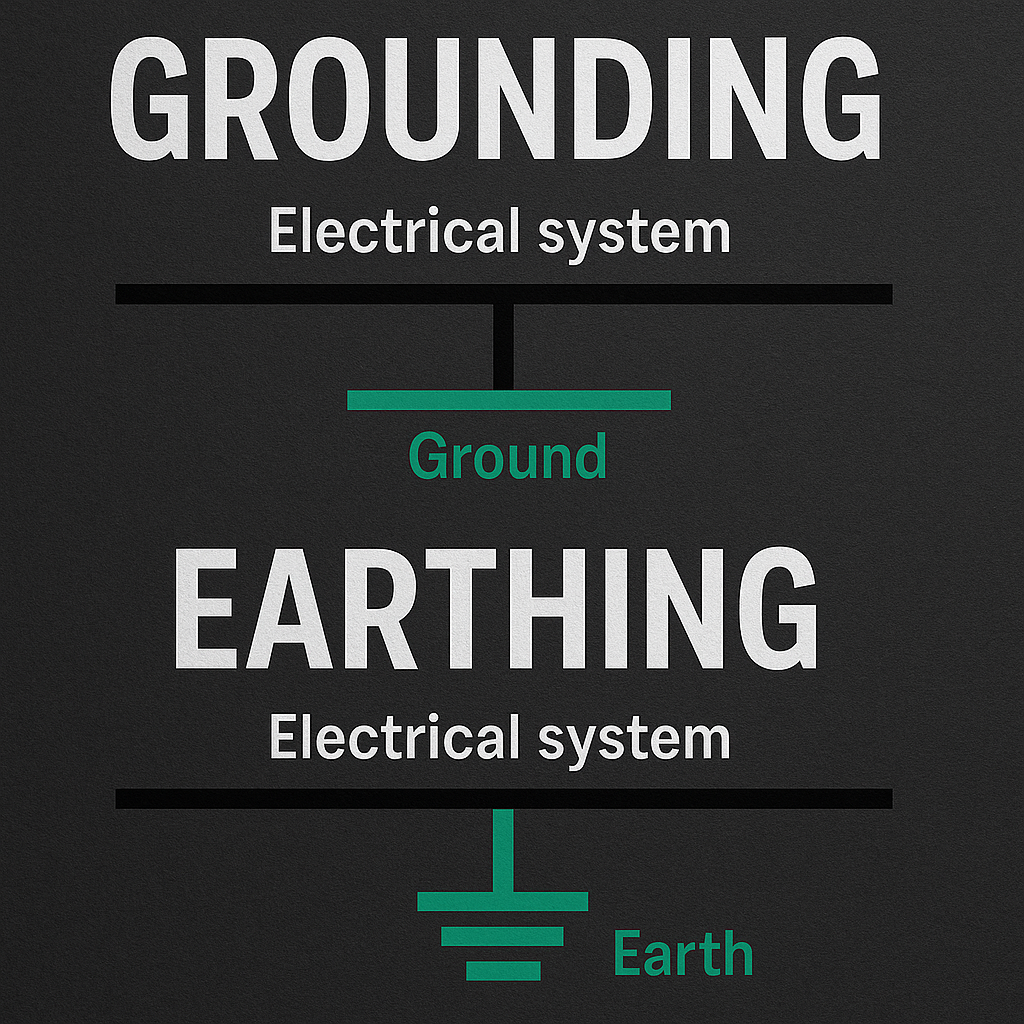
A protective conductor can provide an intended low-impedance fault path, but that does not guarantee zero current through every other available path. A person contacting different potentials can still be part of the circuit. Protection depends on the complete bonding, source, and protective-device arrangement and its operation time. Never test grounding by touching equipment or assume a ground wire makes contact with live parts safe. Electrical safety requires proper isolation and verification, not a belief that current will politely prefer the metal wire.
Trace complete paths rather than ranking isolated objects
A wire, pipe, body, or resistor matters electrically only through its connections and the potentials involved. Draw the source, the outgoing paths, and the return paths before making a prediction. For a low-energy learning circuit, calculate each known resistor branch separately and add the currents, using suitable component ratings. Keep hazardous installations out of improvised experiments. If an unexpected path appears through a signal cable or grounded instrument, remove power and resolve the full connection map rather than adding another conductor to make it lower resistance.
What to check before you act
- Identify the voltage shared by the parallel branches.
- Calculate each branch instead of selecting a single winner.
- Use impedance when frequency-dependent effects matter.
- Never rely on a preferred path as protection from live contact.
Common questions
Does a higher-resistance parallel branch carry no current?
No. With a nonzero applied voltage and finite resistance, it carries current according to its own branch conditions.
Does adding a ground wire make touching live equipment safe?
No. Current can divide among paths, and safe work requires proper protection, isolation, and verification.
The practical takeaway
Current distributes through the connected circuit. A lower-impedance path can carry more, but it does not erase the other paths or their hazards.
References and further reading
- OpenStax: Parallel branch voltage and current
- OSHA: Hazardous potential differences and protective paths
Numerical scenarios are illustrative unless identified otherwise. Follow the exact product instructions; component ratings and local installation requirements can differ.