
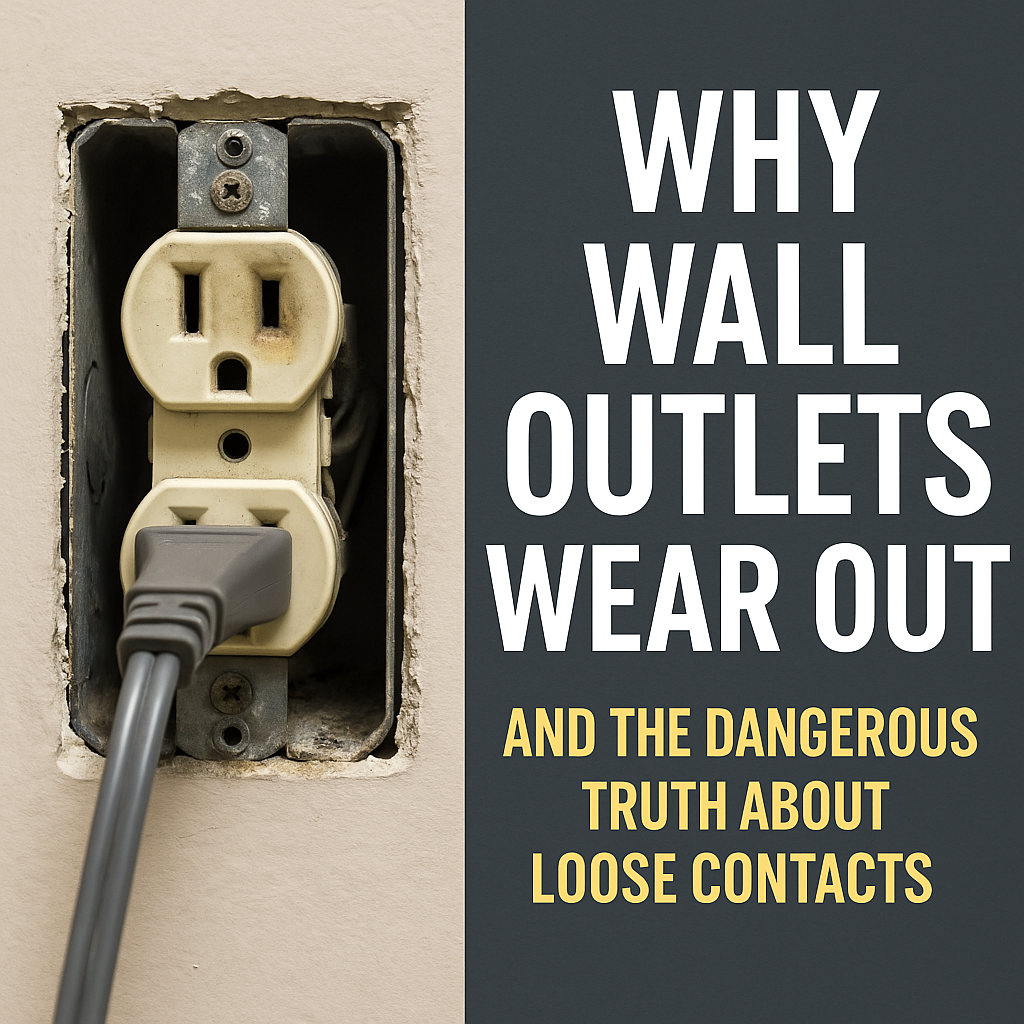
Most homeowners think of wall outlets as permanent fixtures — something that lasts the life of the house.
They assume:
- an outlet is either “fine”
- or “completely broken”
- or “just loose because the screw came out”
But electricians know the truth:
Wall outlets are mechanical devices with internal contacts that wear out — and they fail long before the plastic faceplate does.
When an outlet starts:
- feeling loose
- losing grip on plugs
- heating up
- making crackling sounds
- causing intermittent power
- discoloring around the plug holes
- melting the faceplate
…it is already in a dangerous state.
Most house fires caused by wiring start right here — at a worn outlet with high contact resistance.
Today Amp Nerd breaks down:
- how outlets are constructed internally
- why plug tension decreases as they age
- how resistance builds up (and why heat follows)
- why heavy appliances kill outlets quickly
- why cheap outlets fail catastrophically
- how backstab wiring contributes to arcing
- the warning signs that a deadly failure has already begun
This is one of the most misunderstood electrical topics in home safety.
Grab a coffee — we’re going deep.
⚡ The First Truth: A Wall Outlet Is a Mechanical Spring Device, Not Just “Two Holes in the Wall”
Inside every outlet (receptacle) are:
- spring-steel contact blades
- copper or brass internal bus bars
- mechanical tension fingers
- contact surfaces with plating
- insulating spacers
- a thermoplastic shell
Every time you plug in or unplug a device, those metal springs flex.
Over years, they lose tension — and lose contact pressure.
This is the root cause of almost all outlet failures.
⚡ Reason #1: Contact Pressure Decreases Over Time → Heat Increases
Electrical contacts must maintain high contact pressure between surfaces for low resistance.
A new outlet clamp might exert:
- 1.5–3 lbs of force on a plug blade
An old one may exert:
- almost nothing
This causes:
✔ higher contact resistance
✔ micro-arcing
✔ heat concentration
✔ carbon buildup
✔ more resistance
✔ even MORE heat
This becomes a dangerous thermal loop.
Temperature inside a failing outlet can reach:
120–160°C,
even if the plastic stays “warm” on the outside.
⚡ Reason #2: Plug Blades Scrape the Metal Every Time → Surface Erosion
Every insertion/removal of a plug:
- scrapes metal
- removes plating
- roughens contact surfaces
- enlarges the internal “jaws”
- wears down sharp edges designed for grip
Do this a few hundred times and the outlet turns into “loose jaws” that barely touch the plug blades.
Loose metal = electromagnetic arc conditions.
This is why outlets fail faster in:
- kitchen islands
- living room entertainment areas
- bedside phone charging points
- workbenches
- locations with vacuum cleaners plugged in repeatedly
Any high-traffic outlet will wear out long before low-use ones.
⚡ Reason #3: Heat Cycling Warps the Metal and Weakens Spring Tension
Every outlet carries devices that heat and cool repeatedly:
- heaters
- hair dryers
- kettles
- microwaves
- toasters
- irons
- space heaters (the biggest offender)
Heat cycling causes:
- metal expansion
- metal contraction
- gradual metal fatigue
- loss of elasticity
- spring softening
- permanent deformation
Once the internal metal loses spring force, the outlet:
- loosens
- arcs
- overheats
- begins to melt internally
This is the physical aging process everyone ignores.
⚡ Reason #4: High-Current Appliances Destroy Outlets Faster Than Low-Current Ones
Plugging in a phone charger does nothing to an outlet.
Plugging in a 1500W heater is a totally different story.
A 1500W heater pulls:
12.5 amps continuous load
That is nearly the maximum safe load for a 15A outlet.
But here’s the dangerous part:
A worn outlet’s internal contact resistance might be:
- 0.05 ohms (still “functional”)
- 0.1 ohms (heating noticeably)
- 0.2 ohms (extreme heating)
Using the formula:
P = I² × R
At 12.5A:
- 0.05Ω → 7.8 watts of heat inside the outlet
- 0.1Ω → 15.6 watts of heat
- 0.2Ω → 31.3 watts of heat
Thirty watts of heat inside a tiny plastic box in your wall is how house fires start.
⚡ Reason #5: Backstab Wiring Is One of the Biggest Hidden Failure Points
Backstab (push-in) connections were extremely common in homes from 1970–2005.
These are:
- fast for electricians
- cheap for contractors
- convenient for mass construction
But they are mechanically terrible.
Backstab issues include:
- weak spring tension
- high resistance over time
- loosening from thermal cycling
- copper creep (slow deformation)
- oxidation at the pressure point
- arcing at the rear of the switch
Many “mystery flickering issues” electrical pros investigate end up being:
“Backstab wire barely holding on by one oxidized strand.”
These absolutely destroy outlets prematurely.
⚡ Reason #6: Cheap Outlets Use Terrible Alloys and Weak Spring Steel
A $0.49 outlet from a hardware store is not engineered for durability.
Cheap outlets use:
- thin stamped brass
- low-tension springs
- poor-grade steel
- minimal plating
- low-temperature plastic
- weak side clamps
They wear out in years.
Commercial-grade or spec-grade outlets use:
- thick nickel-plated brass
- strong steel springs
- full-contact grips
- temperature-resistant materials
- heavy-duty side terminations
Cheap outlet = fast failure.
Good outlet = decades of safe operation.
⚡ Reason #7: Devices With Internal Power Supplies Stress Outlets on Plug-In
Switch-mode power supplies (SMPS) in:
- laptops
- gaming PCs
- monitors
- TVs
- chargers
- audio equipment
…generate inrush current spikes when first plugged in.
Typical spikes:
- 20A–60A for 1–20 ms
- some devices exceed 80A at plug-in
These short bursts:
- arc across contact surfaces
- vaporize tiny amounts of metal
- weaken the internal contact springs
- accelerate pitting and carbon buildup
Every high-powered SMPS “kills” the outlet a little each time you plug it in.
⚡ Reason #8: Arcing Happens Before You Ever Hear It
Most arcing inside outlets is completely silent.
“Crackling” is the late stage.
Early-stage arcing includes:
- microscopic sparks
- high-frequency electrical noise
- small carbon deposits
- localized heating
- oxidation of contact surfaces
By the time crackling or sizzling is audible, the outlet has:
- severely worn contacts
- significant resistance buildup
- high heat production
- a real fire risk
This is why electricians replace outlets at the first sign of looseness.
⚡ Reason #9: Outlets Often Fail at the Rear, Not the Front
What homeowners see is the front.
But most electrical failures happen:
- at the wire terminals
- at the internal bus bars
- inside the contact mechanism
- behind the faceplate
Examples:
- a screw terminal loosens
- copper oxidizes
- vibrations loosen wires
- insulation melts
- bus bars warp
The outlet may look “fine.”
Internally, it can be a ticking bomb.
⚡ Reason #10: Heat + Oxidation + Mechanical Wear = Complete Failure
Once an outlet begins to heat:
- Metal oxidation accelerates
- Resistance increases
- Heat increases further
- Plastic softens
- Spring tension weakens
- Contact pressure drops
- Arcing increases
- Carbon buildup increases resistance
- Outlet reaches runaway thermal failure
This is a classic failure chain.
⚡ Warning Signs of a Dangerous Outlet
If you see ANY of these symptoms, the outlet should be replaced immediately:
⚠ Loose grip on plugs
⚠ Warm or hot faceplate
⚠ Crackling, sizzling, or buzzing
⚠ Sparks when plugging in
⚠ Flickering lights on connected devices
⚠ Burn marks or discoloration
⚠ Melted plastic
⚠ Plug falling out by gravity alone
⚠ Scorch smell or “electrical” smell
⚠ Outlet wobbles or moves
These are signs of:
- contact failure
- heat buildup
- arc damage
- internal melting
- dangerous resistance
- potential fire hazard
⭐ Amp Nerd Fun Facts
- A worn outlet can generate over 30 watts of heat internally — more than many LED bulbs.
- Outlets often fail before the breaker ever notices anything is wrong.
- A single loose connection can reach 150°C inside the wall cavity.
- Cheap outlets may lose 50% of their grip strength after only 300 insertions.
- Commercial-grade outlets often last 50,000+ plug cycles.
- Arcing inside an outlet can produce ultraviolet light, invisible to humans.
- A plug falling out on its own is not “annoying” — it’s dangerous.
⚡ Amp Nerd Summary
Wall outlets wear out because:
- their internal mechanical contacts lose tension
- metal surfaces erode from plug insertion
- oxidation increases resistance
- high-current devices create heat
- switching power supplies create inrush arcs
- backstab wiring loosens over time
- cheap materials deform from heat
- thermal cycling weakens springs
A worn outlet is NOT a small problem.
It is one of the top fire starters in older homes.
Replacing a bad outlet costs $2–$15.
Ignoring one can cost your entire house.