
Surge protectors sit quietly under desks, behind TVs, next to gaming PCs, and beside nightstands — silently guarding our devices from “dangerous power spikes.”
Or at least… that’s what we hope they’re doing.
The truth is far less comforting:
Most surge protectors wear out, fail silently, and stop protecting your devices long before you replace them.
People trust them because:
- they have a switch
- they have outlets
- they say “protected” on the label
- maybe there’s a glowing light
- they last for years without complaint
But inside that plastic housing is a component that ages, degrades, and eventually becomes useless:
the MOV — Metal Oxide Varistor.
Today, we’re breaking down:
- how surge protectors REALLY work
- the science behind MOV degradation
- why every surge protector has a limited lifespan
- the loads and appliances that destroy them early
- why most fail without warning
- when a surge protector becomes a fire hazard
- how whole-home surges chew up protectors
- and how to actually protect sensitive electronics
This is critical safety information most manufacturers never highlight — for obvious reasons.
Let’s begin.
⚡ The First Truth: Surge Protectors Don’t Block Surges — They Absorb Them
Everyone imagines a surge protector acting like a filter that “blocks” high voltage.
Reality:
Surge protectors use MOVs that absorb excess voltage by sacrificing themselves.
MOVs are:
- disks of zinc oxide
- with metal electrodes
- designed to shunt excess voltage to ground
- sacrificial components
Every time they absorb a surge:
- they heat up
- their internal structure changes
- their clamping voltage shifts
- they degrade permanently
MOVs get weaker each time they activate.
Eventually, they:
- stop clamping at the right voltage
- get slower
- fail to protect anything
- or fail short (dangerous)
This is why:
**Surge protectors ALWAYS have a finite lifespan.
They are consumables, not permanent equipment.**
⚡ Reason #1: Surge Protectors Wear Out from Very Small, Daily Micro-Surges
Most people assume surges only happen during:
- lightning storms
- grid faults
- downed power lines
But the most common surges come from inside your home, from:
- air conditioners
- washing machines
- fridges
- pumps
- vacuum cleaners
- heaters
- motors of any kind
Every time one of these switches on or off, they cause:
- inductive kickback
- voltage spikes
- harmonics
These small surges don’t destroy electronics in one hit —
they just nibble away at MOV lifespan.
Your MOV may experience:
5–50 micro-surges every single day.
This silently ages your surge protector until it becomes useless.
⚡ Reason #2: A Single Good Lightning Strike Can Kill a Surge Protector Instantly
Lightning does NOT need to hit your house directly.
You can lose protection from:
- a strike on your street
- a strike on the next block
- a strike miles away traveling through the grid
- a strike hitting cable/internet lines
A strong surge will:
- fully clamp the MOV
- push it to 300–700°C internally
- permanently damage the oxide grain boundaries
- destroy its protective ability
Sometimes the strip dies dramatically — pop, smoke, burnt smell.
But MOST times?
**The MOV dies quietly
and the power strip continues working
but with zero surge protection.**
A surge protector that still powers devices is not necessarily protecting them.
⚡ Reason #3: Heat Destroys MOVs Over Time (Even Without Surges)
MOVs degrade significantly when stored or used in hot environments.
Think about where people place surge protectors:
- behind TVs
- inside entertainment centers
- under gaming PCs
- behind heaters
- in dusty corners
- under carpets (dangerous!)
- inside humid basements
- near radiators
MOV degradation accelerates drastically above 40°C, and some surge protectors reach 60–90°C internally under load.
Heat aging does:
- lowers clamping performance
- shortens lifespan
- increases leakage current
- raises the chance of thermal runaway
A surge protector in a hot room might last half as long as one in a cool, ventilated spot.
⚡ Reason #4: Many Surge Protectors Share MOVs Between Outlets
Cheap protectors often use:
One single MOV for the entire strip.
If that MOV fails:
- all outlets lose surge protection
- the strip still powers everything
- the user has no idea protection is gone
Higher-end strips use:
- multiple MOVs in parallel
- thermal fusing
- redundancy
But the $5–$10 strips sold everywhere?
One MOV.
No monitoring.
Minimal thermal protection.
These fail fast.
⚡ Reason #5: MOVs Fail in Two Terrifying Ways
MOVs have two possible failure modes:
1. Fail OPEN (no protection)
- protector still powers devices
- user assumes everything is fine
- zero surge protection remains
- next surge kills the electronics
2. Fail SHORT (fire hazard)
- MOV overheats
- melts
- smokes
- burns
- catches fire
- ignites dust and carpet
This is why:
UL standards now require thermal fuses inside surge protectors
to prevent MOV runaway.
But many cheap models do NOT meet these requirements.
⚡ Reason #6: Joule Ratings Mislead Consumers
Surge protectors proudly display:
“1050 Joules!”
“2000 Joules!”
“4320 Joules Protection!”
But the joule rating is:
- NOT lifetime
- NOT surge strength
- NOT how much energy it blocks
- NOT how long it protects
The joule rating is:
Total energy the MOV can absorb over its entire usable life.
Every surges subtracts from that total.
A 4320J protector might lose:
- 100 joules from small surges
- 200 from inductive spikes
- 500 from lightning ripple
- 1500 from grid switching
- 2000+ from a major surge
Once the joule capacity is used up:
- protection = ZERO
- strip still powers devices
- user is completely unaware
Surge protectors should be treated like airbags — once deployed, they must be replaced.
⚡ Reason #7: Surge Protectors Are Not Designed for High Loads
People plug surge protectors into:
- heaters
- hairdryers
- coffee makers
- kettles
- space heaters
- gaming PCs
- AC units
- fridges
- microwaves
Most protectors are rated for:
- 10–15 amps max
- often less continuous current
- no high inrush tolerance
High loads:
- heat the MOV
- age the MOV
- heat the bus bars
- weaken the switch
- increase line resistance
- melt the plug
Heat + current = faster MOV death.
⚡ Reason #8: Surge Protectors Expire in 2–5 Years (Even with No Major Surges)
MOVs age from:
- heat
- humidity
- leakage currents
- small voltage spikes
- micro-surges
- time
Even if you never experience a lightning strike,
typical surge protectors last:
• 2–3 years in hot environments
• 3–5 years in normal homes
• 5–7 years for high-end models
After that?
Protection is gone.
Most people keep surge protectors for 10–20 years.
Their MOVs are long dead.
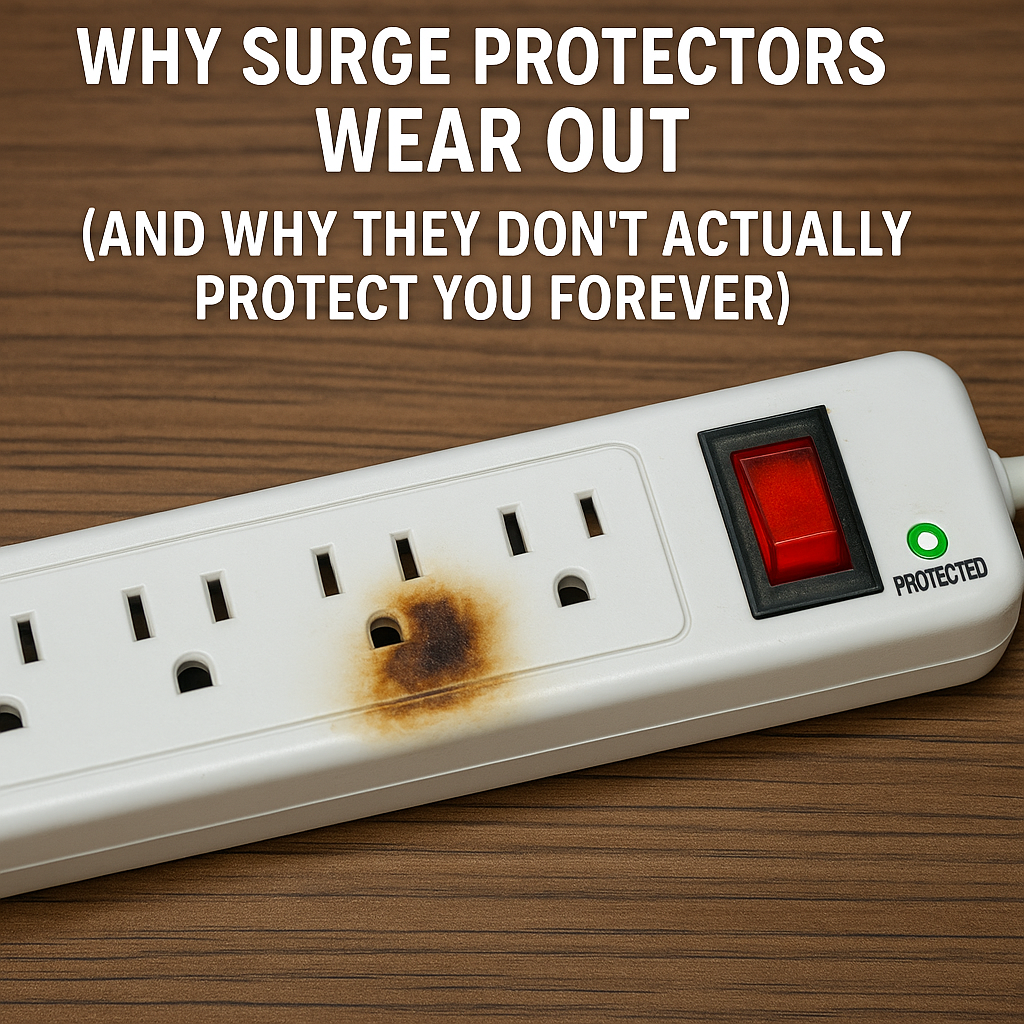
⚡ Reason #9: “Protected” Lights on Surge Protectors LIE
Many protectors have a little LED labeled:
- PROTECTED
- SURGE
- SAFEGUARD
- OK
This LED is often connected to:
- mains power
- a resistor
- a pilot light circuit
Meaning:
The LED merely shows the strip has power — not that the MOV is functioning.
Some better models use:
- monitoring circuits
- MOV continuity tests
- thermal fuses connected to the LED
But many cheap strips give you a fake sense of safety.
⚡ Warning Signs Your Surge Protector Is Dead or Unsafe
Replace immediately if:
❌ It’s warm or hot
❌ Plastic is discolored
❌ You hear buzzing
❌ The plug is loose or scorched
❌ The switch flickers
❌ The protector is older than 5 years
❌ Your area had a recent lightning storm
❌ High-powered appliances were plugged in
❌ Electronics randomly reboot
❌ The protector smells like burnt plastic
❌ The “protected” light doesn’t come on
These signs mean:
- MOVs are degraded
- internal heating is happening
- contacts have loosened
- the unit may catch fire
A “dead” surge protector is more dangerous than none at all.
⭐ Amp Nerd Fun Facts
- A single lightning strike miles away can consume 1000+ joules of MOV capacity.
- Surge protectors don’t block surges — they sacrifice themselves.
- Many surge protectors silently lose protection in under 2 years.
- Cheap surge protectors use one MOV for all outlets.
- Half of surge protector failures happen with no visible symptoms.
- The joule rating is a lifetime allowance, not the strength of protection.
- A failed MOV can reach 700°C internally — enough to ignite carpet fibers.
⚡ Amp Nerd Summary
Surge protectors fail because:
- MOVs degrade with every surge
- micro-surges eat away lifespan
- heat accelerates aging
- high-current appliances weaken protection
- lightning wipes out MOVs instantly
- cheap strips have inadequate thermal safety
- the “protected” LED often lies
- MOVs fail open or short
- joule ratings mislead consumers
Surge protectors are consumable safety devices,
not permanent protection.
If you haven’t replaced yours in the last 3–5 years —
it’s already expired.