
Walk into any home or office and you’ll find them everywhere:
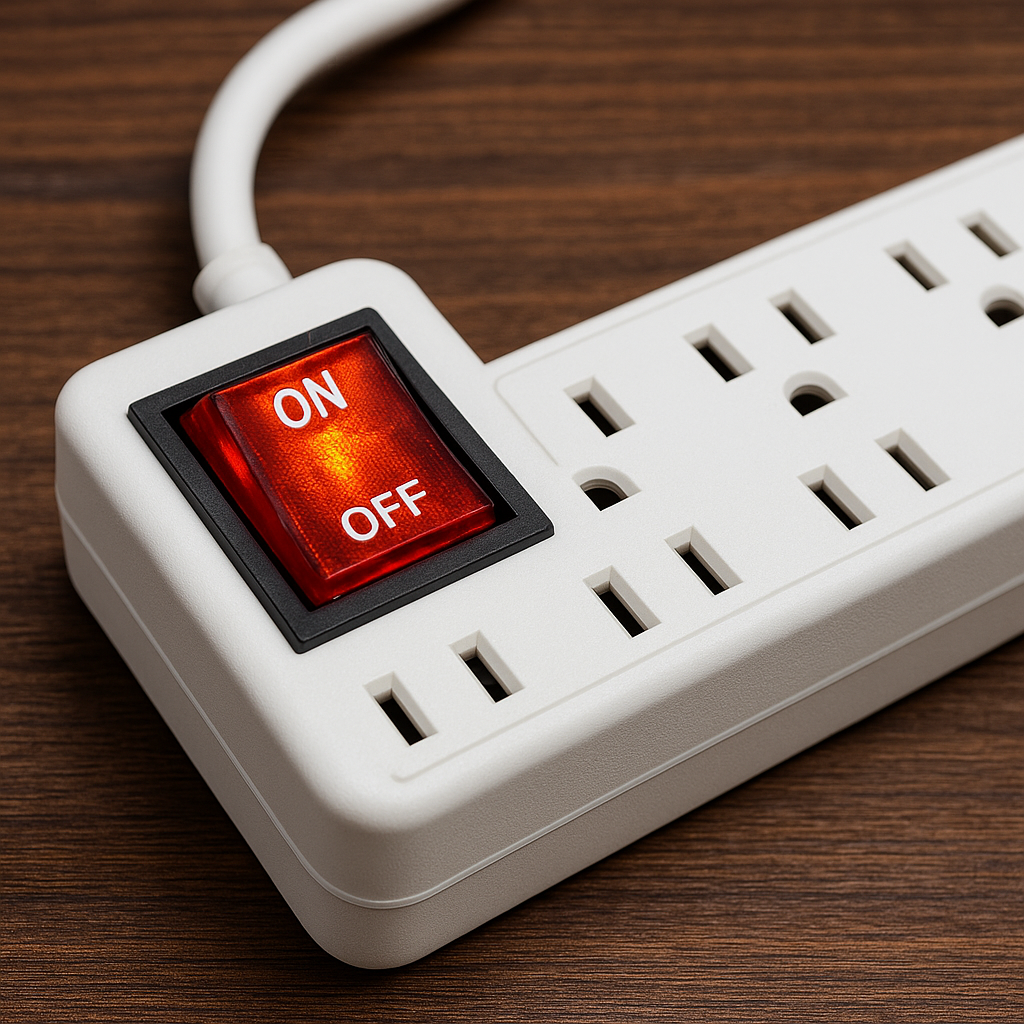
Power strips with little red rocker switches.
They promise:
- convenience,
- control,
- safety,
- a quick way to turn everything off.
But here’s the uncomfortable truth:
Switches on cheap power strips are one of the weakest, most failure-prone electrical components in your home — and many of them quietly become fire hazards long before they fail outright.
If your power strip has a switch, especially a cheap plastic one, there are a lot of things engineers know that consumers absolutely don’t.
Today we’re breaking down:
- why these switches fail,
- what happens electrically when they do,
- and the hidden dangers that make them far riskier than you think.
Let’s get into it.
⚡ The First Truth: The Switch Is the Weakest Link — Not the Strip Itself
People assume the dangerous part of a power strip is:
- the plug,
- the thin wiring,
- the outlet sockets,
- or the cheap plastic housing.
But engineers know the real weak point:
The built-in rocker switch.
Why?
Because inside that little plastic toggle is:
- a tiny metal contact,
- a spring-loaded mechanism,
- a minimal arc suppression design,
- and almost no thermal mass.
These switches were never designed to handle:
- heaters,
- air fryers,
- gaming PCs,
- kitchen appliances,
- vacuum cleaners,
- hair dryers.
Yet people plug these high-power loads into them all the time.
And when they do?
The switch slowly self-destructs.
⚡ Reason #1: Cheap Rocker Switches Arc Every Time You Flip Them
Every time you turn a device ON or OFF, the switch experiences an electrical arc.
An arc is:
- a tiny lightning bolt,
- extremely hot,
- destructive to metal contacts,
- capable of vaporizing material.
Cheap switches offer:
- no arc snubbers,
- no spark suppression,
- no proper contact plating.
Each arc damages the switch a little more.
After hundreds or thousands of cycles:
- contacts get pitted,
- resistance increases,
- heat builds up,
- plastic starts to deform,
- carbon deposits form,
- the switch becomes a fire hazard.
This happens silently.
⚡ Reason #2: Switches Are Rated Differently Than the Strip (Marketing Trick)
Power strip claims:
“2500W / 10A / 16A”
But the switch inside is often rated:
- 2A
- 3A
- 6A
- sometimes 10A (barely)
This means the internal switch cannot safely handle the load the strip can.
If your strip is powering:
- a heater (2000W),
- a microwave (1500W),
- an oven (2000W),
- air conditioner (1000–2000W),
…the switch is dangerously overloaded, even if the rest of the strip is not.
This is one of the most misleading aspects of modern power strips.
⚡ Reason #3: Increased Resistance = Increased Heat (Physics You Can’t Avoid)
As switches wear out:
- oxide layers form,
- contact surfaces degrade,
- spring tension weakens.
This increases contact resistance.
And when resistance increases, heat increases dramatically: Heat=I2×R\text{Heat} = I^2 \times RHeat=I2×R
Even a small rise in resistance (0.2–0.5 ohm) under a 10–16A load can generate dangerous heat inside the switch.
Inside a sealed plastic strip, this can reach:
- 80°C
- 100°C
- 150°C
and cause total meltdown.
⚡ Reason #4: The Switch Is Often Placed in the Worst Possible Location
Inside most power strips:
- the switch is NOT heatsinked,
- it’s surrounded by plastic,
- it’s located near wiring,
- it has poor ventilation.
This means any heat generated inside the switch has nowhere to go.
Heat accumulates → insulation softens → contacts loosen → arcing increases → failure accelerates.
This is textbook thermal runaway.
⚡ Reason #5: Many Switches Are Fake-Rated or Falsely Marked
Cheap manufacturers print:
- “10A 250V”
even if the switch is genuinely a 2A 125V component originally meant for small appliances.
Many online-sold power strips use:
- counterfeit switches,
- knockoff designs,
- extremely thin internal contacts.
These fail catastrophically under heavy loads.
⚡ Reason #6: Switch Failure Often Starts Fires at the Back of the Strip
When switches fail, they produce:
- sparks,
- carbon deposits,
- melting plastic,
- localized overheating.
These failures occur inside the strip, hidden from view, until something external happens:
- smell of burning plastic,
- discoloration,
- popping sound,
- scorch marks,
- total strip failure.
These fires often start silently, and many homeowners never notice the warning signs.
⚡ Reason #7: Switches Are Not Designed for Reactive Loads (Motors & Transformers)
Loads that cause switch damage include:
- vacuum cleaners,
- refrigerators,
- air compressors,
- induction motors,
- microwave ovens,
- power tools.
These devices cause:
- huge inrush currents,
- voltage spikes,
- inductive kickback.
Cheap switches can’t handle inductive kickback and arc violently when switched.
⚡ Reason #8: Switches Wear Out Far Faster Than the Outlets
Outlets wear down mechanically.
Switches wear down electrically and thermally.
You might use a strip only occasionally, but the switch is cycled constantly:
- every day you turn it on/off,
- every time a surge hits it,
- every time a spark jumps inside.
Switch lifespan in cheap strips can be as low as:
- 50 cycles
- 100 cycles
- 300 cycles
Better switches are rated for:
- 10,000 cycles
- 50,000 cycles
- 100,000 cycles
Most cheap strips use the former.
⚡ When Is a Power Strip Switch Dangerous?
⚠ Signs your switch is failing:
- feels warm
- makes clicking or sizzling noises
- red indicator light flickers
- smells like burning plastic
- intermittent power
- visible discoloration
- strip randomly turns off
- you hear a faint “buzz” under load
ANY of these means the strip should be thrown away.
⚡ How to Avoid Switch-Related Hazards
✔ Choose strips WITHOUT switches for high-power loads
Heaters, microwaves, kettles, and appliances should NEVER be run through switched strips.
✔ Only buy from reputable brands
Anker, APC, Belkin, Brennenstuhl, CyberPower.
✔ Keep switches OFF during storms (protects from surges)
✔ Avoid “extra-cheap” strips (price = quality in this case)
✔ Replace strips every 2–4 years (especially cheap models)
✔ Never daisy-chain strips
⭐ Amp Nerd Fun Facts
- Cheap rocker switches can fail in 50–100 cycles, while name-brand ones survive 100,000+ cycles.
- Every ON/OFF cycle causes a microscopic lightning bolt inside the switch.
- Some strips use the exact same switches found in €2 electric kettles.
- A switch rated at 100,000 cycles will last 30 years under normal use.
- Many power strip fires start at the switch, not the outlets.
- UL-rated strips test switches at full load for thousands of cycles — cheap strips don’t.
⚡ Amp Nerd Summary
Power strips with switches fail because:
- cheap switches arc heavily,
- contact resistance increases over time,
- heat builds up inside plastic housings,
- switches are often underrated,
- inductive loads destroy contacts,
- aging accelerates failure.
The switch is the weak point —
and most people never realize this until something melts.