
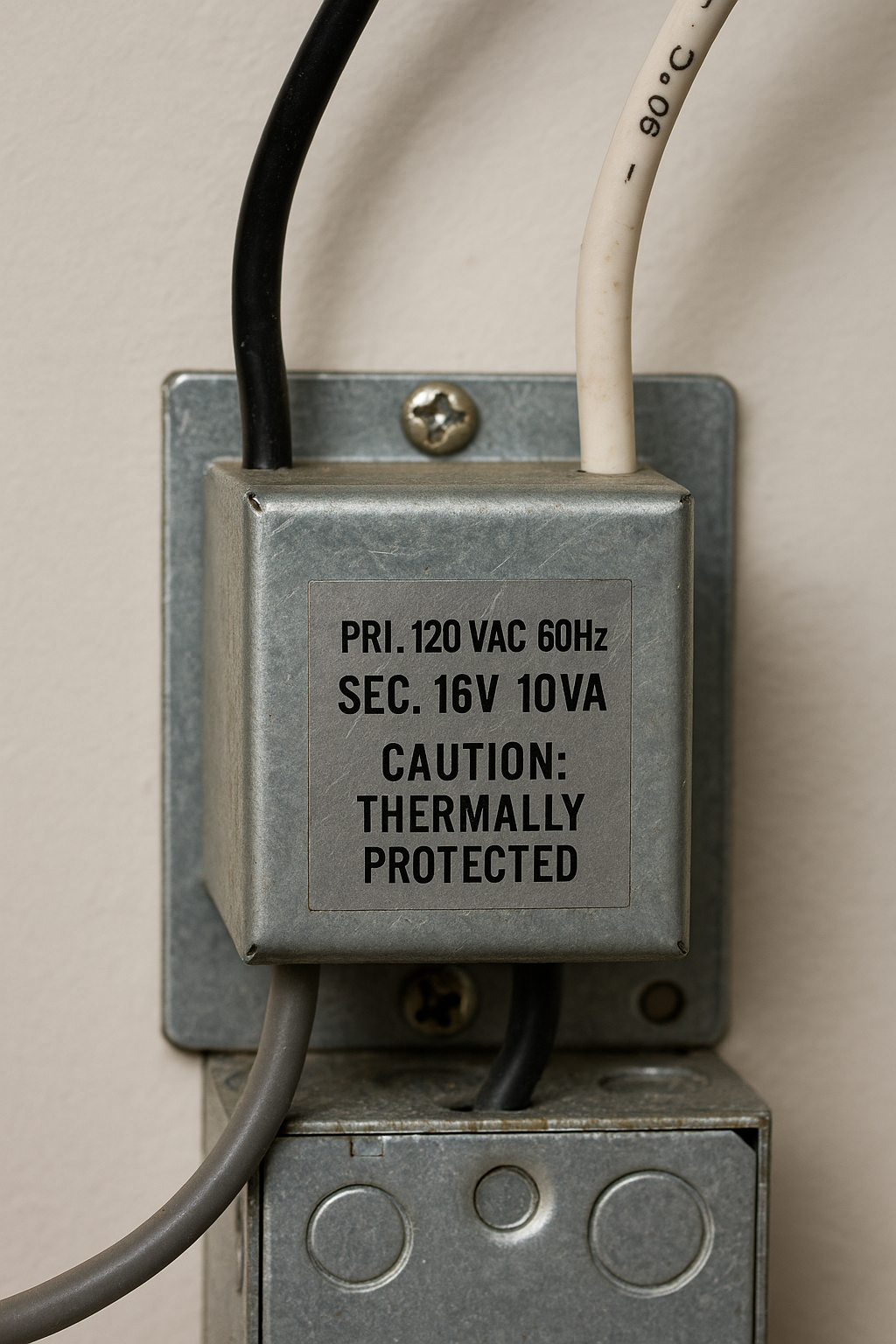
If your house has a wired doorbell, then somewhere — behind a wall, in a basement, in an attic, or above a junction box — there is a doorbell transformer quietly running 24 hours a day.
Most people never think about it.
But electricians know something most homeowners don’t:
Doorbell transformers are some of the oldest, least-updated electrical components still in use today — and many of them are underrated, overheated, or dangerously installed.
These little metal boxes:
- run hot for decades,
- are often unprotected,
- sometimes lack proper fusing,
- handle voltage spikes poorly,
- and can fail catastrophically.
Today we break down:
- why doorbell transformers run constantly,
- what actually burns out inside them,
- why smart doorbells overload them,
- and why many transformers are fire hazards despite being “low voltage.”
Let’s dive in.
⚡ The First Truth: Doorbell Transformers Run 24/7 at Full Excitation
A doorbell transformer steps down:
- 120/230V AC → 12–24V AC
But unlike modern power supplies, doorbell transformers:
- are unregulated,
- use old laminated iron cores,
- run energized with no load,
- waste energy as heat continuously.
Even when nobody rings the doorbell, the transformer:
- energizes the primary coil,
- magnetizes the iron core,
- produces warmth constantly.
A typical 10–20VA transformer can run at:
- 45–70°C surface temperature
- 80–100°C internal temperature
This is normal — and dangerous long-term.
⚡ Reason #1: Most Doorbell Transformers Are Undersized (Even for Old Doorbells)
Many older homes use 10 VA transformers, which were barely enough for:
- a single chime,
- one pushbutton.
But modern homes often add:
- long wiring runs
- illuminated doorbell buttons
- smart doorbells
- cameras
- WiFi modules
- motion sensors
- multiple chimes
These draw far more current.
A 10VA transformer becomes:
- overloaded,
- overheated,
- noisy (electrical hum),
- prone to insulation breakdown.
Electricians routinely find glowing-hot transformers behind walls.
⚡ Reason #2: Smart Doorbells Demand WAY More Power Than Old Transformers Can Provide
Ring, Nest, Eufy, and other smart doorbells draw:
- 2–4× more power than traditional chimes
- constant current for WiFi radios
- peak current for night vision LEDs
- surge current during video upload
- 24/7 standby power
A smart doorbell with IR LEDs may spike to:
- 1.5A at 16–24V AC
(30–36 VA load!)
Most existing transformers are:
- 10VA
- 15VA
- 16VA
Smart doorbells push them to failure.
Symptoms:
- transformer buzzing
- transformer too hot to touch
- chime malfunction
- random doorbell reboots
- video feed lag
- flickering LED on the doorbell
- “low power” warnings in the app
This is classic overload stress.
⚡ Reason #3: Doorbell Transformers Are Often Hidden in Terrible Locations
Electricians frequently find doorbell transformers:
- buried inside walls
- above ceiling drywall
- behind insulation
- inside old junction boxes
- in HVAC closets
- in attics exposed to 60°C+ heat
Transformers produce internal heat.
Combine this with:
- zero ventilation
- dust accumulation
- moisture exposure
- extreme temperature swings
…and you get:
- overheated insulation
- cracked windings
- short circuits
- smoke or fire risk
Poor placement dramatically shortens lifespan.
⚡ Reason #4: Old Transformers Have No Thermal Fuses or Overload Protection
Modern power supplies include:
- thermal cutoff switches
- electronic overload protection
- isolating fuses
- thermal shutdown circuits
Doorbell transformers?
❌ No thermal fuse
❌ No resettable breaker
❌ No surge protection
❌ No current limiter
If they overheat:
- they keep heating
- varnish insulation breaks down
- coils short to the core
- transformer smokes or melts
Transformers can fail catastrophically — even at low voltage.
⚡ Reason #5: Cheap Transformers Use Thin Copper Windings
Budget doorbell transformers use:
- thin copper wire
- minimal varnish insulation
- loose winding tolerances
- poor core materials
Thin windings mean:
- higher resistance
- more heat
- lower efficiency
- faster insulation failure
When overloaded, the windings heat until:
- varnish melts
- copper shorts
- transformer emits burning smell
- primary fuse (if any) blows
- sometimes arcs internally
Most failures start this way.
⚡ Reason #6: Voltage Drop in Long Wiring Runs Overloads Transformers
Doorbell wiring is often:
- 18 AWG or thinner
- running 20–40 meters
- corroded
- zig-zagged through walls
Voltage drop reduces AC voltage at the doorbell.
Smart doorbells respond by:
- drawing more current
- heating themselves
- overloading the transformer even more
This creates a loop:
- transformer overheats
- doorbell underperforms
- transformer fails
- doorbell reboots randomly
⚡ Reason #7: Doorbell Transformers Are Old — Many Over 40 Years
Transformers naturally degrade.
Internal insulation dries out after decades of:
- heat
- humidity
- voltage spikes
- constant magnetization
An old transformer is a failure waiting to happen.
Signs of aging:
- humming
- buzzing
- clicking
- intermittent doorbell power
- warm faceplate
- discoloration
Some 1970s–1980s transformers are still in use — well past any safe lifespan.
⚡ When a Doorbell Transformer Becomes Unsafe
Stop using it immediately if you notice:
⚠ buzzing louder than usual
⚠ hot to the touch (>50°C)
⚠ scorch marks on the mounting plate
⚠ chime ringing weak or intermittent
⚠ smart doorbell rebooting
⚠ burnt smell
⚠ very dim doorbell light
⚠ voltage lower than 14V under load
These are signs of overload or internal breakdown.
⭐ Amp Nerd Fun Facts
- Some doorbell transformers have been operating continuously for 50+ years.
- A 16VA transformer can overheat to 90–120°C internally.
- Smart doorbells can draw as much power as a 40-year-old mechanical chime on their own.
- Many homes have two doorbell transformers because a previous owner simply added another instead of replacing the old one.
- A buzzing transformer is NOT normal — it’s a sign of magnetic core saturation.
- Cheap transformers often use aluminum winding wire, not copper.
⚡ Amp Nerd Summary
Doorbell transformers are weak because:
- they run 24/7,
- they’re undersized for modern loads,
- they lack overload protection,
- they’re buried in terrible locations,
- they use outdated iron-core designs,
- they overheat easily,
- they struggle with smart doorbells,
- they’re often decades old.
A failing doorbell transformer is not just an annoyance —
it’s a hidden electrical hazard.