
Extension cords are everywhere — garages, workshops, kitchens, construction sites, offices, backyards.
People buy them constantly, often choosing the cheapest one labeled “heavy duty”, “industrial strength”, or “reinforced”.
But here’s the uncomfortable truth:
Cheap extension cords are engineered to fail.
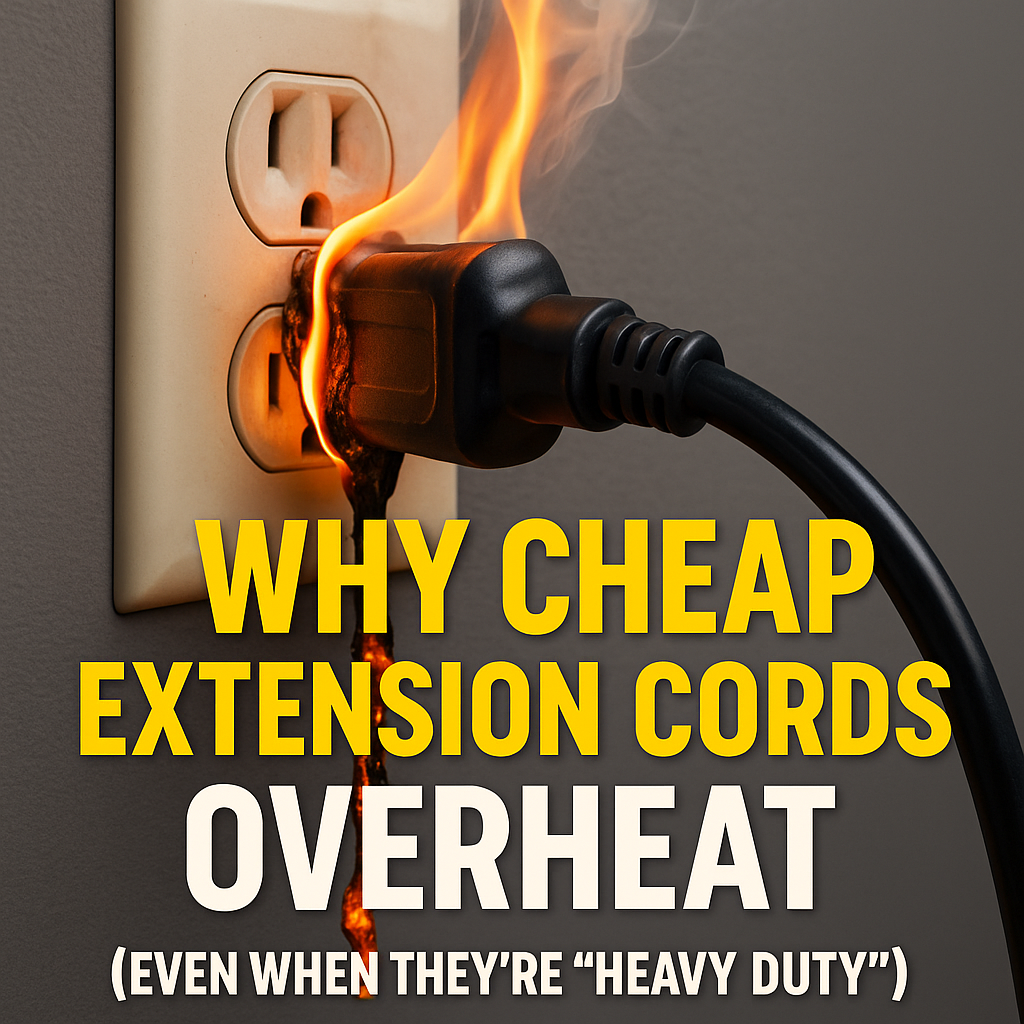
And they frequently overheat, melt, or ignite long before reaching their “rated” load.
You’ve probably seen:
- warm extension cords
- melted plug ends
- stiff or brittle insulation
- blackened outlets
- cords fused to heaters or appliances
These aren’t rare defects.
They’re predictable engineering consequences.
Today we break down why cheap extension cords overheat — electrical, mechanical, material, and thermal reasons — and why even “heavy duty” ones can be complete scams.
Let’s get into it.
⚡ The First Truth: Most Cheap Extension Cords Use Thin Wire Pretending to Be Thick
The current rating of an extension cord depends almost entirely on:
the thickness (gauge) of the copper inside.
But cheap cords:
- lie about gauge
- use copper-clad aluminum (CCA)
- use recycled copper of poor purity
- reduce copper strand count
- use insulation to imitate thickness
That “thick” cord may hide wire that’s:
- 0.5 mm² instead of 1.5 mm²
- 1.0 mm² instead of 2.5 mm²
- aluminum instead of copper
Under load, thin conductors:
- drop voltage
- heat rapidly
- melt insulation
- burn plugs
Manufacturers know customers judge cords by thickness, not actual conductor size — and they exploit this ruthlessly.
⚡ Reason #1: Copper-Clad Aluminum (CCA) Heats Dramatically Under Load
CCA is one of the worst conductors used in consumer products.
Compared to real copper:
- higher resistance
- weaker mechanically
- more prone to breakage
- heats up faster
- fails under flexing
- corrodes faster
CCA gets dangerously hot even at half its rated load.
Heating leads to:
- insulation softening
- copper plating flaking off
- exposed aluminum oxidizing
- resistance increasing further
- rapid thermal runaway
A fake “10A” cord made from CCA can reach 100–150°C in minutes.
⚡ Reason #2: Cheap Cords Use PVC Insulation That Hardens and Cracks Over Time
High-quality cords use:
- TPE
- rubber
- flexible PVC with stabilizers
Cheap cords use:
- brittle PVC
- low-temperature plastics
- recycled plastic with unknown composition
When heated repeatedly:
- insulation hardens
- cracks appear
- micro-tears form
- copper becomes exposed
- carbon tracks form (partially conductive)
- arcing begins
Once PVC insulation becomes stiff:
- internal wires lose flexibility
- bending stresses the copper
- conductors break internally
- heat increases at the break point
This leads to localized hotspots that melt the coating.
⚡ Reason #3: Tight Coils + Load = CATastrophic Heating (Physics 101)
Many people:
- leave extension cords coiled
- use reels without fully unwinding them
- wrap cords tightly under rugs
- bundle cords together with zip ties
This traps heat.
Very dangerous.
Why?
Because heat cannot escape, and:
- resistance rises
- current stays the same
- temperature skyrockets
A cord that is safe straightened out can be lethal when coiled.
A coiled 25m cord under load can reach 200°C, melting completely.
Even “heavy-duty” reels will melt if not unwound fully.
⚡ Reason #4: Undersized Plugs and Contacts Create HUGE Hotspots
Cheap extension cords use:
- thin brass blades
- weak spring contacts
- low-quality plating
- poorly crimped terminals
The result?
- poor pressure inside the wall outlet
- micro-arcing
- localized heating
- carbonized surfaces
- drastically increased resistance
This turns the plug into a heater.
You’ve probably touched a warm plug before — that’s the beginning of failure.
⚡ Reason #5: Multiple High-Load Devices = Overload Disaster
People commonly plug into extension cords:
- heaters (1500W–2000W)
- kettles (2000W–3000W)
- air fryers (1500W–2000W)
- microwaves (1200W–1800W)
- hair dryers (1200W–1800W)
These devices pull near the limit of the outlet by themselves.
Plug two into the same cheap cord?
Catastrophe.
Even “10A rated” cords fail because:
- they’re lying
- they’re using CCA
- their plugs can’t handle the current
- their internal crimps melt
The heating is exponential: Heat∝I2R\text{Heat} \propto I^2 RHeat∝I2R
Doubling current quadruples heat.
⚡ Reason #6: Cheap Cords Have Terrible Crimp Quality Inside
Most extension cords fail inside the plug because of:
- loose crimps
- cold welds
- half-inserted wires
- strands not captured properly
- aluminum strands oxidizing
Loose crimps behave like resistors.
Resistors under load = heat.
This is why melted plugs are so common.
⚡ Reason #7: Many Cheap Cords Are Not Flame-Retardant
High-quality cords use:
- UL94-V0 or V1 flame-retardant insulation
- high-melting-point plastics
- proper thermal additives
Cheap cords use:
- recycled plastic
- no flame retardants
- materials that ignite easily
When they overheat:
- they burn
- they drip flaming plastic
- they release toxic fumes
- they spread fire along walls or carpets
This is how extension cord fires become house fires.
⚡ Reason #8: Long Cords Increase Voltage Drop → Increased Heating
Longer cords = more resistance.
More resistance:
- increases heating
- reduces appliance efficiency
- stresses motors
- causes LED or tool flicker
- increases current draw of some devices
For example:
- A 20 m cheap cord can drop 10–15 V under load
- A heater drawing 2000 W may now draw MORE current
- More current = more heat in the cord
Voltage drop is a silent killer of both cords and appliances.
⚡ Reason #9: Fake Ratings Flood the Market (Especially Online)
You’ll see cords advertised as:
- 16A
- 2500W
- 3500W
- 4000W
But the internal wire is 0.75 mm² or CCA.
These ratings are complete fiction.
True ratings by gauge:
- 0.75 mm² → 6A
- 1.0 mm² → 10A
- 1.5 mm² → 16A
- 2.5 mm² → 20–25A
If the price is too cheap for the gauge claimed → it’s lying.
⚡ Reason #10: Old Extension Cords Quietly Become Fire Hazards
Over years:
- copper strands break
- insulation dries
- plugs loosen
- crimps corrode
- plastic degrades
- internal resistance rises
Old cords fail in predictable ways:
- plug gets hot
- cord stiffens
- insulation cracks
- brown or black marks appear
- intermittent connection occurs
- buzzing sounds appear
- sparks are visible when plugged in
Once an extension cord shows ANY of these symptoms, it should be thrown away immediately.
⚡ How to Choose a Safe Extension Cord (Engineer-Approved)
Look for:
✔ 100% copper wire
✔ Proper gauge (1.5–2.5 mm² for high load)
✔ Thick, flexible insulation
✔ High-quality molded plugs
✔ Strong contact tension
✔ UL/CE/GS certification (real, not fake)
✔ Flame-retardant insulation
✔ Full unwinding on reels
✔ No visible seams or cheap connectors
✔ No “too good to be true” pricing
Avoid:
- CCA cords
- extremely cheap cords
- cords that feel stiff
- cords that get warm
- multi-outlet cubes
- extension cords powering heaters
⚡ Amp Nerd Summary
Cheap extension cords overheat because:
- thin wire
- copper-clad aluminum
- poor contact pressure
- bad crimps
- cheap insulation
- coiled usage
- high loads
- multiple devices
- fake ratings
- voltage drop
- age and degradation
A cheap extension cord isn’t just low quality —
it’s a slow-burning fire hazard designed to fail.
⚡ Final Thought
Extension cords are not harmless accessories.
They’re electrical conductors carrying serious current — and when engineered poorly, they’re one of the most common ignition sources in homes.
Tomorrow :
“Why Cheap Soldering Irons Kill PCBs (And How Heat Actually Damages Electronics).”