
Most people blame outlets for failing:
- “This outlet is worn out.”
- “The plug keeps falling out.”
- “It’s getting hot.”
- “It sparked when I plugged in my heater.”
But the truth is far more interesting:
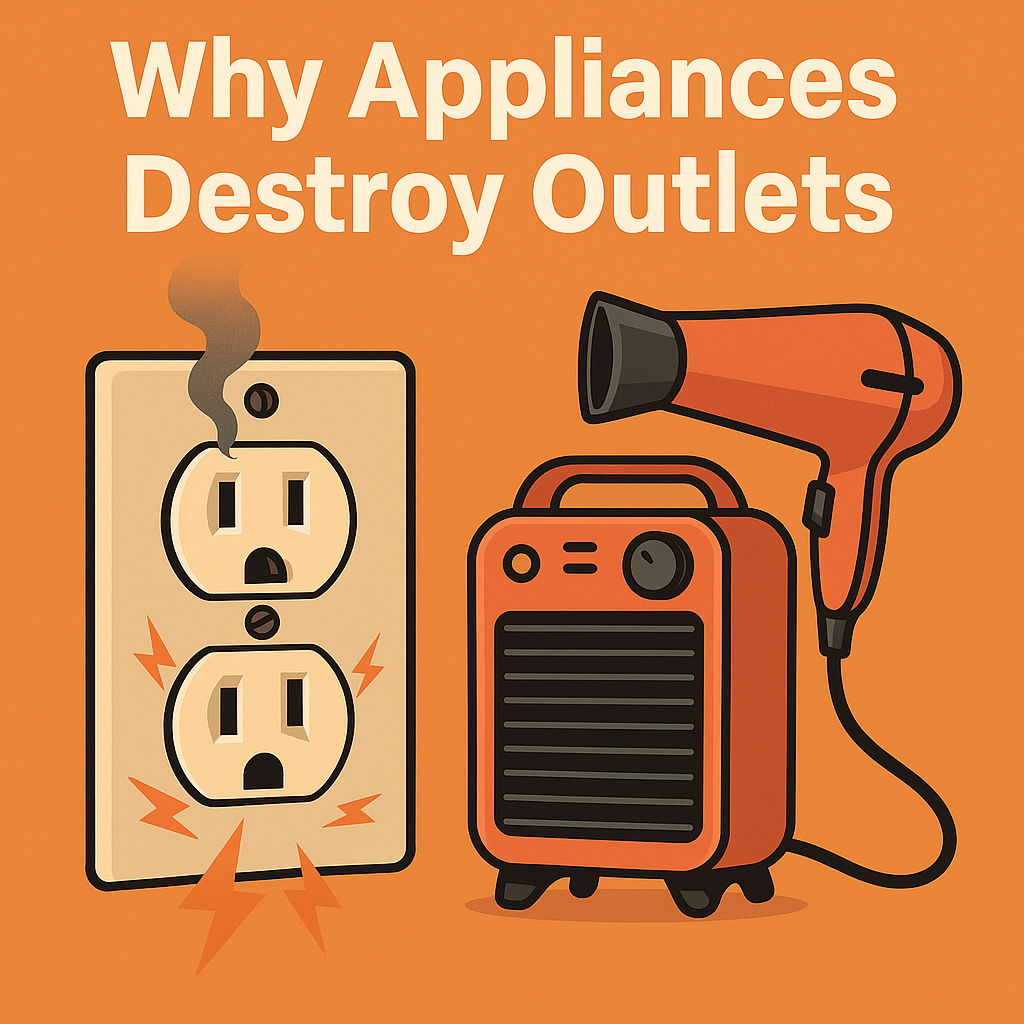
**Wall outlets don’t just “go bad.”
They are destroyed by the appliances plugged into them.**
Some appliances slowly erode outlet contacts over years.
Others kill outlets in weeks.
A few can destroy an outlet in one afternoon.
Today’s Amp Nerd deep dive explains exactly which appliance types are outlet killers, why the damage happens, and what hidden physics is happening inside that little plastic rectangle on your wall.
⚡ The First Truth: Outlets Are Mechanical Devices With Weak, Aging Springs
Inside every outlet are:
- metal contact plates,
- spring fingers,
- tension clamps,
- and copper/brass jaws.
Every time you plug in an appliance:
- the springs flex
- the metal rubs
- plating wears away
After hundreds of plug cycles, the contact pressure can drop from:
2.0 lbs force → 0.2 lbs force
That’s when:
- arcing starts,
- heat rises,
- resistance skyrockets,
- the outlet begins to fail.
But what accelerates this wear?
Appliances — especially certain kinds.
Let’s break them down.
⚡ Category 1: Appliances That DESTROY Outlets by High Current (The Heavy Load Killers)
These are the most lethal appliances for outlets.
Anything 1000+ watts draws huge current for long periods. Examples:
- Space heaters
- Hair dryers
- Toasters
- Kettles
- Air fryers
- Microwaves
- Irons
- Electric heaters/furnaces
- Instant Pots
- Rice cookers
A 1500W space heater draws:
12.5 amps continuous
or
83% of a full 15A circuit
But here’s the problem:
A worn outlet with slightly loose contacts can have:
- 0.05Ω resistance (barely noticeable)
- 0.1Ω resistance (moderate)
- 0.2Ω resistance (dangerous)
Using P = I² × R:
At 12.5 amps:
- 0.05Ω → 7.8W of heat inside the outlet
- 0.1Ω → 15.6W of heat
- 0.2Ω → 31W of heat
30 watts of heat is enough to:
- melt insulation
- soften the outlet body
- ignite dust
- char the box
- deform metal contacts
- create runaway thermal failure
High-power appliances DESTROY weak outlets in hours — not years.
⚡ Category 2: Appliances That DESTROY Outlets With Inrush Current (The Surge Killers)
When you plug in electronics with switching power supplies, they generate a massive inrush spike for a few milliseconds.
Typical surge:
- 10A
- 20A
- even 40–80 amps on large devices
Outlet killers in this category include:
- Gaming PCs
- Laptops with 150–300W chargers
- Big-screen TVs
- Audio amplifiers
- Monitors
- Laser printers (HUGE inrush)
- Microwaves
- External GPU docks
- Workstation computers
Each plug-in erodes the outlet contacts a little more.
Over time:
- metal plating burns off,
- spring tension weakens,
- contact area shrinks,
- arc pits form,
- sockets become loose.
Eventually:
The plug falls out by gravity alone — the outlet is dead.
⚡ Category 3: Appliances That DESTROY Outlets by Vibration (The Mechanical Killers)
Any device that vibrates or shakes stresses the outlet mechanically.
Examples:
- Vacuum cleaners
- Blenders
- Power tools
- Angle grinders
- Air compressors
- Standing fans
- Sewing machines
Why?
Because vibration:
- loosens the internal spring contacts
- causes micro-motion arcs
- stresses wires and terminals
- increases friction between plug and socket
- breaks down plating
This accelerates wear dramatically.
Vacuum cleaners are notorious outlet killers because:
- high current + vibration = internal outlet destruction.
⚡ Category 4: Appliances That DESTROY Outlets With Heat Cycling (The Thermal Killers)
Some devices generate heat near the plug, raising outlet temperature repeatedly.
Examples:
- Heated blankets
- Electric heaters
- Oil radiators
- Air fryers
- Hair tools
- Coffee machines
Heat causes:
- metal expansion
- metal contraction
- plastic softening
- spring loss of tension
After years of heat cycling:
The outlet gets loose and dangerous.
⚡ Category 5: Appliances That DESTROY Outlets With Back-EMF (The Inductive Killers)
Motors, compressors, and inductive loads destroy outlets with voltage spikes when turning OFF.
Examples:
- Fridges
- Freezers
- AC units
- Dehumidifiers
- Well pumps
- Sump pumps
- Washing machines
- Ceiling fans
- Box fans
Inductive kickback can reach:
800–1200 volts for a few microseconds
Over time:
- arc erosion worsens
- contact plating pits
- carbon builds up
- springs weaken
This kills the outlet much faster than normal lighting loads.
⚡ Category 6: Appliances That DESTROY Outlets Through Poor Plug Design
Some appliances simply have bad plugs.
Things like:
- cheap phone chargers
- generic imports
- knockoff lamps
- old appliances
- CCA-wired (aluminum) plug cords
- loose or bent prongs
Bad plugs:
- scrape the outlet
- heat up at poor contact points
- cause uneven pressure
- create hot spots
- arc internally
These can ruin a good outlet quickly.
⚡ What Actually Happens Inside the Outlet When It’s Being Destroyed
Here’s the engineering breakdown:
Step 1 — Current heats the contact
Resistance in the metal contact turns into heat.
Step 2 — Heat weakens the spring tension
Metal loses elasticity at as low as 60°C.
Step 3 — Looser contacts = more resistance
More resistance → more heat.
Step 4 — Arcing begins
Tiny electrical arcs jump between surfaces.
Step 5 — Arcing burns metal
Plating is destroyed, exposing raw brass or copper.
Step 6 — Carbon builds up
Carbon increases resistance even more.
Step 7 — Plastic begins to deform
The outlet becomes loose or warped.
Step 8 — Runaway heating
15–30W of heat internally causes catastrophic failure.
Step 9 — The breaker never trips
Because the current is often BELOW the breaker limit.
The outlet becomes a hidden fire hazard.
⚡ Warning Signs an Appliance Is Killing an Outlet
If you plug in a device and notice:
- the plug feels warm
- the outlet face is warm
- outlet crackles
- lights flicker
- breaker trips immediately
- you smell “hot plastic”
- plug wiggles
- arc spark when plugging in
- plug falls out easily
- small burn marks on outlet
These mean:
⚠ That appliance is too much for the outlet
⚠ The outlet is already damaged
⚠ Fire risk is increasing
Stop using that outlet with that appliance.
⭐ Amp Nerd Fun Facts
- A laser printer can create 60A inrush current, murdering outlets prematurely.
- A single loose outlet can generate 30 watts of heat inside the wall.
- Space heaters destroy more outlets than any other appliance.
- Inductive loads (motors) create arcs that are invisible but damaging.
- Cheap outlets lose 50% of their grip after 200–300 plug cycles.
- A plug falling out on its own is more dangerous than most people realize — it means contact pressure is gone.
⚡ Amp Nerd Summary
Appliances destroy outlets because of:
- high continuous current (heaters, dryers, air fryers)
- massive inrush current (PCs, TVs, printers)
- vibration (vacuums, tools)
- heat cycling (heaters, hair tools)
- back-EMF spikes (motors, fans, pumps)
- cheap or damaged plugs
Outlets aren’t built to withstand decades of abuse.
Their internal springs weaken, resistance increases, heat rises — and failure happens.
Understanding this helps you:
- replace outlets BEFORE they become dangerous
- stop using appliance-outlet combinations that destroy contacts
- upgrade outlets in high-stress locations
- avoid preventable electrical fires