
Smart bulbs promise everything:
- long lifespan,
- low energy use,
- perfect dimming,
- millions of colors,
- app control,
- voice control,
- “25,000 hours” or “15 years of use.”
But the reality?
Most smart bulbs die LONG before their advertised life — sometimes in just 1–3 years.
People blame:
- cheap LEDs,
- overheating,
- power surges,
- WiFi issues.
But the real reason is almost never the LED emitter.
It’s the electronics inside — the driver, the capacitors, the WiFi chip, the regulators — that actually fail first.
Today, we break down exactly why smart bulbs fail early, why they die far faster than dumb LED bulbs, and the engineering truth behind their short lifespans.
Let’s get into it.
⚡ The First Truth: LED Emitters Can Last 50,000+ Hours — Smart Bulb Electronics Don’t
Pure LED chips (diodes) are extremely reliable:
- no moving parts
- tiny heat footprint
- durable semiconductor structure
- predictable degradation curve
A basic LED chip can last 20–30 years of household use.
So why do smart bulbs die in 1–3 years?
Because smart bulbs aren’t simple LED lamps.
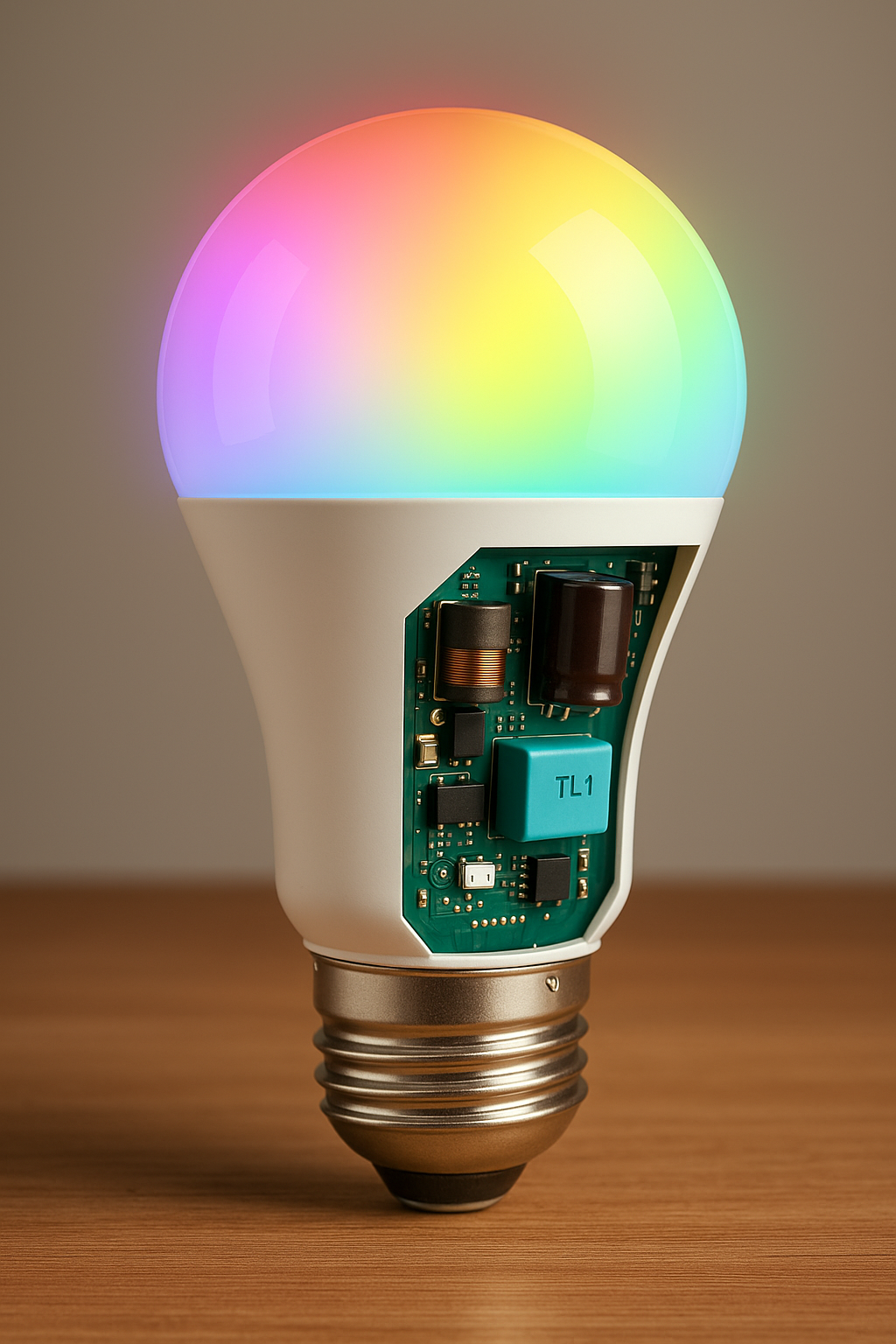
Inside every smart bulb is:
- a switching power supply (LED driver)
- a microcontroller
- a WiFi/BLE chip
- voltage regulators
- antenna circuitry
- logic-level converters
- capacitors
- resistors
- diodes
- sensors
ALL of these age faster than the LED.
Smart bulbs die because their electronics cook themselves to death, not because the LED burns out.
⚡ Reason #1: The WiFi Chip Generates Heat — Constantly
A smart bulb’s WiFi module:
- transmits
- receives
- maintains connection
- processes packets
- polls your router
- stays in standby mode
This chip generates heat 24/7, even when the bulb is OFF (but still powered).
Typical idle temperature:
- 40–60°C inside the bulb
- 70–80°C when lit
Electronics hate heat.
WiFi modules degrade quickly under constant thermal stress:
- solder joints crack
- silicon aging accelerates
- RF components drift
- firmware becomes unstable
This alone cuts bulb lifespan dramatically.
⚡ Reason #2: The LED Driver Uses Cheap Electrolytic Capacitors
Electrolytic capacitors are the #1 failure point in power supplies.
Smart bulbs use:
- cheap, tiny capacitors
- placed close to heat sources
- often rated only 85°C
- sometimes 2000–3000 hours lifespan
Inside a sealed bulb at 80°C internal temp, those caps:
- dry out
- lose capacity
- increase ESR
- cause flicker
- fail completely
A dried capacitor → no regulated DC → bulb dies.
This is why the LED chips themselves rarely fail.
The capacitor dies first.
⚡ Reason #3: Smart Bulbs Run Hotter Than Normal LEDs (Bad Thermal Design)
Smart bulbs include:
- more electronics
- more heat sources
- less physical space
- sealed plastic diffusers
- compact PCBs with poor airflow
Unlike dumb LED bulbs:
- smart bulbs cannot dissipate heat easily
- internal components share thermal load
- heat builds up each time the bulb is used
Many smart bulbs run 20–30°C hotter internally compared to regular LEDs.
Higher temp = shorter lifespan.
⚡ Reason #4: “Always ON Power” Slowly Burns Components
Even when the light is turned OFF in the app, smart bulbs remain electrically active.
They still:
- power the microcontroller
- power the WiFi chip
- power the LED driver standby circuit
- maintain network presence
- accept commands
This 24/7 operation means:
A “25,000-hour” smart bulb actually runs continuously
while a regular LED only runs when lit.
Your smart bulb ages 5–10× faster simply by existing.
⚡ Reason #5: Voltage Spikes and Brownouts Kill Sensitive Electronics
Smart bulbs are tiny computers.
Their microcontrollers are extremely sensitive to:
- undervoltage
- overvoltage
- line noise
- lightning-induced surges
- unstable mains supply
- dirty household power
A dumb LED bulb may survive a surge.
A smart bulb will not.
Symptoms include:
- blinking
- unresponsive app
- random resets
- brightness stuck at “half”
- WiFi disconnect loops
- complete death
Smart bulbs fail a lot in older houses for this exact reason.
⚡ Reason #6: Over-the-Air Updates Stress the Flash Memory
Smart bulbs update firmware over WiFi.
Each update:
- erases flash
- rewrites flash
- runs bootloader routines
- stresses the microcontroller
Most microcontroller flash is rated for:
- 10,000 write cycles
- sometimes as low as 1,000
Frequent updates and configuration changes accelerate wear.
⚡ Reason #7: The LED Driver Is More Complex (More Components = More Failures)
A dumb LED bulb has:
- rectifier
- capacitor
- current-limiting resistor
- maybe a simple driver
A smart bulb has:
- SMPS power stage
- logic-level power regulator
- 3.3V buck converter
- radio frequency module
- LED array driver
- MCU
- WiFi front-end
- safety resistors
- thermal sensors
More components = more failure points.
⚡ Reason #8: Color-Changing LEDs Create Uneven Wear
RGB LEDs wear at different rates.
Blue dies fastest.
Red lasts longest.
Green is in the middle.
If the smart bulb uses RGB mixing to create white (common in cheap bulbs), the blue LED’s early wear makes the bulb:
- turn greenish
- appear dim
- have inaccurate colors
High-end bulbs use separate white LEDs to avoid this — cheap ones do not.
⭐ Amp Nerd Fun Facts
- A smart bulb running 24/7 can rack up 8760 hours of use per year, even when “off.”
- Some smart bulbs run hotter internally than laptop CPUs.
- The LED emitter almost never dies — the WiFi chip usually dies first.
- Cheap smart bulbs often use 85°C capacitors in environments that reach 100°C.
- Smart bulb firmware updates can corrupt if power dips during flashing.
- A regular LED bulb can last 10+ years — a smart bulb rarely reaches half that.
- Many cheap smart bulbs are just tiny IoT computers crammed into a plastic shell.
⚡ Amp Nerd Summary
Smart bulbs fail early because:
- constant WiFi heat
- poor thermal management
- cheap capacitors
- always-on electronics
- sensitive microcontrollers
- voltage instability
- uneven RGB wear
- complex power regulation
The LED survives.
The electronics do not.
Smart bulbs are convenient — but they’re also some of the shortest-lived lighting products ever sold.