
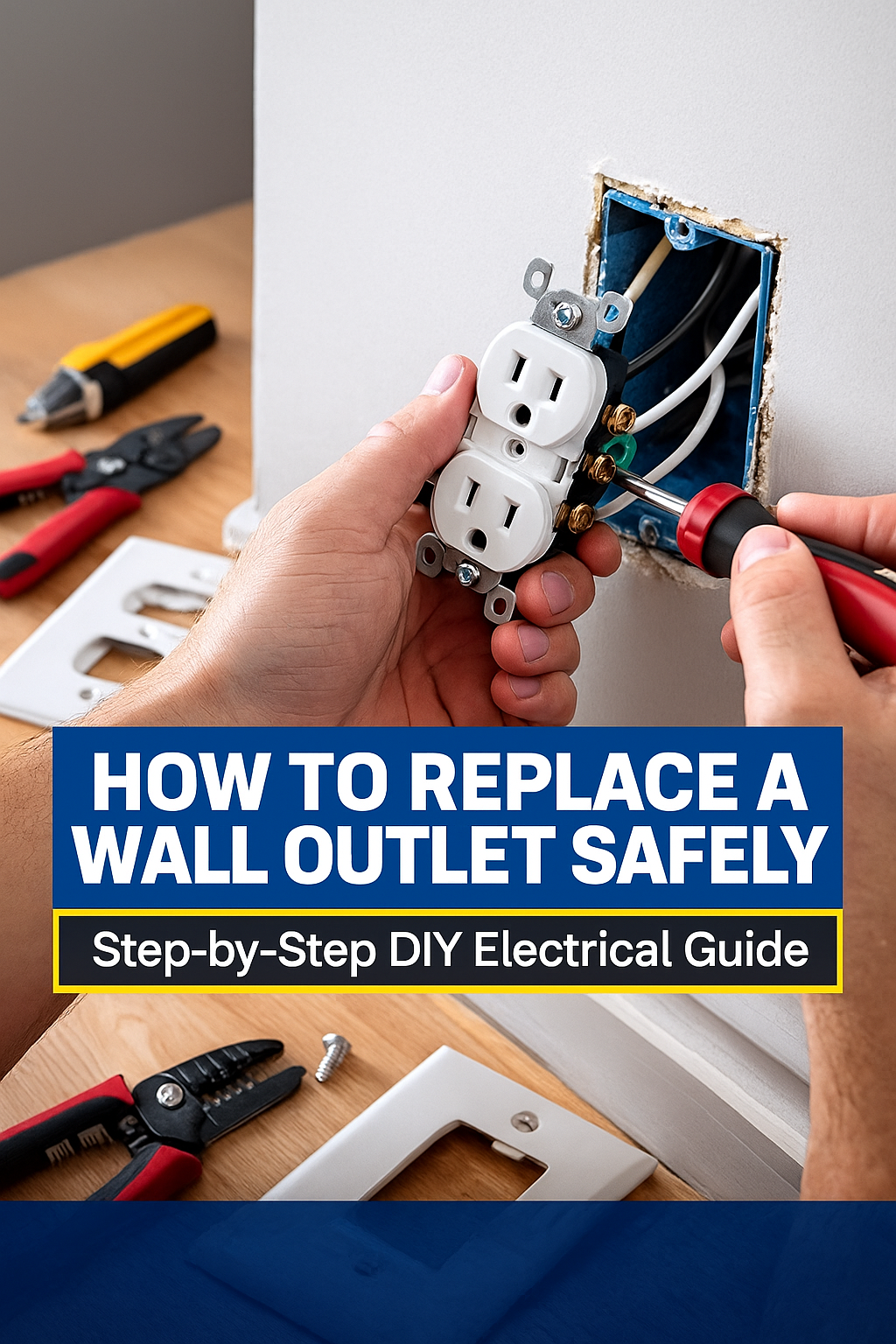
Replacing a wall outlet is one of the most common DIY electrical tasks.
But it’s also one of the most misunderstood.
Homeowners often assume:
- “It’s just two wires.”
- “It can’t be that dangerous.”
- “Outlets last forever.”
- “I can swap it out in 5 minutes.”
But the reality is this:
Outlets fail far earlier than people expect — and a loose, burned, or worn outlet can be a major fire hazard.
So learning how to safely replace one is one of the most valuable DIY skills you can pick up.
Today, Amp Nerd will walk you through:
- when you MUST replace an outlet,
- the tools you actually need (no fluff),
- how to identify backstab vs screw terminal wiring,
- how to avoid the #1 mistake DIYers make,
- how to wire the outlet the right way,
- and how to test your work like a professional.
This guide is engineered to be safe, accurate, and simple — perfect for beginners, landlords, or anyone maintaining their home.
⚡ When You Should Replace a Wall Outlet (Important)
Replace an outlet immediately if:
- the plug falls out easily
- the outlet crackles or sizzles
- the outlet feels warm or hot
- the faceplate is discolored
- you smell a faint burning/ozone smell
- one side of the outlet works and the other doesn’t
- the outlet wiggles or moves inside the box
- a plug has melted in it
- the breaker trips when you plug something in
- the outlet is 25+ years old
Any of these mean:
⚠ internal contacts are worn
⚠ resistance is high
⚠ arcing already happened
⚠ fire risk is increasing
Replacing the outlet is cheap, fast, and greatly improves safety.
⚡ Tools You Actually Need (No Useless Stuff)
You DO NOT need:
- a drill
- 15 tools
- specialized electrician gear
Here are the exact tools required:
✔ Flathead screwdriver
✔ Phillips screwdriver
✔ Voltage tester (non-contact tester recommended)
✔ Needle-nose pliers
✔ Wire stripper (if needed)
✔ Replacement outlet (15A or 20A, depending on circuit)
Optional but helpful:
- outlet tester ($7)
- electrical tape
- new faceplate
Total project cost: $3–$10 for the outlet.
Total time: 6–12 minutes for most jobs.
⚡ Step 1 — Turn Off the Correct Breaker
Go to the electrical panel and flip the breaker for that room.
If the panel isn’t labeled (most aren’t):
- plug a lamp into the outlet
- flip breakers one by one
- when the lamp turns off, you found the right circuit
Important Safety Tip:
Even if the breaker is off, ALWAYS check the outlet with a non-contact voltage tester before touching anything.
⚡ Step 2 — Remove the Faceplate and Outlet
- Unscrew the faceplate.
- Remove the single screw holding the outlet to the electrical box.
- Pull the outlet out gently.
Do NOT touch the wires until you confirm with a voltage tester that everything is dead.
⚡ Step 3 — Identify the Wiring Type
There are 3 common wiring situations:
1. Screw terminals (best)
Wires looped around screws on the sides.
Pros:
- safest
- tightest connection
- best long-term reliability
Cons:
- takes a little more time
2. Backstab (push-in holes) — VERY common in old homes
Wires pushed straight into small holes in the back of the outlet.
Pros:
- fast for builders
- easy for mass installation
Cons:
- weak spring tension
- loosens over time
- major fire hazard
- causes flicker and heat
- never use backstab again
If your old outlet has backstab wires — good news:
YOU are fixing a huge hidden safety risk today.
3. Backwire (clamp-style) — GOOD type on newer high-end outlets
A screw tightens a plate that clamps the wire inside.
Pros:
- strong
- safe
- professional
- equal to screw terminals
Cons:
- usually on expensive outlets
⚡ Step 4 — Remove the Wires Properly
Depending on wiring:
If your outlet uses BACKSTAB:
There is a small rectangular release slot next to each hole.
- Insert a tiny flathead.
- Push the release spring.
- Gently pull wire out with pliers.
NEVER yank the wire — you’ll damage the conductor.
If your outlet uses SCREW TERMINALS:
- Loosen screw.
- Slide wire loop off.
- Straighten wire with pliers if needed.
If your outlet uses BACKWIRE (clamp-style):
- Loosen clamp screw.
- Pull wire straight out.
⚡ Step 5 — Inspect the Wires (Critical Safety Check)
Look closely at the copper.
If the copper looks:
- dark
- burnt
- blackened
- brittle
- charred
- cracked
- green (corrosion)
…then cut back to clean copper and strip fresh insulation.
Burned copper = poor conductivity = heat.
⚡ Step 6 — Prepare the Wires Correctly
If using screw terminals:
- Strip 3/4 inch of insulation.
- Use pliers to bend a hook in a clockwise direction.
- The hook should wrap almost fully around the screw.
- Ensure no bare copper extends past the screw head.
Clockwise wrapping is important because tightening the screw pulls the wire in, not out.
⚡ Step 7 — Connect the Wires the RIGHT Way
Typical 15A outlet wiring:
Hot (black) → brass screws
Neutral (white) → silver screws
Ground (bare/green) → green screw
If the old outlet had tab breaks (for split circuits), replicate them exactly.
Otherwise, leave the tabs intact.
Important:
Do NOT place multiple wires under one screw unless the outlet is rated for it (most are not).
If there were multiple wires on one side, use a wirenut and pigtail:
- Connect both circuit wires with a short 6-inch jumper wire.
- Attach the jumper to the outlet screw.
This is the professional method and is required by code in many areas.
⚡ Step 8 — Secure the Outlet and Faceplate
- Push wires neatly back into the box
(no sharp bends — copper can fatigue over decades). - Screw the outlet into the box.
- Attach the faceplate.
- Do a wiggle check — the outlet should NOT move.
⚡ Step 9 — Restore Power and TEST IT
Turn the breaker ON.
Now test using:
✔ non-contact tester
✔ plug-in outlet tester (optional but recommended)
Check for:
- correct wiring
- no open neutral
- no reversed polarity
- no open ground
These are incredibly common DIY mistakes.
⚡ Step 10 — Use This Moment to Look for Hidden Damage
Take note of:
- loose wires
- burnt insulation
- melted plastic
- brittle copper
- scorch marks in the box
- ground wires not connected
- signs of arcing
Many outlets hide decades of electrical sins.
This is your chance to fix them.
⭐ Amp Nerd DIY Safety Tips
- A plug falling out of an outlet is more dangerous than most people realize — it means contact tension is gone.
- Backstab connections cause a huge percentage of outlet fires.
- A failing outlet can produce 20–40 watts of heat inside your wall.
- Outlets often fail before the breaker detects any overload.
- High-wattage devices (heaters, hairdryers, vacuums) kill outlet contacts quickly.
- Commercial-grade outlets last 5–10× longer than cheap $0.49 outlets.
- Replacing old outlets is one of the BEST upgrades you can make in an older home.
⚡ Amp Nerd Summary
Replacing an outlet safely requires understanding:
- how outlet contacts wear
- why backstab wiring is dangerous
- how to properly secure screw terminals
- how to identify burnt copper
- how to wire hot, neutral, and ground properly
- how to test for correct wiring after installation
This DIY job is simple — but only when done with real electrical awareness.
A worn or loose outlet is one of the most common fire hazards in homes,
and replacing it yourself is one of the easiest ways to dramatically improve electrical safety.