
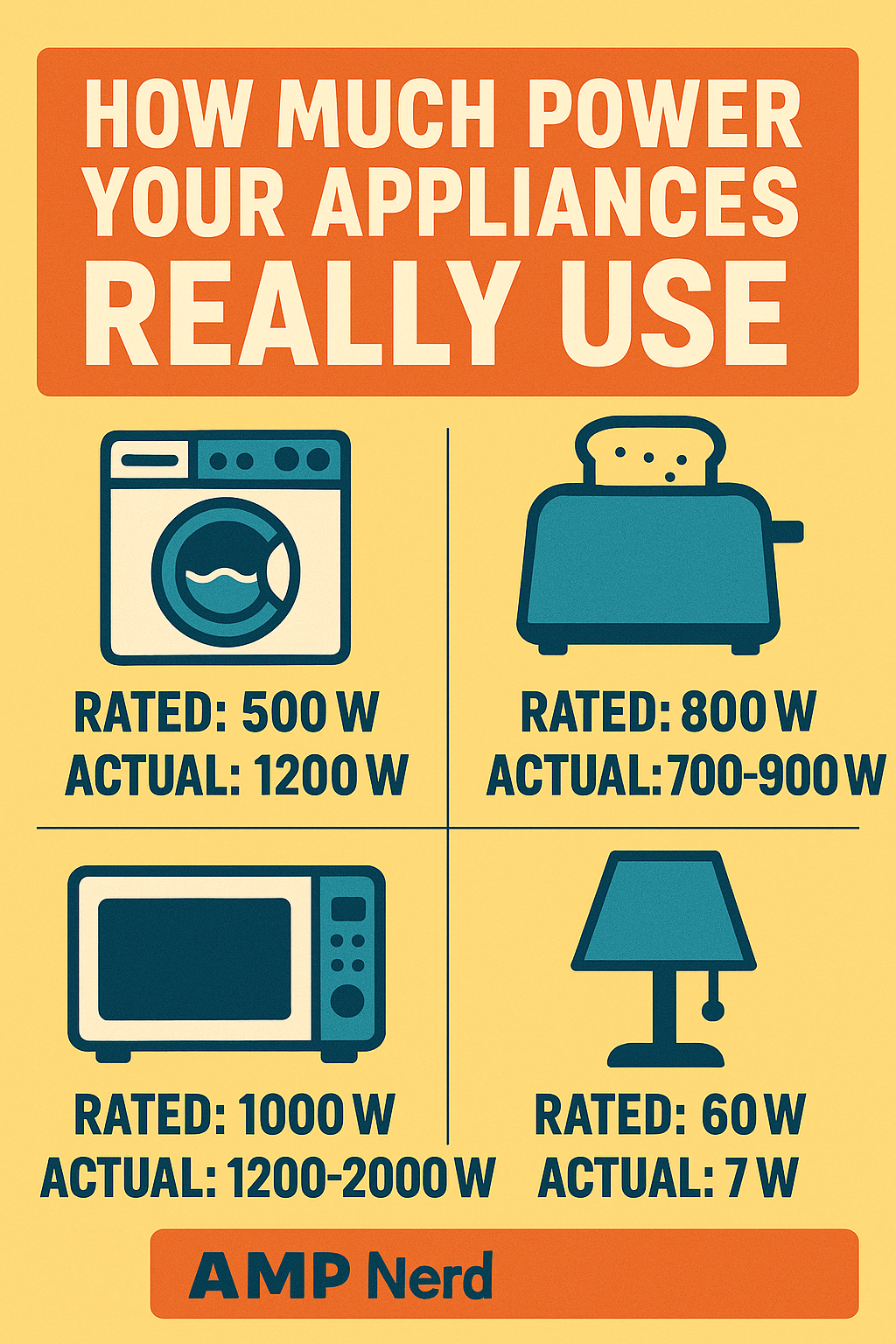
When people look at the wattage printed on their appliances, they assume that’s what the device actually uses.
It’s a logical assumption…
unfortunately, it’s wrong.
Most appliances do NOT use their rated wattage continuously, or even accurately.
In fact:
- many devices use far MORE than their rating under real conditions,
- some use far LESS,
- some fluctuate wildly,
- some spike power for milliseconds,
- some use more power “off” than “on.”
The label is often nothing more than a rough guideline.
Your energy bill? That’s based on reality, not the label.
Today, Amp Nerd breaks down:
- what appliances really use,
- why wattage numbers are misleading,
- the hidden spikes most people never see,
- how switching power supplies distort readings,
- and which devices kill your electricity bill without you noticing.
Let’s dive in.
⚡ The First Truth: Rated Wattage Is Usually the MAX, Not the Average
The wattage printed on appliances typically represents:
- peak consumption,
- maximum safe draw,
- a regulatory value,
not real-world operating consumption.
Example:
- A “1500W” space heater uses ~1500W continuously.
- A “1500W” microwave rarely uses 1500W — many draw 1500–2000W momentarily.
- A “1500W” air fryer might average only 800–1200W depending on duty cycle.
This misleading labeling causes major confusion.
⚡ Reason #1: Some Devices Cycle Power (Thermostats, Compressors, Heating Elements)
Any device with a thermostat does not draw constant wattage.
Examples:
• Refrigerators
Rated: 150–300W
Actual:
- 20–60W most of the time
- 150–500W during compressor cycle
- 800–1200W in defrost mode
- small surges up to 6–10× for milliseconds
• Air Fryers / Toaster Ovens
Rated: 1500W
Actual:
- 1500W only when heating
- 500–800W during temperature maintenance
- 0W for 40–60% of the cycle
• Irons
Rated: 1200–1800W
Actual:
- short bursts of peak usage
- long periods of nearly no draw
This means “rated power” ≠ typical energy use.
⚡ Reason #2: Electric Motors Have Huge Startup Surges
Anything with a motor pulls massive inrush current when starting.
Examples:
• Vacuum cleaner
Rated: 800–1800W
Startup surge: 2000–3000+ W
Duration: 0.1–0.3 seconds
• Air conditioner
Rated: 1000–2000W
Startup surge: 4000–6000W
Duration: milliseconds
• Fridge compressor
Rated: 150W
Startup surge: 900–1200W
These spikes:
- trip breakers,
- stress wiring,
- are completely unknown to most consumers.
Smart meters measure these spikes — your bill includes the total energy used.
⚡ Reason #3: Electronics Use Less Than Their Rating, But Waste Power Inefficiently
Modern electronics use switch-mode power supplies.
These supplies:
- rarely draw rated power,
- constantly fluctuate,
- have poor power factor at light loads.
Examples:
• Laptop chargers
Rated: 65W
Actual:
- 30–55W charging
- 3–8W idle charging a full laptop
- 0.5–2W unplugged from laptop but still in wall
• TVs
Rated: 150–250W
Actual:
- modern LEDs: 50–150W
- OLED: 70–200W
- standby mode: 0.5–4W
• Desktop PCs
Rated PSU: 500–800W
Actual:
- idle: 40–80W
- browsing: 60–120W
- gaming: 200–400W
- stress testing: 500–700W
The PSU rating ≠ real-world usage.
⚡ Reason #4: Some Appliances Use MORE Power Than Their Label Says
This happens more often than you’d expect.
Examples:
• Microwaves
A “1000W” microwave often consumes 1500–2000W from the wall.
Why? The rating refers to cooking power, not electrical draw.
• Cheap heaters
Cheap models often draw more than rated (dangerous).
Label: 1500W
Actual: 1600–1900W
• Kettles
Label: 1500W
Actual: 1600–1700W
(measured frequently in EU kettles)
• Hair dryers
Label: 1800W
Actual: 2000–2200W on max heat
This is why certain appliances frequently:
- trip breakers,
- melt cheap extension cords,
- overload power strips.
⚡ Reason #5: Power Factor Makes Readings Misleading
Most consumers — and many electricians — misunderstand power factor (PF).
Devices with poor PF draw:
- the same apparent power,
- more real current,
- more load on the wiring,
- more stress on circuits.
Switch-mode loads often have:
- PF = 0.5 at low load
- PF = 0.9 under heavy load
Example:
A PC with:
- 300W real power
- PF = 0.6
Actually draws: 500W of apparent power
This makes wiring and breakers run hotter.
Consumers never see this number.
⚡ Reason #6: “Standby Power” Is the Silent Killer of Electricity Bills
Most homes have 10–30+ devices drawing power when “off”:
- TVs
- smart speakers
- set-top boxes
- routers
- chargers
- game consoles
- monitors
- printers
- microwaves
- washing machines
- phone chargers
- power strips with switches
Standby usage can total:
20–80W constantly
That’s:
- 0.5–2 kWh per day
- 180–730 kWh per year
- €35–€150/year wasted
All for nothing.
⚡ Real-World Example: What You Think Uses Power vs What Actually Does
What people THINK uses the most:
❌ phone charger
❌ laptop
❌ router
❌ small devices
What actually uses the most:
✔ water heater
✔ oven
✔ space heaters
✔ dryers
✔ fridge
✔ electric kettles
✔ AC units
✔ pool pumps
Single minutes of heating water > hours of charging a phone.
⭐ Amp Nerd Fun Facts
- A fridge uses more energy in the first 5 minutes after turning on than the next 30 minutes combined.
- A microwave’s “1000W” power refers to food heating, not electrical draw.
- Vacuum cleaners can spike to 3 kW for milliseconds during startup.
- A PlayStation 5 uses more power than many refrigerators while gaming.
- A phone charger wastes more electricity in standby than actually charging a phone.
- Cheap heaters often exceed their rating by 10–20%, causing fires.
- A washing machine uses more energy heating water than spinning the drum.
⚡ Amp Nerd Summary
Actual appliance usage differs from the label because:
- thermostat cycling
- motor inrush surges
- switching power supply inefficiency
- power factor distortion
- poor regulatory labeling rules
- standby power waste
Rated wattage is a rough estimate —
real power consumption is dynamic, messy, and often much higher than expected.
This is the engineering truth behind your energy bill.