
Dimmers look simple.
You rotate a knob or slide a lever, and the lights get brighter or darker.
But inside the wall, something far more chaotic is happening — a fast, violent electrical chopping process that many people have no idea is taking place.
Dimmers:
- cut voltage,
- distort the AC waveform,
- stress electronics,
- and can quietly destroy LED bulbs over time.
Most people think dimmers “reduce power smoothly.”
But the real story is more interesting — and more destructive.
Today we break down how dimmers actually work, why some bulbs fail, why certain dimmers buzz or flicker, and what engineers wish consumers understood.
Let’s get into it.
⚡ The First Truth: Traditional Dimmers Don’t Lower Voltage — They Chop It Into Pieces
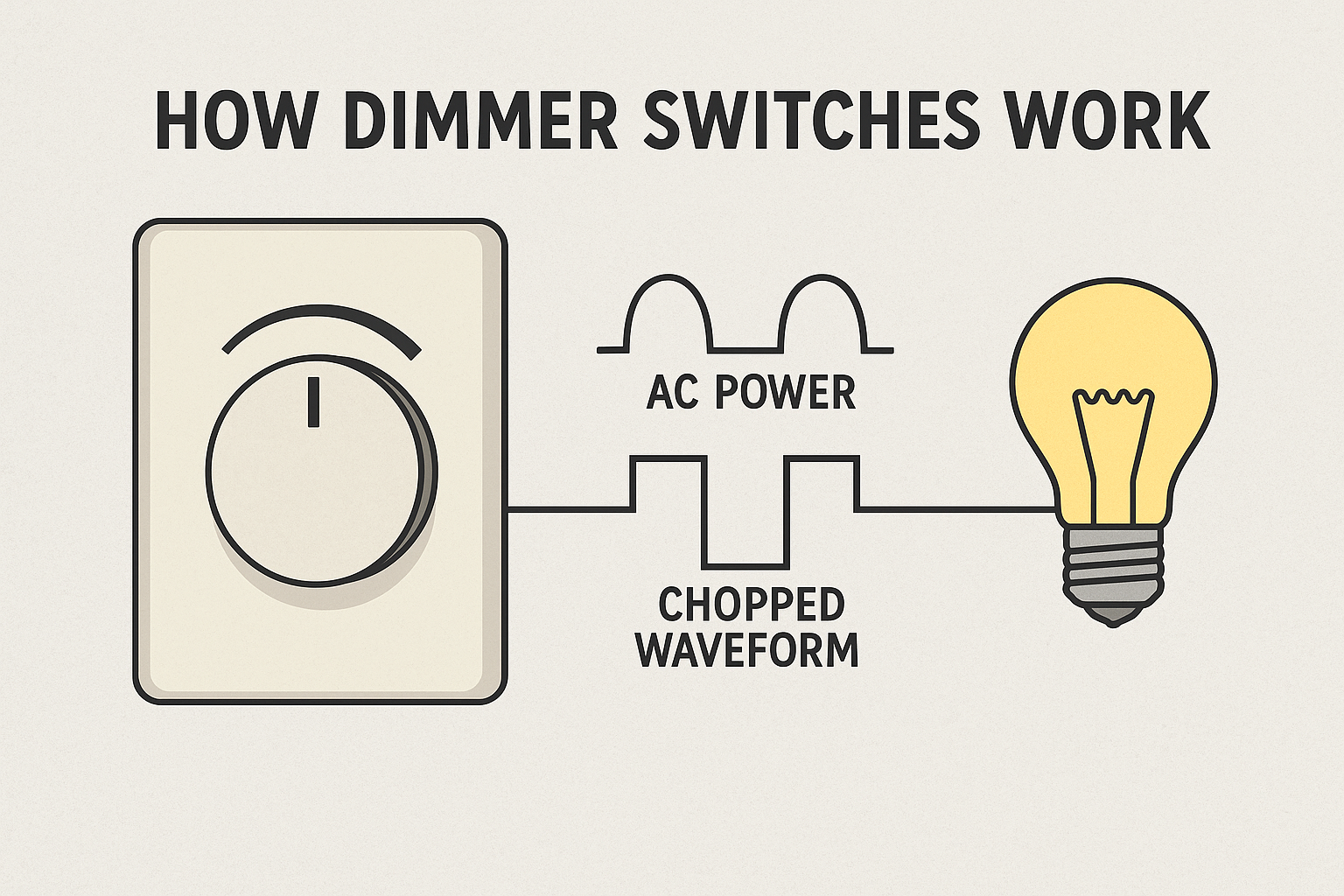
Most wall dimmers (TRIAC dimmers) do not reduce voltage the way a variable transformer does.
Instead, they delay when current is allowed to flow.
AC power is a smooth sine wave:
/‾‾\    /‾‾\
    \__/
A TRIAC dimmer slices out a chunk of each half-cycle.
Your bulb receives this waveform instead:
____/‾‾ ____/‾‾
This abrupt switching:
- reduces average power,
- generates electrical noise,
- introduces harmonics,
- stresses certain loads.
This is phase-cut dimming, and it’s electrically violent.
⚡ Reason #1: TRIACs Need a Minimum Load (LEDs Often Don’t Provide It)
Old dimmers were designed for incandescent bulbs — basically resistors that draw:
- 40W
- 60W
- 100W
- or more
LED bulbs draw:
- 4W
- 6W
- 9W
That’s 10× less.
When the dimmer fires the TRIAC, there may not be enough current to keep it conducting through the rest of the AC cycle. The TRIAC turns off early → light flickers or pulses.
Symptoms:
- flickering at low dim levels
- dead zone where slider does nothing
- sudden bright/dark jumps
- buzzing noises
This is why many LED bulbs are not “dimmable.”
⚡ Reason #2: The Chopped Waveform Destroys Cheap LED Drivers
Inside an LED bulb is a tiny power supply (driver).
Cheap LED drivers expect smooth AC.
TRIAC dimming produces:
- 100–200 V/µs switching slopes
- huge EMI spikes
- variable conduction times
- asymmetric waveforms
This stresses:
- MOSFETs
- rectifier diodes
- electrolytic capacitors
- linear regulators
Some LED drivers simply aren’t engineered to handle the chaos.
This causes:
- early failure
- buzzing
- overheating
- flicker
- random shutoffs
LEDs don’t fail — their drivers fail.
⚡ Reason #3: Dimmers Operate Using Strong Electromagnetic Fields (Which Cause Buzzing)
The TRIAC turns on with a sharp high-frequency pulse.
This causes:
- magnetic vibration in coils,
- mechanical movement in windings,
- resonance in nearby wiring.
That “buzzing dimmer” sound is not defective — it’s physics.
If your dimmer:
- buzzes loudly,
- gets hot,
- causes humming in the bulbs,
…it’s being overloaded or its harmonics are interacting with the LED driver.
⚡ Reason #4: Incandescent Bulbs Loved Dimmers — LEDs Hate Them
Incandescent bulbs are simple:
- purely resistive loads
- heat filament → emits light
- respond smoothly to chopped AC
LED bulbs are:
- semiconductor devices
- require stable DC
- sensitive to ripple
- vulnerable to EMI
- dependent on internal electronics
Old-style dimmers were never intended for LED technology.
⚡ Reason #5: There Are Two Types of Dimmers (And 90% of Homes Use the Wrong One)
1. Leading-edge (TRIAC) dimmers
- cheap
- common
- designed for incandescent
- terrible with LED
- cause buzzing/flicker
2. Trailing-edge (MOSFET) dimmers
- more expensive
- smoother waveform
- designed for LED
- silent
- minimal flicker
- no inrush arcs
- gentler on electronics
Trailing-edge dimmers fix most LED dimming issues —
but almost nobody installs them.
⚡ Reason #6: Dimmer Circuits Heat Up and Lose Performance Over Time
Even a good dimmer produces:
- conduction losses
- thermal rise
- energy dissipation
Cheap dimmers:
- overheat quickly
- shift their operating threshold
- become unstable
- worsen flicker over time
- melt or warp internally
Dimmer failures often produce:
- sizzling or crackling noises
- intermittent lights
- discoloration of faceplate
- warm wall area around switch
This is a major fire risk.
⚡ Reason #7: LED Bulbs Have a Minimum And Maximum Dimming Range
Incandescent bulbs could dim from:
100% → 0%
LED bulbs typically dim:
100% → 10–30% at best
Below this point:
- driver shuts down,
- flicker becomes severe,
- TRIAC won’t latch,
- bulb goes completely off.
Consumers think the bulb is faulty —
but the dimmer is incompatible.
⚡ When Dimming Becomes Dangerous
You should immediately stop using your dimmer if:
- bulbs flicker while fully bright
- bulbs flash randomly
- dimmer gets warm or hot
- dimmer buzzes loudly
- bulb hums or rattles
- breaker trips while dimming
- faceplate is warm
These are signs of:
- thermal runaway
- TRIAC instability
- EMI problems
- failing LED drivers
- arcing inside the dimmer
⭐ Amp Nerd Fun Facts
- The TRIAC dimmer design is over 50 years old — barely changed since the 1970s.
- LED bulbs don’t “dim” — they modulate current, not filament heat.
- An LED bulb can fail just from being used on an old dimmer, even at full brightness.
- Some incandescent bulbs dim to 1–2%, while LEDs rarely dim below 20%.
- Flicker from bad dimming can cause headaches or eye strain, especially at 100–120 Hz.
- High-end LED dimmers use MOSFET switching, similar to variable power supplies.
⚡ Amp Nerd Summary
Dimmers destroy bulbs because:
- TRIAC dimmers chop the AC waveform violently,
- LEDs are sensitive to electrical noise,
- cheap LED drivers can’t handle phase-cut power,
- dimmers overheat,
- switch timing becomes unstable,
- minimum load requirements aren’t met.
Most dimming problems come from pairing modern LED bulbs with outdated dimmer technology.
If you want reliable dimming:
- get LED-rated trailing-edge dimmers
- use high-quality dimmable LED bulbs
- avoid overloading dimmer modules
This is the engineering truth behind dimmer performance — and dimmer failure.