
Extension cords are supposed to be temporary, convenient helpers.
Instead, people use them as:
- permanent wiring,
- multi-outlet power distribution systems,
- heater feeds,
- outdoor everything-solvers,
- “well it fits so it must be fine” adapters.
Most of the time, nothing bad happens.
And that’s the trap.
The failure isn’t dramatic—until it is.
Melted plugs, scorched outlets, tripped breakers, or full-on electrical fires usually start with quiet, boring misuse.
Today, Amp Nerd is going to be aggressively honest:
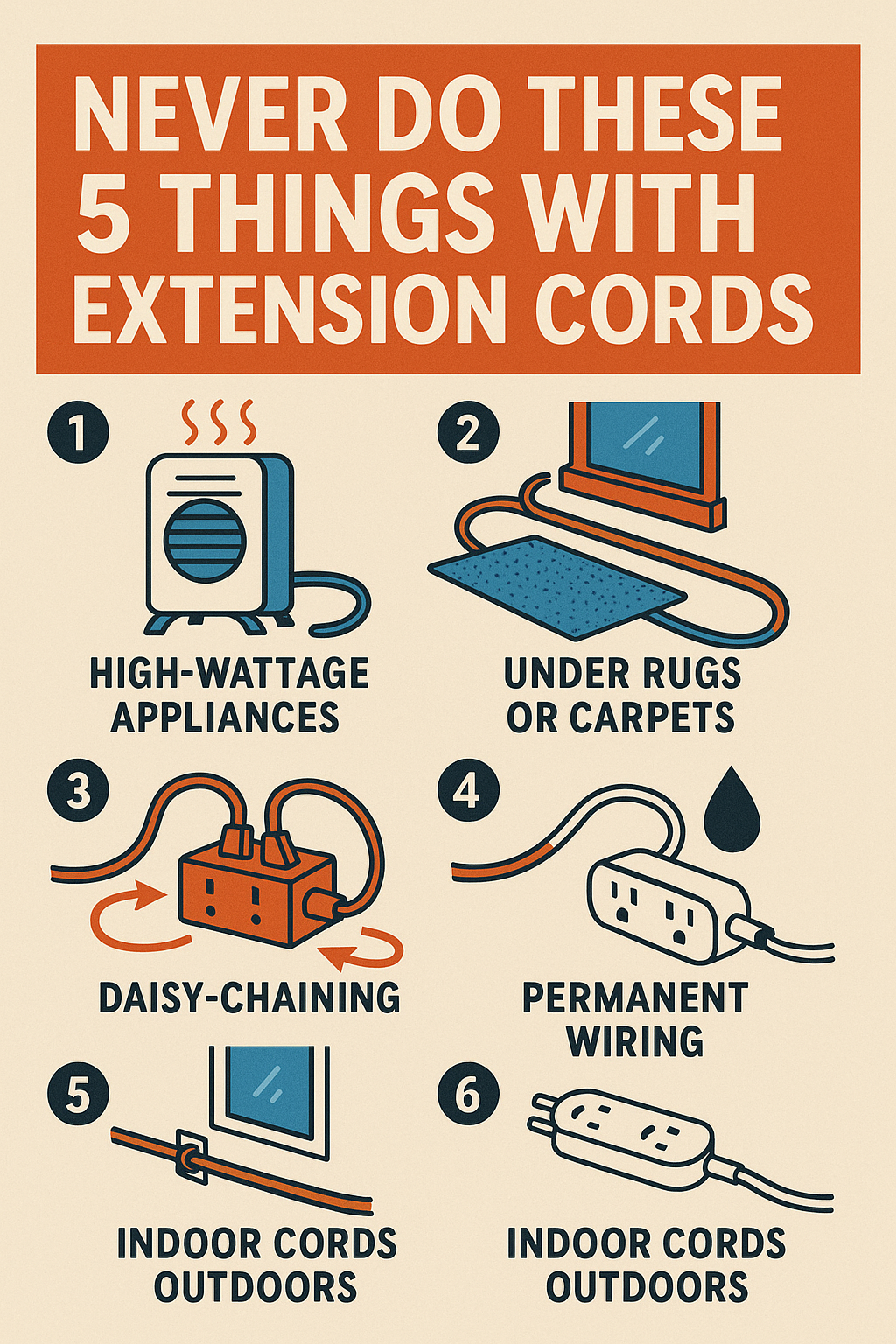
Here are 5 things you should never do with extension cords — and why each one is actually dangerous.
If you recognize your own setup in here… yeah. This is your sign.
1. Don’t Run High-Wattage Appliances on Thin, Cheap Extension Cords
You know those skinny white or brown “indoor household” cords?
- Super flexible
- Very light
- Often have 2-pin, non-grounded plugs
- Sometimes with a 3-outlet little head on the end
Those are not meant for:
- space heaters
- hair dryers
- irons
- kettles
- microwaves
- portable AC units
- air fryers
But that’s exactly what people plug into them.
Why it’s dangerous (actual physics)
Most of those cords are:
- 16 AWG or 18 AWG wire
- typically rated for 7–10 amps max
A typical space heater is 1500 W:
- At 120 V → 1500 ÷ 120 ≈ 12.5 A
So you’re pushing more current than the cord is rated for.
The cord responds by becoming a resistor heater:
P = I² × R
more current + thin copper = more heat
The results:
- cord gets hot
- plug gets hot
- outlet gets hot
- insulation softens and breaks down
- plastic starts to brown or melt
This often happens slowly over days/weeks/months of use. You don’t notice until something smells or fails catastrophically.
Rule of thumb:
- Heavy loads (heaters, hair dryers, irons, microwaves) go:
- directly into a wall outlet, or
- into a short, heavy-duty 12/14 AWG extension cord used only for that load
If the cord is thin and light, it’s a “lamp cord”, not a heater cord.
2. Don’t Run Extension Cords Under Rugs, Carpets, or Mattresses
This one should be illegal just on common sense grounds, but here we are.
Why people do it:
- “I don’t want to see the cord.”
- “It’s ugly.”
- “This is the only way to get power across the room.”
So they:
- run it under a rug,
- tuck it under a mattress,
- squeeze it along the edge under a carpet,
- cover it with a mat or runner.
Why it’s dangerous
Extension cords generate heat whenever they carry current. The more current, the more heat.
Normally, the heat:
- radiates into the air
- convects away from the cord
- doesn’t build up much
Under a rug or carpet:
- no airflow
- heat gets trapped
- rug and dust act as insulation
- local temperature keeps rising
If the cord is overloaded, thin, or damaged:
- insulation softens and fails
- internal conductors deform
- resistance increases
- even more heat is generated
Add:
- flammable material (carpet fibers, dust, pet hair)
- mechanical wear from people walking over it
…and you’ve basically created a slow electric toaster under your flooring.
Rule:
If you have to hide a cord, you don’t need an extension cord — you need proper wiring or a floor-safe cable raceway designed for it.
3. Don’t Daisy-Chain Extension Cords and Power Strips
This is the one that makes engineers physically wince.
Setup looks like:
- wall outlet → extension cord → power strip → another extension → another strip → 10 devices, including a heater
It’s everywhere:
- behind entertainment centers
- in home offices
- in server closets (!!)
- in garages
Why it’s dangerous
Every link in the chain adds:
- extra resistance
- extra contact points
- extra failure points
You’re stacking:
- plug + socket (wall)
- plug + socket (cord)
- plug + socket (strip)
- internal strip wiring
- each device plug + socket
Each contact:
- wears with time
- can loosen
- can oxidize
- can generate heat
With daisy-chaining:
- the first cord/strip in the line might be carrying all the current for everything downstream
- it may not be rated for that
- it might be old and worn
So you end up with:
12–15 A of current passing through
a single cheap strip or cord
buried behind furniture
with questionable contacts
This is why electricians and safety codes hate daisy chains.
Rule:
- One strip per outlet.
- No “strip into strip into cord into strip” nonsense.
- If you need more outlets, you don’t need more strips – you need more circuits or properly installed outlets.
4. Don’t Use Extension Cords as Permanent Wiring
Extension cords are temporary by design.
Permanent use looks like:
- an orange cord stapled to a wall
- cord running along baseboards for years
- cord feeding a shed or garage permanently
- cord to a fridge or freezer in another room, always plugged in
- cord going through a door or window gap year-round
Why it’s dangerous
Extension cords:
- are not designed for long-term UV exposure
- are not protected in walls or conduits
- get stepped on, crushed, pinched
- get flexed and twisted daily
- collect dirt, moisture, and mechanical damage
Over time:
- jacket cracks
- insulation breaks down
- copper strands fatigue and break
- resistance increases
- heat hotspots develop
Also:
- using a cord instead of adding a proper circuit often means you’re drawing significant current from a circuit that was never designed for that layout or load.
Rule:
If you need a cord to do the same job every day for months →
you don’t need an extension cord; you need a new outlet or circuit.
That’s a “call an electrician” problem, not a “buy 3 more cords” solution.
5. Don’t Use Indoor Extension Cords Outdoors (Especially in Wet Conditions)
Those thin, white/brown cords and most cheap power strips are indoor-only.
People use them:
- for holiday lights outside
- in the garden
- down driveways for tools
- through windows to power stuff outside
Why it’s dangerous
Indoor cords:
- have jackets not designed for UV exposure
- are not necessarily water-resistant
- may not stay flexible in cold
- can crack and split with temperature cycles
Moisture + cracked insulation + live conductors =:
- shock risk
- tripped breakers
- arcing, burning, eventual failure
Also, indoor multi-outlet heads:
- collect water
- trap condensation
- have no drainage
- can fill with wet dirt and dead bugs (nature’s perfect conductive mess)
Rule:
- Use outdoor-rated extension cords (SJTW, SJEOW, etc.) for outdoor work.
- Keep connections off the ground and away from standing water.
- If it rained on your indoor cord… that cord’s career is over.
Bonus: 3 “Gray Area” Habits You Should At Least Think About
These aren’t always instant disasters, but they’re worth rethinking.
⚠ Running cords where doors or windows close on them
- Crushing, cutting, or pinching the insulation over time.
- Risk of slow internal damage.
⚠ Leaving cords wound tightly on reels at high load
- Heat buildup in the middle of the coil.
- Some reels literally warn “unwind fully under heavy load”.
⚠ Using multi-way “cube adapters” on the end of an extension cord
- Easy way to overload the cord and socket.
- Cheap internal contacts often heat quickly.
So… How Should You Use Extension Cords?
Quick “good practice” list:
- Use the shortest cord that does the job.
- Match the gauge (thickness) to the load:
- 12/14 AWG for heavy loads
- 16 AWG for light/medium loads (lamps, small tools)
- Keep cords visible, not hidden.
- Unplug them when not needed.
- Replace any cord that is:
- stiff, cracked, frayed
- discolored
- repaired with tape
- hot under normal load
Amp Nerd Fun Facts
- Many “mystery” breaker trips are just overloaded cords and strips being pushed too hard.
- A 1500 W heater on a skinny cord can drop the voltage enough that the heater runs weaker and the cord runs hotter. Worst of both worlds.
- Fire departments have entire photo archives of melted extension cords under rugs and couches.
- Extension cords are one of the most misused electrical items in homes, simply because they’re cheap and easy to get.
Amp Nerd Summary
Extension cords are tools, not permanent infrastructure.
The 5 things you should never do with them:
- Run high-watt appliances on thin, cheap cords
- Hide cords under rugs, carpets, or bedding
- Daisy-chain cords and power strips together
- Use them as permanent, semi-installed wiring
- Use indoor cords outdoors, especially in wet conditions
If reading this made you think of a specific cord in your house…
that’s the one you should probably deal with first.