
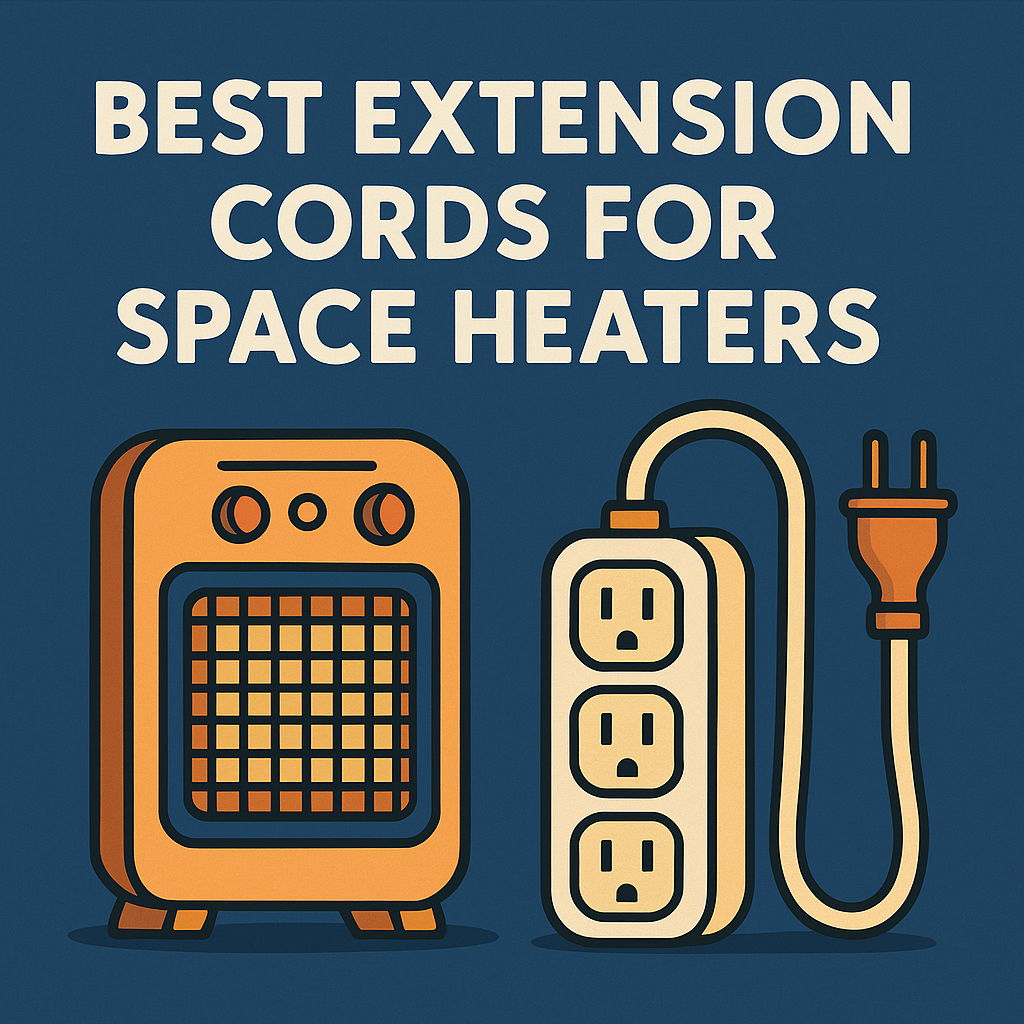
Space heaters are one of the most dangerous things people ever plug into their wiring.
They pull a lot of power, for a long time, through outlets and cords that were never designed for that kind of abuse. Most heater fires don’t start inside the heater — they start in the cords, plugs, power strips, or outlets feeding them.
So here’s the blunt rule:
If you can avoid using an extension cord with a space heater, do that.
If you must use one, you need the right cord or you’re playing with fire.
This guide is about those “must” situations:
- The outlet is just a bit too far away
- You need to cross a small gap
- You’re in an older room with badly placed outlets
- You want the heater in a safe spot, not right under a curtain
Let’s walk through what makes an extension cord safe(-ish) for a heater, what specs actually matter, and how to pick one like an engineer.
1. Why Space Heaters Are So Hard on Cords
Most portable electric heaters are:
- 1200–1500 W in many regions (up to ~2000+ W on 230 V systems)
- Continuous load — they stay on for hours, not seconds
- Often plugged into cheap cords or strips “just for a bit”
A 1500 W heater on 120 V draws:
I = P / V ≈ 1500 / 120 ≈ 12.5 A
That’s:
- over 80% of a 15 A circuit
- a huge continuous current for a little plastic cord on the floor
Any extra resistance — thin copper, long length, corroded plug, cheap metal contacts — becomes heat:
P = I² × R
12.5² × 0.1 Ω ≈ 15.6 W of heat in one bad connection
15 W inside a plug or cord is basically a tiny heater you didn’t ask for.
That’s why the minimum bar for a heater cord is way higher than for, say, a phone charger.
2. The Non-Negotiables: What a Heater Extension Cord MUST Have
If an extension cord fails any of these, it’s not for heaters. Full stop.
✅ 1. Thick Enough Wire (Gauge Matters More Than Marketing)
For 120 V, 1500 W space heaters:
- Best: 12 AWG (≈ 3.3 mm²)
- Acceptable: 14 AWG (≈ 2.1 mm²)
- Never for heaters: 16 AWG or 18 AWG
Those long, skinny, super-flexible “indoor household cords” (16/18 AWG) are fine for lamps and chargers, not for a 12.5 A heater.
On the jacket, look for:
- “12 AWG” or “14 AWG”
- “SJTW”, “SJEOW”, or similar (flexible, outdoor-rated types are usually better built)
If the cord doesn’t say the gauge, or it looks suspiciously thin and light → skip it.
✅ 2. Short Length (Shorter = Safer)
Length increases resistance → increases voltage drop → increases heat.
Practical rule:
- Best: 1.5–3 m (5–10 ft)
- Max I’d tolerate for a heater: 7.5–10 m (25–30 ft) in 12 AWG only
- Longer than that? Don’t. Move the heater or run a new circuit.
If you’re using 14 AWG, try to stick to no more than 7.5 m.
✅ 3. Pure Copper, Not CCA (Copper-Clad Aluminum)
Cheap cords sometimes use copper-clad aluminum conductors:
- higher resistance
- more heat for same current
- more fragile over time
If you see markings or product listings that mention:
- “CCA”
- “copper-clad aluminum”
…that cord is for Christmas lights or low loads, not heaters.
Look for:
- “100% copper conductors”
- reputable brands that clearly state copper
✅ 4. Heavy-Duty Plugs and Sockets
For heater use, the cord ends need:
- solid, molded plugs (not flimsy snap-together shells)
- full-size blades, not thin stamped junk
- a ground pin (3-prong) — most heaters are grounded
- tight, solid female contacts that grip the heater plug firmly
Avoid:
- multi-tap “cube” style ends
- 3-outlet “octopus” ends
- USB + outlets combos
You want one cord, one heater, not a tiny power strip on a rope.
✅ 5. Proper Rating on the Jacket
On the jacket, you want to see something like:
- “15A 125V” or “13A 125V” (for 120 V countries)
- “10–16A 250V” (for 230 V regions, depends on local norms)
- “1875W” or “3250W” etc.
If it doesn’t clearly state a current rating, treat that as a warning sign.
Remember, heater = 12.5 A on 120 V. So:
- A 13 A or 15 A cord is the minimum
- On 230 V, 2000 W is only ~8.7 A, but I’d still want a proper 1.5 mm²+ cable
3. Example “Good” vs “Bad” Heater Cord Scenarios
Let’s keep this practical.
👍 Good(ish):
- 2 m (6 ft) 12 AWG, 15 A rated, pure copper, single outlet, grounded
- 5 m (15 ft) 14 AWG, 15 A rated, only used for one heater, fully uncoiled
- Outdoor-rated heavy cord (SJTW or SJEOW) of reasonable length, 12/14 AWG
🚫 Bad:
- 10 m (30 ft) 16 AWG “indoor household” cord
- Any cord that’s warm or soft to the touch when heater is on
- Cord that’s coiled on a reel while in use
- Cord powering a heater plus other stuff (lamps, PC, TV, etc.)
- Cord with cracked or stiff insulation from age
4. Why “Indoor Slimline” and Retractable Reels Are a Trap
Those slim, flat, or very thin white/brown cords with a 3-outlet head?
They’re usually:
- 16–18 AWG
- only rated for 7–10 A
- intended for lamps, clocks, and small appliances
A 1500 W heater will:
- push them beyond rating
- heat them excessively
- cook the plug and the outlet
- potentially melt the head
Retractable reels are just as bad if you leave them coiled while under load. The wire can’t shed heat in a tight coil, so the inner wraps get hotter and hotter.
Heater + coiled reel = “why does my garage smell like burnt plastic?”.
5. Features That Are Nice to Have (But Not a Substitute for Gauge)
These things are good, but only after the basics above are satisfied:
- Lighted ends – help you see if the cord is live
- On/off indicator on the plug head – easy visual status
- Temperature-resistant insulation – stays flexible in cold garages
- Outdoor rating (SJTW, SJEOW) – usually built to higher durability
- Built-in GFCI – nice for damp areas, but still need correct gauge
But remember:
A 16 AWG cord with a cute LED is still a bad heater cord.
A thick 12 AWG cord with no bling is way safer.
6. How to Use a Heater on an Extension Cord Without Being an Arsonist
If you really must:
- Use the shortest, thickest cord you can.
Prefer 12 AWG, accept 14 AWG. - Make it a dedicated cord.
One heater. Nothing else. - Fully uncoil the cord.
No loops, no reels, no cable ties. - Keep it visible and off soft, flammable surfaces.
Not under rugs, not under blankets, not squeezed behind a couch. - Check for warmth after 10–15 minutes.
Feel:- the cord
- the plug at the heater end
- the plug at the wall
- Inspect the wall outlet.
If:- the outlet is loose,
- the plug wiggles,
- or the face feels warm…
7. Cords You Should Retire Immediately (No Matter What)
If you see any of this on a cord you’re using or thinking of using for a heater:
- cracked or brittle insulation
- exposed copper strands
- electrical tape “repairs”
- melted or discolored plug
- missing or wobbly ground pin
- loose female contacts that barely hold a plug
→ That cord is done. Not just for heaters — for anything.
8. TL;DR: The “Engineer’s Heater Cord Checklist”
Before you ever plug a heater into an extension cord, ask:
- Is the cord 12 or 14 AWG?
- Is it as short as reasonably possible?
- Is it pure copper?
- Is it rated for at least 13–15 A?
- Is it powering ONLY the heater?
- Is it fully uncoiled and visible?
- Are the plugs and outlet in good shape and not loose?
If you can’t confidently say yes to all of that, you’re outside the “this is reasonably safe” territory.
Amp Nerd Fun Bits
- A 1500 W heater can use more power than a big gaming PC + monitor + speakers combined.
- Many “indoor household” cords are literally labeled “Not for use with heaters.”
- A cheap 16 AWG cord can drop several volts under heater load, making the heater weaker and the cord hotter.
- Most heater fires blamed on “faulty heaters” actually involve cords, strips, or outlets failing first.
- In pro environments, heaters are often banned from extension cords outright.
Amp Nerd Summary
If you can avoid using an extension cord with your space heater, do that.
When you truly can’t:
Treat the extension cord like part of the heater’s heating system.
If it’s thin, long, cheap, or warm — it’s acting like a second heater.
For heaters:
- Good: short, 12/14 AWG, heavy-duty, single-outlet, pure copper
- Bad: thin, long, coiled, multi-tap, “indoor” slimline, or mystery gauge
Your heater isn’t the real fire risk.
It’s the invisible stuff you plug it into.