
Short answer:
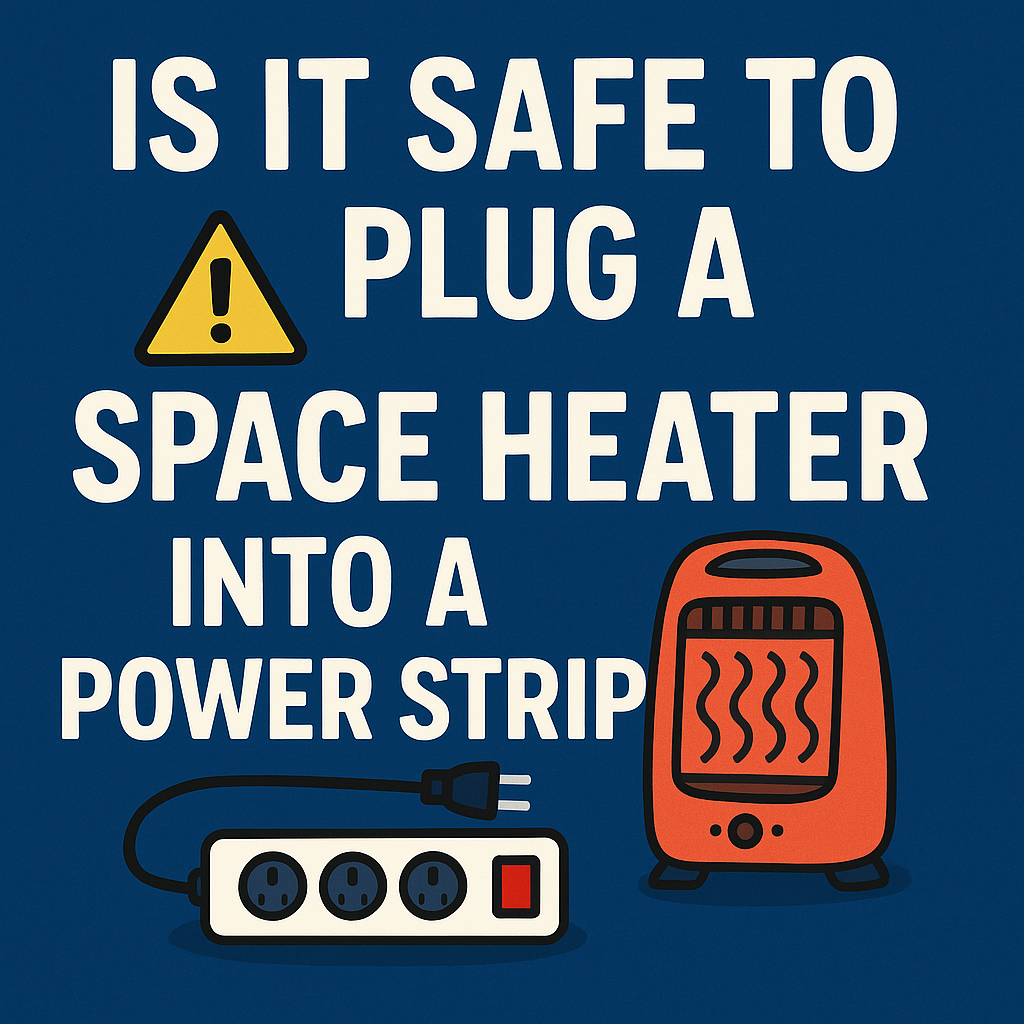
No – in almost all real-world situations, it is not safe to plug a space heater into a power strip or cheap extension cord.
Longer answer:
It can be done safely, but only with the right cord, the right circuit, the right load, and the right conditions – which almost nobody actually checks.
Space heaters are one of the top causes of electrical fires, and the number one mistake people make with them is this:
They treat a 1500W heater like it’s a phone charger.
Let’s break down why that’s a problem, what happens electrically, and what an actual engineer would (and wouldn’t) do with a space heater.
1. How Much Power Does a Typical Space Heater Draw?
Most plug-in space heaters are rated:
- 1500W (very common)
- Sometimes 1200W–2000W depending on model and setting
On a standard 120V circuit:
- 1500W ÷ 120V ≈ 12.5 amps
On a 15A circuit, that’s over 80% of the circuit’s capacity – by itself.
Now add:
- a TV
- a PC
- lights
- chargers
You’re right at – or above – what that circuit and wiring should be handling continuously.
That’s before we add a power strip or extension cord into the mix.
2. What a Power Strip Is Actually Designed For (Spoiler: Not Heaters)
People assume:
“If it has multiple sockets, it must be able to handle multiple big loads.”
Nope.
Most cheap power strips are designed for:
- phone chargers
- lamps
- routers
- TVs
- monitors
- small electronics
They often have:
- thin internal copper bus bars
- low-cost plastic housings
- minimal contact surface area
- cheap rocker switches
- sockets that are not meant for 12+ amps continuous
A heater is basically a glorified toaster element – a big resistive load that asks for a lot of current non-stop.
When you push 12.5A through:
- thin internal contacts
- old, worn springs
- cheap copper strips
…the strip heats up from the inside, often without you noticing until plastic starts softening or discoloring.
3. Where Things Actually Overheat (It’s Not Where You Think)
People imagine the heater overheating.
In reality, the hottest points usually are:
- the outlet on the wall
- the plug of the heater
- the sockets on the power strip
- the internal switch of the power strip
- the weakest point of the extension cord
Why?
Because of contact resistance.
If the plug blades don’t grip tightly inside the strip, or the strip’s internal contacts are worn or flimsy, you get:
P = I² × R
At ~12.5A, even a tiny resistance (say 0.1Ω) creates:
- P = 12.5² × 0.1
- P ≈ 15.6 watts of heat
at that single bad contact.
That’s like gluing a small soldering iron inside your power strip.
Now multiply that by:
- two hot contacts
- maybe a weak neutral contact
- cheap copper bus bar
- a switch that was never meant for this
Things absolutely get hot.
4. Coiled Cords + Heaters = Hidden Fire Starter
If that strip or extension cord is:
- coiled up
- left on a cable reel
- bundled under a desk
- stuffed behind furniture
- running under a rug
The heat cannot escape.
Electrical current heats the copper;
the copper heats the insulation;
the insulation heats the air around it.
When the cable is coiled, it acts like a heating element.
Even if the wire gauge itself barely handles the current, coiling can push it past safe temperature.
That’s why:
Heaters + coiled extension cords = classic fire investigation photo.
5. Why “But the Strip Says 16A / 2500W!” Is Misleading
In many regions, power strips say something like:
- “Max 16A”
- “Max load 2500W”
- “15A / 125V”
That sounds like:
“Okay, a 1500W heater is below the rating, so it must be fine.”
But that rating assumes:
- perfect contact pressure
- brand new internal components
- no other loads on the strip
- no heat buildup from coiling or poor ventilation
- continuous full load only for limited time in some cases
- high-quality copper inside (which cheap ones do NOT use)
In practice:
- cheap strips use thin metal that heats quickly
- the switch may be only rated for 10A
- the internal wiring might be aluminum or CCA (copper-clad aluminum)
- aging + dust + oxidation increase resistance
- they’re rarely tested under real “heater” loads for hours
So yes, the label says 16A.
No, that doesn’t mean your $5 strip from the bargain bin can safely run a 1500W heater for 8 hours every night.
6. The Outlet in the Wall Might Already Be Half Dead
Even if your strip or cord were perfect, your wall outlet might not be:
- worn contacts → loose grip on the plug
- old plastic → slightly deformed
- backstabbed wiring → high resistance at the rear
- previous overheating episodes → damaged internally
A heater plugged into a marginal outlet will:
- heat it further
- loosen contacts more
- increase arcing
- accelerate failure
Now add a strip or extension cord in between and you’ve added multiple weak links into a chain that will be carrying near-max current for hours.
7. Real-World Failure Modes (What Actually Happens)
Common outcomes when people plug heaters into power strips / cords:
- The strip gets warm → hot → melts locally
Often around the socket or switch. - The plug partially melts into the strip
Blades discolor, plastic deforms. - Faint burning plastic smell
Usually ignored until visible damage. - The strip stops working on one side
Contacts have burned open internally. - The heater cuts out randomly
Bad connection, micro-arcing, thermal deformation. - Breaker trips
Sometimes due to arcing or cumulative load on the circuit. - Worst-case: ignition of nearby flammable stuff
Dust, carpet, plastic, furniture.
Fire investigators see the combo:
space heater + power strip/cord + confined area
…way more often than you’d like.
8. So… Is It Ever Safe to Use a Cord With a Heater?
The honest engineer answer:
Yes, BUT only if you respect the numbers and conditions.
Safe-ish conditions look like this:
- A heavy-duty extension cord:
- 14 AWG or thicker (preferably 12 AWG)
- clearly rated for 15A or more
- pure copper, not copper-clad aluminum
- not coiled, not under rugs, not bundled
- On a dedicated or lightly-loaded circuit:
- nothing else high-power on the same circuit
- ideally, just the heater
- Plugged directly into a wall outlet, not:
- another power strip
- a daisy chain
- a travel adapter cube
- Outlet is in good condition:
- plug fits firmly
- no warmth after 10–15 minutes of running
- no discoloration or scorch marks
Even then, the safest answer is always:
If possible, plug the heater directly into a good, modern wall outlet with no strip or extension at all.
9. Hard “Don’t Do This” List (Heater Edition)
If a post of yours needs a screenshot, it’s this section.
Never do this with a 1500W space heater:
- ❌ Plug into a cheap $5 power strip
- ❌ Plug into a multi-plug cube or travel adapter
- ❌ Plug into a thin white/brown 2-wire extension cord
- ❌ Run on a coiled cord or reel
- ❌ Run on a cord hidden under a rug
- ❌ Daisy-chain strip → extension → strip → heater
- ❌ Use on a circuit that already runs:
- another heater
- hairdryer
- microwave
- gaming PC + monitors
If you can check any of those boxes, that setup is a strong “no”.
10. What an Engineer Would Actually Do at Home
If we’re being honest:
Here’s how a cautious electrical engineer would treat a plug-in space heater at home:
- ✅ Plug directly into a modern, snug wall outlet
- ✅ Keep it away from soft furnishings and clutter
- ✅ Use only one heater per circuit
- ✅ Avoid using it in old houses with sketchy wiring on that same circuit
- ✅ Turn it off when leaving the room or sleeping
- ✅ Replace any outlet that:
- feels even slightly loose
- gets warm
- shows discoloration
Would they use a heater on a cheap strip or thin extension?
No. Absolutely not.
Would they use a heater on a thick, short, 12–14 AWG extension cord temporarily if the outlet is far?
Maybe, but only if they’ve checked the cord rating and know what else is on that circuit.
🔍 Amp Nerd Fun Facts
- A 1500W heater can use more power than a gaming PC + two monitors + router combined.
- Many “house wiring failures” start with outlets and strips, not in-wall cables.
- An extension cord that seems fine on a phone charger can quietly cook itself on a heater.
- Loose outlet contacts can generate 20–30 watts of heat in the wall without tripping the breaker.
- Coiled cords are so bad with heaters that some cord reels literally say “Do not use fully coiled under high load” right on the label.
- A heater is one of the very few household devices where “directly into the wall” is not just a suggestion – it’s the standard safety advice.
Amp Nerd Summary
Is it safe to plug a space heater into a power strip?
- For most people, with typical cheap strips and cords:
No, it’s a bad idea and a real fire risk. - There are technically safe setups (heavy-gauge, short cords, low other loads, healthy outlets), but:
- They require checking ratings most people never read
- They require outlets that are in genuinely good condition
- They require not abusing or hiding the cord
If you want the clear, cautious guideline:
Treat a space heater like a “wall outlet only” device.
No power strips, no daisy chains, no thin extension cords.