
Light switches look simple.
You flip a little piece of plastic up or down, and the light turns on or off.
No moving parts (at least to the untrained eye), no electronics, nothing fancy.
So when old switches begin to:
- crackle,
- pop,
- warm up,
- make buzzing noises,
- flicker the lights,
- or get stuck halfway…
…most people are shocked.
How can something so basic go wrong?
Here’s the truth:
A light switch is a mechanical high-current interrupter — and every time you flip it, it performs a tiny violent electrical event.
All that “invisible” arcing slowly destroys the switch from the inside out.
Today Amp Nerd breaks down:
- why old switches arc and crackle,
- how switch contacts wear,
- why heat builds up inside,
- why certain loads destroy switches faster,
- when a light switch becomes a fire hazard,
- and why modern LED bulbs don’t fix the problem (they sometimes make it worse).
Let’s open the switch and look at the engineering behind failure.
⚡ The First Truth: Every Switch Flip Creates an Arc
A light switch does exactly one job:
**Break the circuit.
Or complete the circuit.**
But during the half-millisecond when contacts separate, electricity doesn’t want to stop.
When you open a circuit under load (especially inductive loads like fans or transformers), electricity jumps the gap as a small arc.
This arc:
- heats the contacts to extremely high temperatures,
- erodes metal surfaces,
- creates carbon buildup,
- weakens spring tension,
- degrades insulation,
- and eventually causes switch failure.
Small arc events happen every single time you flip a switch.
With enough cycles, the switch becomes:
- noisy
- resistive
- loose
- unsafe
A 20-year-old switch may have been flipped 20,000–50,000 times.
Its contacts are no longer smooth or clean — they’re pitted, oxidized, and carbonized.
⚡ Reason #1: Contact Erosion Turns Smooth Copper Into a Pitted, High-Resistance Disaster
Inside every switch is a set of metal contacts.
Originally, they are:
- shiny
- smooth
- low-resistance
- high-conductivity
Over time:
- arcs pit the metal
- oxidation coats the surface
- micro-particles of metal vaporize
- contact area decreases
- resistance increases
This is why old switches:
- feel stiff
- get warm
- make crackling noises
- flicker connected lights
High resistance = heat.
Heat = more resistance.
More resistance = even more heat.
This loop destroys switches.
⚡ Reason #2: Loose Contacts Cause Micro-Arcing (Buzzing, Crackling, Flickering)
Old switches lose:
- spring tension
- mechanical tightness
- contact pressure
When the internal spring weakens, the metal contacts don’t clamp tightly together.
This causes micro-arcing, tiny bursts of electricity jumping between surfaces.
Micro-arcing produces:
- audible crackles
- visible flicker
- heat
- soot buildup
- melting of plastic housings
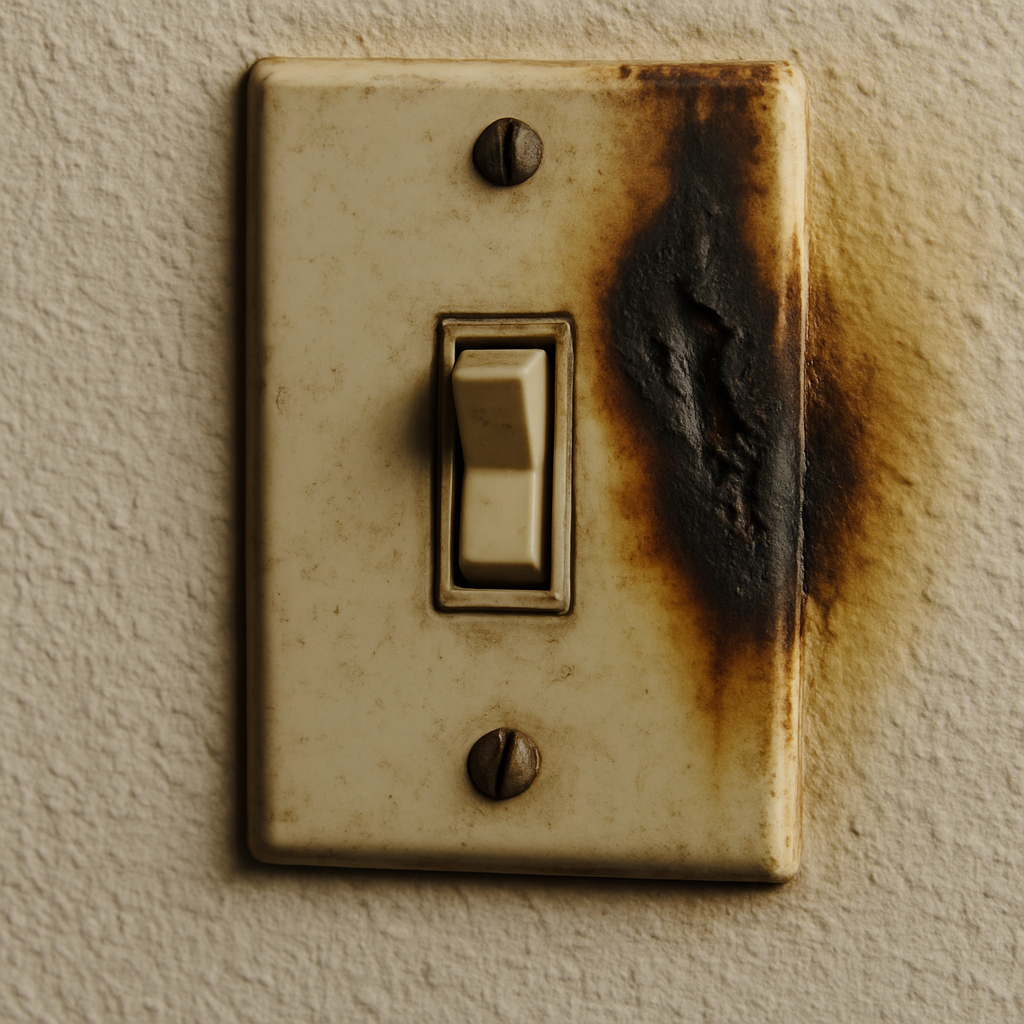
- brown discoloration around the switch plate
This is not harmless — it’s the precursor to complete failure.
⚡ Reason #3: Switches Were Never Designed for Modern LED Electronics
You’d assume LED bulbs reduce switch wear.
Lower wattage = less heat, right?
Actually, no.
LED bulbs contain:
- switching power supplies
- high-frequency drivers
- small capacitors
- fast current pulses
- inrush surges at turn-on
When you flip the switch:
- the LED driver charges instantly
- a fast inrush pulse occurs
- sometimes 10× higher than running current
Example:
- 10W LED
- steady-state draw: ~0.08A
- turn-on surge: up to 1–2 amps for a few milliseconds
This surge stresses the switch contacts disproportionately.
In old switches, this can create:
- sharper arcs
- bigger sparks
- pitted metal
- overheating
Ironically, incandescent bulbs were easier on switches because they presented a predictable, resistive load.
⚡ Reason #4: Fans, Transformers, and Motors Absolutely Destroy Switch Contacts
If a switch controls:
- a bathroom fan
- a ceiling fan
- a garage light with a ballast
- a halogen transformer
- a fluorescent ballast
- a doorbell transformer
- a chime
- any inductive load
…it is under far more stress.
Inductive loads generate:
- high-voltage spikes
- strong back-EMF
- large arcs when switched
A 1-amp fan motor can create a 600–1000V arc spike when a switch is opened.
This massively accelerates contact erosion.
⚡ Reason #5: Heat Builds Up Inside Old Switches (Often Unnoticed)
Switch heat often goes unnoticed because:
- the cover plate hides discoloration
- the switch warms slowly
- the load cycles on and off
- the switch is in a cool room
But inside:
- carbon deposits insulate heat
- copper expands and contracts
- plastic softens
- metal fingers lose tension
- screws loosen from thermal cycling
A bad switch may reach 60–90°C inside the wall before the user notices anything.
That’s a fire hazard.
⚡ Reason #6: Backstabbed Wires Loosen Over Time (A Very Common Failure Point)
“Backstab” wiring — where the conductor is pushed into a spring-loaded hole — is allowed by code, but it is far less reliable than screw connections.
Over time:
- the spring weakens
- copper creeps (slow deformation)
- thermal cycling loosens the grip
- oxidation builds on the connection
This leads to:
- arcing at the rear of the switch
- heat at the wire entry
- flickering lights
- total switch failure
- melted insulation
- carbonized copper
Many melted switches fail at the backstab point, not the front contacts.
⚡ Reason #7: Cheap Switches Use Thin Metal, Weak Springs, and Poor Alloys
A $0.49 switch from a bargain bin is not the same as a commercial-grade switch.
Cheap switches use:
- thin copper contacts
- low-quality brass
- weak springs
- minimal plating
- low melting point plastic
High-quality switches use:
- thick silver-alloy contacts
- large copper pads
- strong mechanical action
- temperature-resistant plastic
- tight tolerances
Cheap switches fail 5–10× faster.
⚡ Reason #8: High-Use Locations Wear Out First
Switches that control:
- kitchen lights
- hallway lights
- bathroom lights
- garage lights
- front porch lights
…get flipped 10–20× more than switches in bedrooms or guest rooms.
More flipping = more arcs = faster failure.
⚡ Reason #9: Humidity and Dust Make Everything Worse
Bathrooms, basements, and garages often expose switches to:
- moisture
- steam
- dust
- corrosion
Humidity accelerates:
- oxidation
- corrosion of springs
- carbon buildup
- weakening of contact pressure
Dust inside the switch can ignite under arcing, producing:
- crackles
- pops
- scorch marks
⚡ Warning Signs of a Failing Light Switch
A light switch is unsafe if you notice:
⚠ crackling or sizzling
⚠ warm switch plate
⚠ intermittent lighting
⚠ slow or “soft” click
⚠ buzzing when switched on
⚠ discoloration (brown/yellow)
⚠ “egg smell” or burning odor
⚠ flicker only when the switch is touched
⚠ a loose or wobbly feel
These signs mean:
- contacts are arcing
- oxidation is severe
- metal is pitted
- heat damage has begun
- internal components are failing
Replace the switch immediately.
This is fire hazard territory.
⭐ Amp Nerd Fun Facts
- Every flip of a switch causes a tiny electrical explosion (arc) between contacts.
- LED bulbs create high inrush spikes that wear switches more than people expect.
- Old switches may have been flipped 50,000+ times.
- Backstab wiring fails far more often than screw terminals.
- Inductive loads (fans, transformers) cause up to 1000V arc spikes when switched.
- A failing switch can reach 90°C inside the wall without feeling hot on the outside.
- Most switches cost under $1 yet control thousands of dollars in electrical equipment.
⚡ Amp Nerd Summary
Old light switches crackle, arc, and fail because:
- contact erosion pits the metal
- micro-arcing increases over time
- springs lose tension
- oxidation builds
- loads create high-voltage spikes
- LED inrush currents stress contacts
- cheap switches wear out quickly
- backstabbed wires loosen and arc
- heat slowly damages insulation
Light switches look simple,
but they’re actually mechanical arc-interrupting devices that perform thousands of high-stress cycles in their lifetime.
When they start making noise, glowing, or flickering —
they’re already past their safe lifespan.