
Extension cords are some of the most abused electrical devices in the home.
People use them for everything:
- space heaters
- air fryers
- refrigerators
- TVs
- power tools
- gaming PCs
- Christmas lights
- EV trickle chargers
- and sometimes… entire home office setups
And then things happen:
- plugs get hot
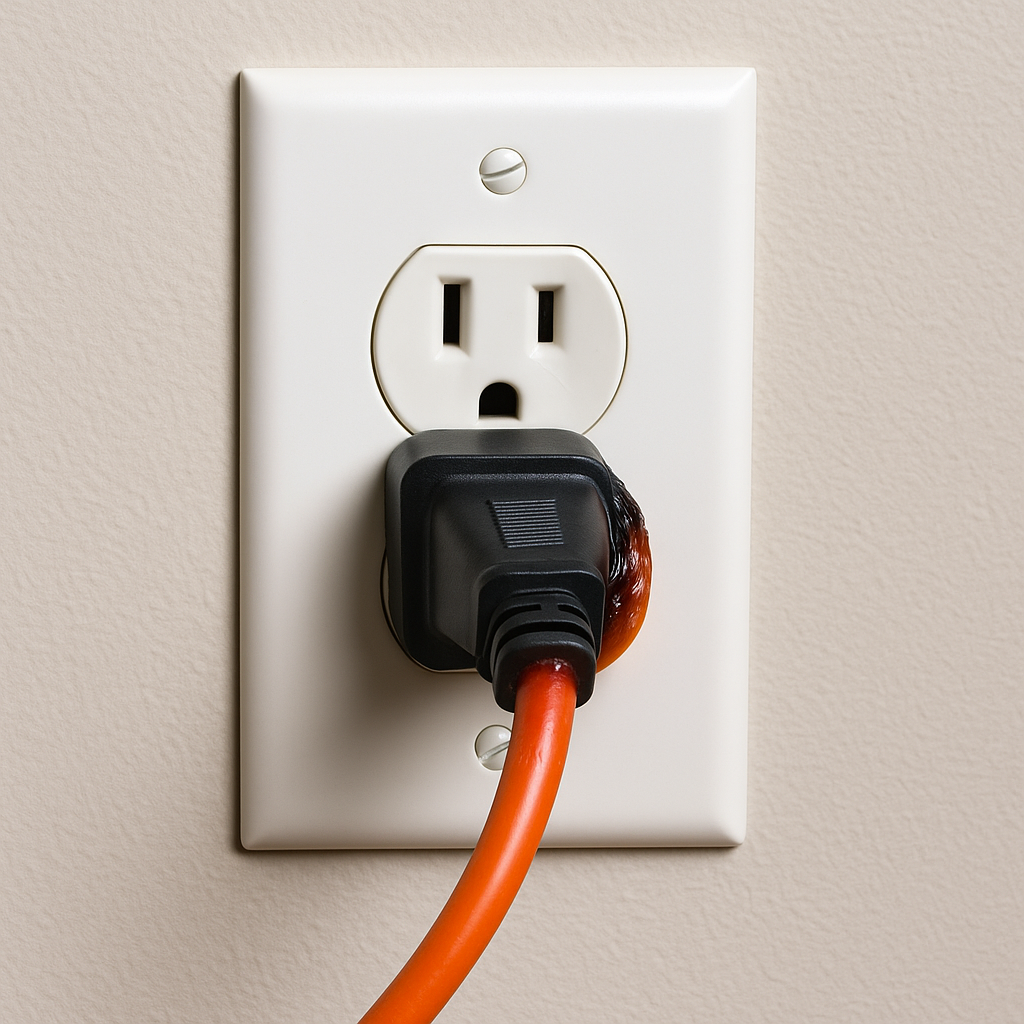
- the cord melts
- the outlet turns brown
- breakers trip
- sparks appear
- a burning smell creeps in
- the cord softens or warps
- appliances randomly shut off
- scorch marks appear on the carpet
Millions of fires worldwide begin with extension cords.
Yet most people have no idea why they actually overheat — or what engineering principles are at play.
Today, Amp Nerd breaks down the real reasons extension cords fail, melt, or catch fire, based on electrical physics, thermal dynamics, conductor design, resistive heating, and load mismanagement.
Let’s tear apart the engineering truth.
⚡ The First Truth: Extension Cords Are Not Designed for Continuous Heavy Loads
People think:
“The cord is rated for 10A or 13A or 15A — I can plug anything up to that limit.”
That’s not how real-world electrical design works.
The rating on extension cords assumes:
- the cord is fully uncoiled
- the cord is in open air
- the load is resistive
- the plug fits perfectly
- the contact surfaces are clean
- ambient temperature is moderate
- duty cycle is low
- the cord is not running under a carpet
- the cord isn’t kinked
How often are all of those true?
Probably never.
In reality, extension cords are used in:
- tight spaces
- behind radiators
- under rugs
- in garages
- wrapped around themselves
- bunched up in piles
- near heaters
- in dusty corners
- next to power-hungry appliances
This turns a “10A rated cord” into a melting hazard.
Let’s talk physics.
⚡ Reason #1: The Wire Gauge Is Too Thin (AWG vs Heat Problem)
Cheap extension cords use thin conductors, like:
- 18 AWG
- 20 AWG
- sometimes 22 AWG (dangerously thin)
The thinner the wire:
- the higher the resistance
- the greater the heat rise
- the faster the insulation breaks down
For example:
| Wire Gauge | Safe Continuous Load | Common Use | What People Actually Plug In |
|---|---|---|---|
| 22 AWG | < 3A | fairy lights | heaters, fridges, PCs |
| 20 AWG | < 5A | small lamps | air fryers, microwaves |
| 18 AWG | 6–7A | TV, chargers | hairdryers, irons |
| 16 AWG | 10A | most standard cords | space heaters |
| 14 AWG | 13–15A | heavy-duty | power tools |
| 12 AWG | 15–20A | industrial | few consumers buy this |
Most people buy the cheapest cord, which uses thin wire that barely handles a laptop charger — let alone a space heater.
Thin wire = high resistance
High resistance = heat
Heat = meltdown
⚡ Reason #2: Coiled Extension Cords Act Like Heating Elements
When you leave an extension cord:
- coiled
- wound on a reel
- tied with a cable tie
- wrapped around itself
…it becomes a resistive heating device.
Electricity passing through a coiled conductor creates:
- resistive heating
- magnetic fields
- inductive heating (small but real)
This is why electricians NEVER operate long cords fully coiled.
The heat cannot escape → insulation softens → internal conductor heats more → runaway heating occurs.
A 1.5mm² (AWG 15) cable carrying 10A can hit:
70–90°C when coiled.
Cheap PVC insulation softens around 60°C.
You can see the problem.
⚡ Reason #3: Space Heaters, Irons, Hair Dryers, and Air Fryers Kill Cords Quickly
These appliances draw:
- 1200W
- 1500W
- sometimes 2000W+
That means a continuous current of:
10–13A continuous
12–15A peak
Plugging one of these into:
- a thin extension cord
- an indoor multi-plug strip
- a coiled cable
- an old cord
- a cheap “flat ribbon” style cord
…is the electrical equivalent of asking a straw to carry the Niagara Falls.
The conductor overheats.
The plug overheats.
The outlet overheats.
The strip overheats.
Many fires begin this way.
⚡ Reason #4: Contact Resistance at the Plug Creates Micro Heaters
Every electrical contact has some resistance:
- plug blades
- outlet contacts
- extension cord socket contacts
- internal copper plates
- spring contacts
As metal ages:
- oxidation increases
- copper darkens
- springs weaken
- blades loosen
- dust enters
- contact area decreases
A worn plug can rise from 25°C to 120°C with only 8–10A flowing.
That’s enough to:
- melt the plug
- burn the socket
- char the wall
- ignite plastic
- carbonize dust and lint
People often blame the cord,
but the real culprit is poor contact pressure at connections.
⚡ Reason #5: Multi-Plug Adapters and Power Strips Are Weak Links
Power strips often use:
- thin bus bars
- weak solder joints
- spring contacts made from cheap alloys
- 0.2–0.5mm copper plating
- PCB traces for current flow (!)
A typical $5 power strip cannot safely deliver more than 4–6A continuously.
But people plug in:
- a heater
- a PC
- a monitor
- a phone charger
- LED strips
- a printer
- a speaker system
All into one strip fed by a thin extension cord.
This creates:
“Load stacking”
—a silent overload condition where multiple small loads add up to a huge current draw.
The strip overheats.
The cord overheats.
The plug overheats.
This is textbook electrical fire behavior.
⚡ Reason #6: Long Extension Cords Have Voltage Drop That Causes More Heat
Long cords = higher resistance = more voltage drop.
At 10–15 meters length, a cheap 18 AWG extension cord can drop:
- 2–4 volts under load
- up to 10V for high-power appliances
When voltage drops:
- the appliance draws MORE current to compensate
- this creates MORE heat in the cord
- the cord loses MORE voltage
- the appliance draws MORE current
A self-reinforcing loop that ends with:
- meltdown
- breaker trip
- scorched plug
- fire
Voltage drop is the silent killer.
⚡ Reason #7: Cheap Cords Use Aluminum or Copper-Clad Aluminum (CCA) Conductors
Real copper is expensive.
So cheap extension cord manufacturers use:
- aluminum wire
- copper-clad aluminum
- copper-coated steel
- ultra-thin multi-strand blends
Aluminum has:
- 61% the conductivity of copper
- lower melting point
- higher resistance
- faster oxidation
- greater brittleness
CCA heats almost 2× more under the same load than pure copper.
You can identify CCA by:
- unusually lightweight cord
- dull, silver-colored strands
- soft, weak conductor feel
- “copper colored” but scratches reveal silver underneath
CCA cords are legal,
but they are fire hazards under heavy loads.
⚡ Reason #8: PVC Insulation Breaks Down Over Time (Especially When Heated)
PVC insulation:
- stiffens
- cracks
- oxidizes
- becomes brittle
- loses flexibility
- shrinks from heat exposure
As insulation ages:
- conductors become exposed
- hot spots form
- arcing becomes more likely
- heat concentrates on weakened areas
- melting accelerates
A 10-year-old extension cord is already a risk.
A 20-year-old cord is a hazard waiting to ignite.
⚡ Reason #9: Overvoltage and Undervoltage Both Cause Overheating
Overvoltage
When mains voltage is high:
- appliances draw more power
- cords get hotter
- resistive heating increases
This is common in areas with poor grid regulation.
Undervoltage
When voltage is low (brownout):
- motors draw more current
- heaters pull more amps
- switching supplies stress input stages
- cords overheat from the extra current
Both conditions stress extension cords dangerously.
⚡ Reason #10: DIY Repairs and Tape Fixes Make Things Worse
People try to “fix” cords with:
- electrical tape
- duct tape
- twisting wires together
- using wire nuts
- reattaching broken plugs poorly
- soldering without strain-relief
These create:
- weak joints
- high resistance points
- loose connections
- exposed conductors
- heat buildup zones
Most homemade repairs do not meet electrical code
and create failure points under load.
⚡ Reason #11: Running Cords Under Carpets Turns Them Into Fire Hazards
Under a carpet:
- heat cannot escape
- friction degrades insulation
- bending stresses conductors
- dirt and dust accumulate
- the cord lights soft furnishings on fire easily
Carpet + extension cord = classic house fire recipe.
⚡ When an Extension Cord Is Unsafe (Stop Using It Immediately)**
Stop using the cord if you notice:
- heat at the plug
- heat at the socket
- soft or melty insulation
- discolored copper
- stiff/brittle sections
- flickering appliances
- buzzing sounds
- ozone/burning smell
- scorch marks
- exposed conductor strands
- damaged plug blades
Any of these are serious warning signs.
⭐ Amp Nerd Fun Facts
- A fully coiled extension cord carrying 10A can reach 90°C internally.
- Cheap cords often use aluminum wire disguised as copper.
- A 1500W space heater should never be used on a cheap cord — ever.
- Voltage drop increases cord heat, which increases resistance, which increases more heat (thermal runaway).
- Most $5 power strips are rated lower than a single hair dryer.
- A loose outlet increases heat by 10× because of high contact resistance.
- Many cords melt at the plug, not the wire — because that’s where resistance is highest.
⚡ Amp Nerd Summary
Extension cords overheat because of:
- thin wire gauge
- coiling during use
- high-power appliances
- poor contact pressure
- long-distance voltage drop
- aluminum or CCA wiring
- aging PVC insulation
- improper repairs
- multi-plug overload
- running cords under rugs
- undervoltage and overvoltage
- cheap connectors and materials
Extension cords are temporary devices,
not permanent wiring.
Most failures happen because users treat them like permanent infrastructure.
Use them wisely — or replace them with proper outlets and rated wiring.