
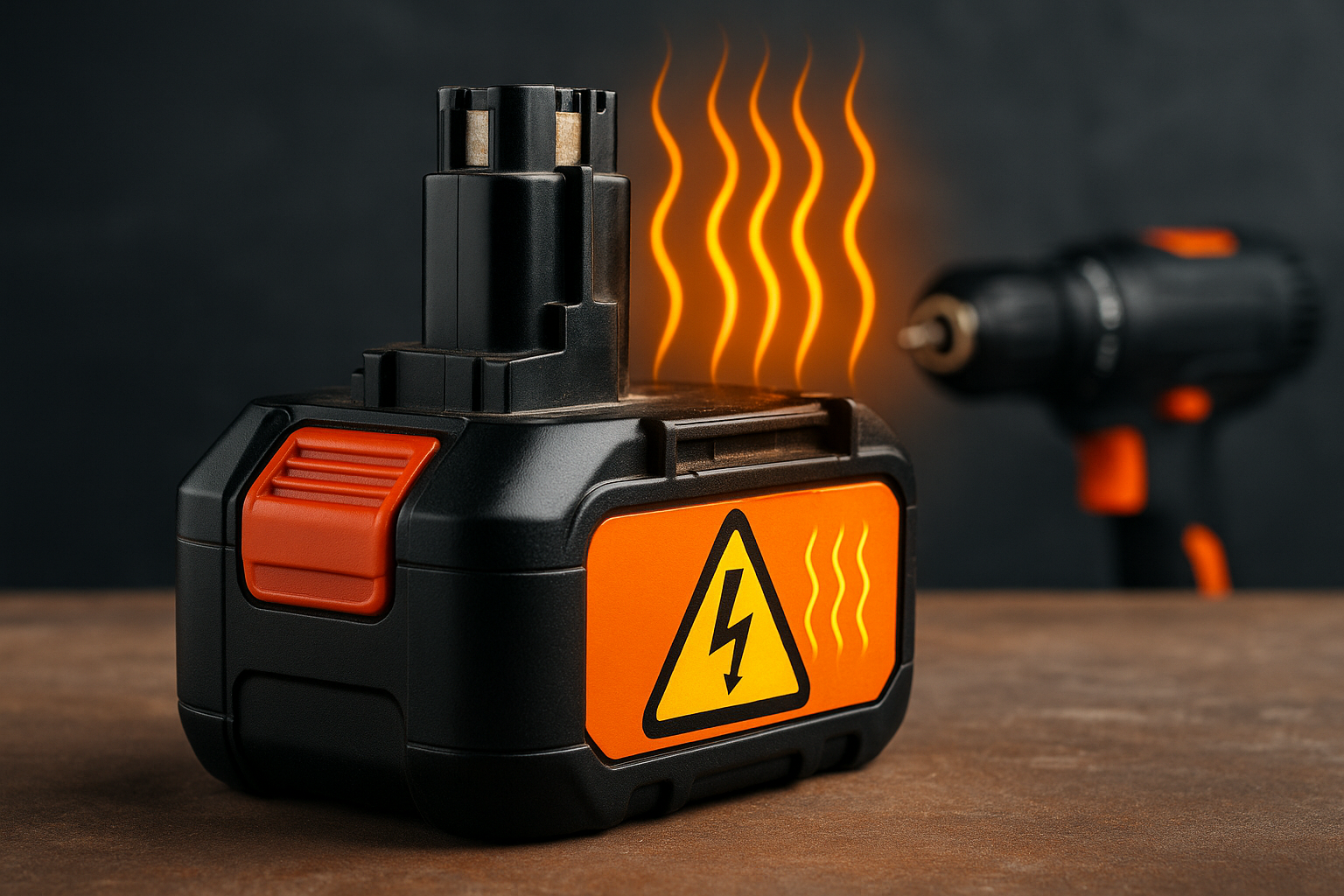
Power tool batteries used to last years.
Today, it feels like they barely survive a renovation.
People notice:
- batteries getting hot when charging,
- batteries swelling,
- chargers blinking red,
- drills losing power halfway,
- batteries shutting down under load,
- packs dying after only a few months,
- “recondition” modes doing nothing.
Here’s the real engineering truth:
Modern lithium power tool batteries are pushed close to their absolute limits — thermally, electrically, and mechanically — and they fail fast because of it.
Today, Amp Nerd explains:
- why these packs overheat,
- what actually kills lithium cells,
- why charge cycles are misunderstood,
- why fast chargers are rough on batteries,
- and how to significantly extend pack lifespan.
Let’s break down what’s inside one of these packs.
⚡ The First Truth: Power Tool Batteries Are High-Capacity, High-C-Rate Lithium Packs
Power tool packs contain:
- multiple 18650 or 21700 lithium-ion cells,
- arranged in series and parallel,
- controlled by a small BMS (battery management system),
- capable of delivering massive current.
A typical 18V pack can output:
- 20A continuous
- 30–40A peak
- some tools draw 50–60A bursts
This is absurdly high for consumer batteries.
Your phone battery would explode if it ever attempted this.
But in power tools, it’s normal.
⚡ Reason #1: High Discharge Current = Extreme Heat
Lithium cells heat up due to:
- internal resistance (IR),
- voltage sag under load,
- rapid chemical reactions,
- current spikes.
When a drill or saw demands a heavy load:
- cells heat internally,
- the pack casing traps heat,
- temperature rises rapidly.
Many packs hit:
50–60°C during use
70°C in hot environments
80°C internally in extreme loads
Above 60°C:
- lithium degradation accelerates,
- electrolyte breaks down,
- the SEI layer becomes unstable,
- aging speeds up 4–10×.
Heat is the #1 killer of tool batteries.
⚡ Reason #2: Fast Charging Is Hard on Lithium Cells
A “fast charger” pushes:
- 3A
- 4A
- sometimes 6A
into lithium cells.
This causes:
- heat generation,
- internal resistance increase,
- uneven cell balancing,
- SEI layer stress.
Most chargers don’t:
- preheat cells in cold climates,
- cool cells in hot climates,
- monitor each cell individually,
- reduce current based on pack age.
Fast charging wears out lithium much faster than slow charging.
Your battery lasts 2–3× longer if charged slowly.
Tool manufacturers won’t tell you this — they compete on charge time.
⚡ Reason #3: The BMS Inside Power Packs Is Shockingly Simple
Unlike EV batteries or laptop packs, which have advanced BMS systems, power tool batteries often use:
- no thermal management (no cooling fans),
- basic cell balancing (passive only),
- cheap thermistors,
- weak overcurrent protection,
- no active monitoring of internal temperatures,
- crude voltage cutoffs.
Tool manufacturers assume:
“Users won’t care about lifespan — they care about power.”
And they’re right.
But the pack pays the price.
⚡ Reason #4: High Torque Tools Cause Huge Current Spikes
Impact drivers, circular saws, and grinders draw:
- enormous instantaneous current,
- sometimes above 50 amps.
This causes:
- voltage dips,
- heat spikes,
- stress on cell interconnects,
- BMS cutoff events,
- uneven cell wear.
The cells closest to the tool terminals experience:
- higher current
- higher heat
- accelerated aging
This is why some packs die in “clusters” — the first few cells fail first.
⚡ Reason #5: Cold Weather Charging Damages Packs Permanently
Lithium cannot charge properly below 0°C.
Charging cold cells:
- cracks the SEI layer,
- causes lithium plating,
- permanently reduces capacity,
- increases internal resistance.
Many users:
- leave batteries in cold garages,
- attempt to charge them in winter,
- kill the pack without realizing it.
Most tool chargers have no heating system to protect cells.
⚡ Reason #6: Vibration and Shock Destroy Cell Connections
Power tools vibrate violently:
- reciprocating saws,
- impact drivers,
- jackhammers,
- grinders.
This vibration:
- cracks solder joints,
- stresses nickel strips,
- loosens welding spots,
- breaks BMS connections.
Many “dead” packs fail from mechanical damage, not chemical aging.
⚡ Reason #7: Heat Build-Up After Use + Immediate Charging Kills Packs
Common mistake:
- Use battery heavily → pack heats to 50–70°C
- Immediately put into fast charger → heats again
- Cells reach 70–90°C → irreversible aging
Lithium must cool before charging.
Most tool manuals recommend this,
but nobody follows it.
⚡ Reason #8: Cheap Aftermarket Packs Use Inferior Cells
Amazon and AliExpress are full of:
- fake tool batteries,
- packs with recycled cells,
- packs with flashlight-grade cells,
- ultra-high “mAh” claims.
These packs:
- overheat,
- sag under load,
- fail prematurely,
- sometimes catch fire.
Brand-name packs use:
- Sony (Murata),
- Samsung,
- LG,
- Panasonic
Cheap packs use:
- rewrapped junk cells.
⚡ Reason #9: Internal Heat Traps Make Everything Worse
Battery pack housings often include:
- no airflow
- small vents
- thick plastic walls
- rubber bumpers
They trap heat to improve tool durability.
But heat ruins lithium.
The result:
- packs overheat from inside,
- users don’t notice,
- cells age rapidly.
⭐ Amp Nerd Fun Facts
- A power tool battery can deliver more current than a car battery — just for a shorter time.
- A single 18650 cell inside a tool pack can output 20 amps continuously.
- Most fast chargers reduce battery lifespan by 40–60%.
- Cold charging is more damaging than hot charging.
- Impact drivers push batteries harder than any other common tool.
- Many “dead” packs still have good cells — only the BMS failed.
- One overheated charge cycle can do the same damage as 30–50 normal cycles.
⚡ Amp Nerd Summary
Power tool batteries overheat and fail because:
- high discharge current generates extreme heat,
- fast charging abuses lithium chemistry,
- basic BMS design lacks protection,
- vibration damages connections,
- cold-weather charging causes plating,
- packs run hot inside sealed housings,
- users charge immediately after heavy use,
- cheap aftermarket packs use poor cells.
Lithium batteries aren’t weak —
they’re just being pushed beyond safe engineering limits.