
LED strips are everywhere now:
- gaming setups
- TV backlighting
- under-cabinet lighting
- cars
- desks
- bedrooms
- PC cases
They’re cheap, bright, colorful, and easy to install.
But almost everyone who owns LED strips has seen this:
- the strip gets dim toward the end
- colors shift
- some LEDs burn out
- the whole strip flickers
- one section turns blue or green
- adhesive melts
- the controller dies
- the 5-meter strip looks nothing like the first meter
Here’s the harsh truth:
Cheap LED strips are engineered to FAIL — and voltage drop is the #1 hidden reason nobody talks about.
Today we’ll explain:
- why LED strips burn out,
- how voltage drop destroys them,
- why certain colors fail first,
- why cheap strips dim unevenly,
- and what engineers do differently when designing quality strips.
Let’s break it down.
⚡ The First Truth: LED Strips Aren’t Wired in One Long Chain (They’re in Groups)
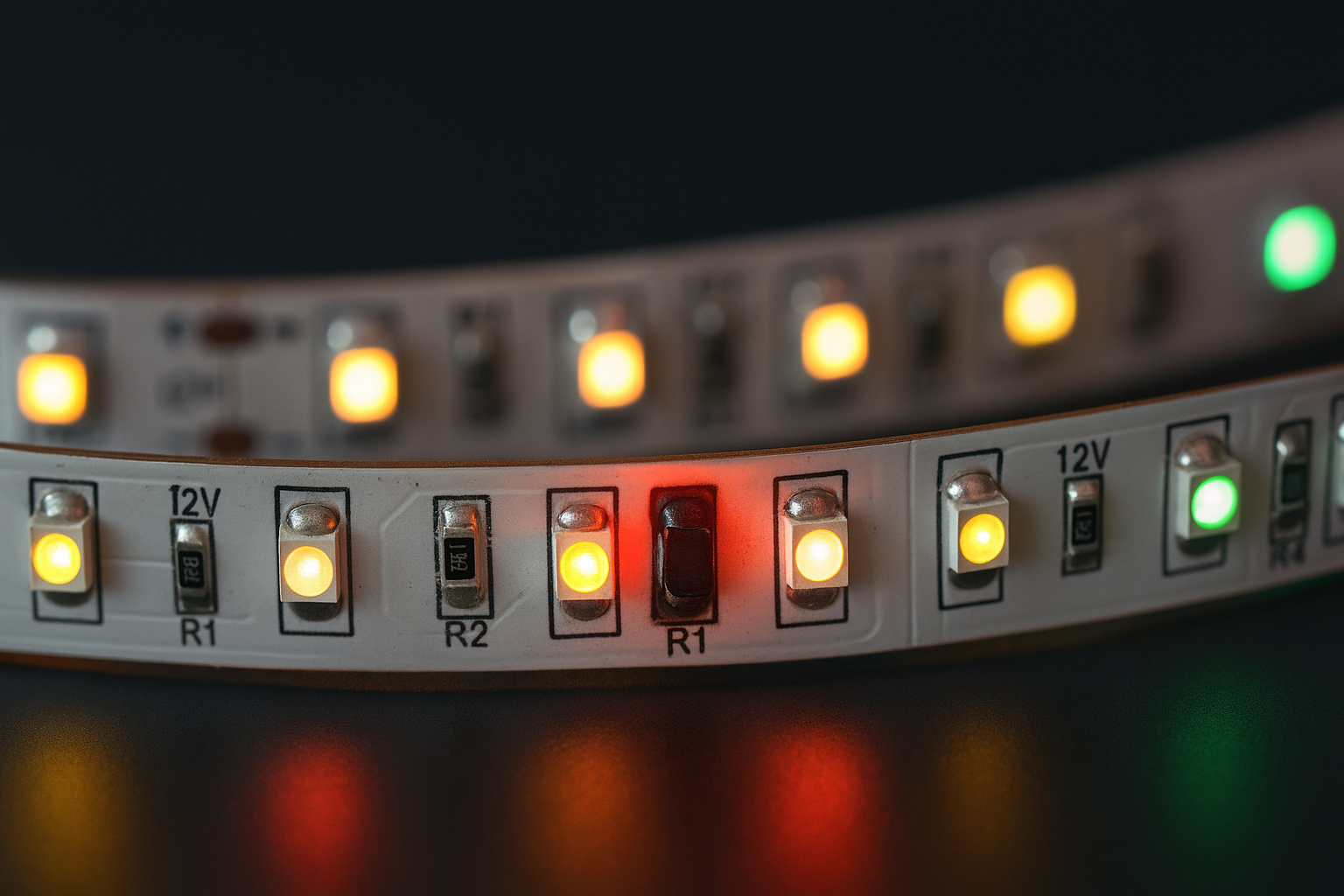
Most cheap LED strips are wired in tiny repeating circuits.
Typical 12V LED strip layout:
- groups of 3 LEDs in series,
- each group has a single resistor,
- groups are wired in parallel.
This design:
- is cheap,
- is simple,
- works “well enough,”
- but has HORRIBLE voltage drop characteristics.
Why does this matter?
Because every group sees a slightly different voltage depending on how far it is down the strip.
The further from the power supply → the lower the voltage → the dimmer the LEDs.
And the strip begins to degrade unevenly.
⚡ Reason #1: The Thin Copper Traces Can’t Handle the Current
Cheap LED strips use:
- very thin copper layers (sometimes 1–2 oz, sometimes less)
- narrow traces
- long run lengths
Current must travel through these skinny traces for the entire length of the strip.
Result:
✔ voltage drop
✔ color shift
✔ overheating
✔ early LED failure
That warm feeling on your LED strip?
That’s resistance burning power that should be going to the LEDs.
⚡ Reason #2: Voltage Drop Causes Different Colors to Fail at Different Rates
LEDs respond differently to voltage:
- Blue and white LEDs need higher forward voltage
- Red LEDs need lower forward voltage
As voltage drops along the strip:
- blue becomes dim
- green becomes weirdly bright
- red becomes overpowering
- the strip looks pinkish or yellowish
- RGB colors shift dramatically
This is why LED strips never look the same along their full length.
⚡ Reason #3: Cheap Resistors Cause Heat + Uneven Current
Those tiny resistors in each LED group:
- limit current
- drop voltage
- compensate for LED variation
But cheap resistors:
- vary wildly in value
- heat up
- drift over time
- burn out first
Symptoms:
- one segment dies
- color changes
- flickering only in certain spots
- shade differences between segments
LEDs rarely fail first —
the resistors do.
⚡ Reason #4: Wrong Power Supplies Kill LED Strips
People often power LED strips with:
- phone chargers
- sketchy 12V supplies
- underpowered adapters
- random leftover power bricks
- cheap eBay/AliExpress power supplies
These supplies:
- sag under load
- output unstable voltage
- have high ripple
- heat up and drop voltage even more
LED strips hate unstable voltage.
⚡ Reason #5: LED Strips Are Frequently Overloaded With Controllers
RGB strips with controllers require:
- stable 12V
- stable ground
- constant current levels
Cheap controllers:
- cannot drive long strips
- introduce flicker
- cause color shift
- overheat and cook components
Worst of all:
- controllers dump noise onto the strip
- noise spikes stress LEDs
- MOSFETs run hot and fail
Many LED strip controllers are under-specced by design.
⚡ Reason #6: Heat Kills LED Strips Faster Than Anything
LEDs hate heat.
In cheap strips:
- resistors heat the PCB
- LED chips get hotter
- adhesive acts like insulation
- strip touches walls or wood
- heat cannot escape
Over time:
- phosphor inside LEDs degrades
- color shifts
- brightness drops
- thermal runaway can occur
Heat is the silent killer.
⚡ Reason #7: Running Long LED Strips From One End Is a Rookie Mistake
Most people plug power into one end of a long strip.
This guarantees:
- huge voltage drop
- dim end segments
- heat accumulation
- color shift
Proper LED strip installations use:
power injection at multiple points.
Cheap strips fail because the average user doesn’t know this —
but manufacturers don’t warn you, because they assume you won’t care.
⚡ Reason #8: RGB Strips Wear Out Unevenly — Blue Dies First
In RGB strips:
- blue LEDs degrade fastest (highest forward voltage)
- green lasts longer
- red lasts the longest
Over time:
- white looks yellow
- colors look sickly
- strip loses vibrancy
- RGB blending becomes inaccurate
This is NOT because the LEDs are bad.
It’s because the strip:
- runs too hot
- runs at too low voltage at the far end
- drives blue LEDs harder to compensate
Blue LED death is almost guaranteed.
⭐ Amp Nerd Fun Facts
- Cheap LED strips often use copper so thin you can see through it.
- A 5-meter LED strip can lose 1–2 volts by the far end.
- Many LED strips rated “12V 5m” are safe only for 2 meters without injection.
- Blue LEDs degrade 3× faster than red.
- A cheap LED strip power supply can have more ripple than a 1990s CRT monitor.
- LED strips dim because of Ohm’s Law, not “LED aging.”
- Voltage drop can make a strip run hotter — which then increases voltage drop even more (thermal runaway loop).
⚡ Amp Nerd Summary
Cheap LED strips fail because:
- copper traces are too thin
- voltage drop ruins color consistency
- resistors overheat and drift
- uneven wear destroys RGB balance
- poor controllers produce unstable current
- strips run too hot
- long runs aren’t powered correctly
- low-quality power supplies worsen everything
LEDs don’t fail first.
Bad engineering does.