
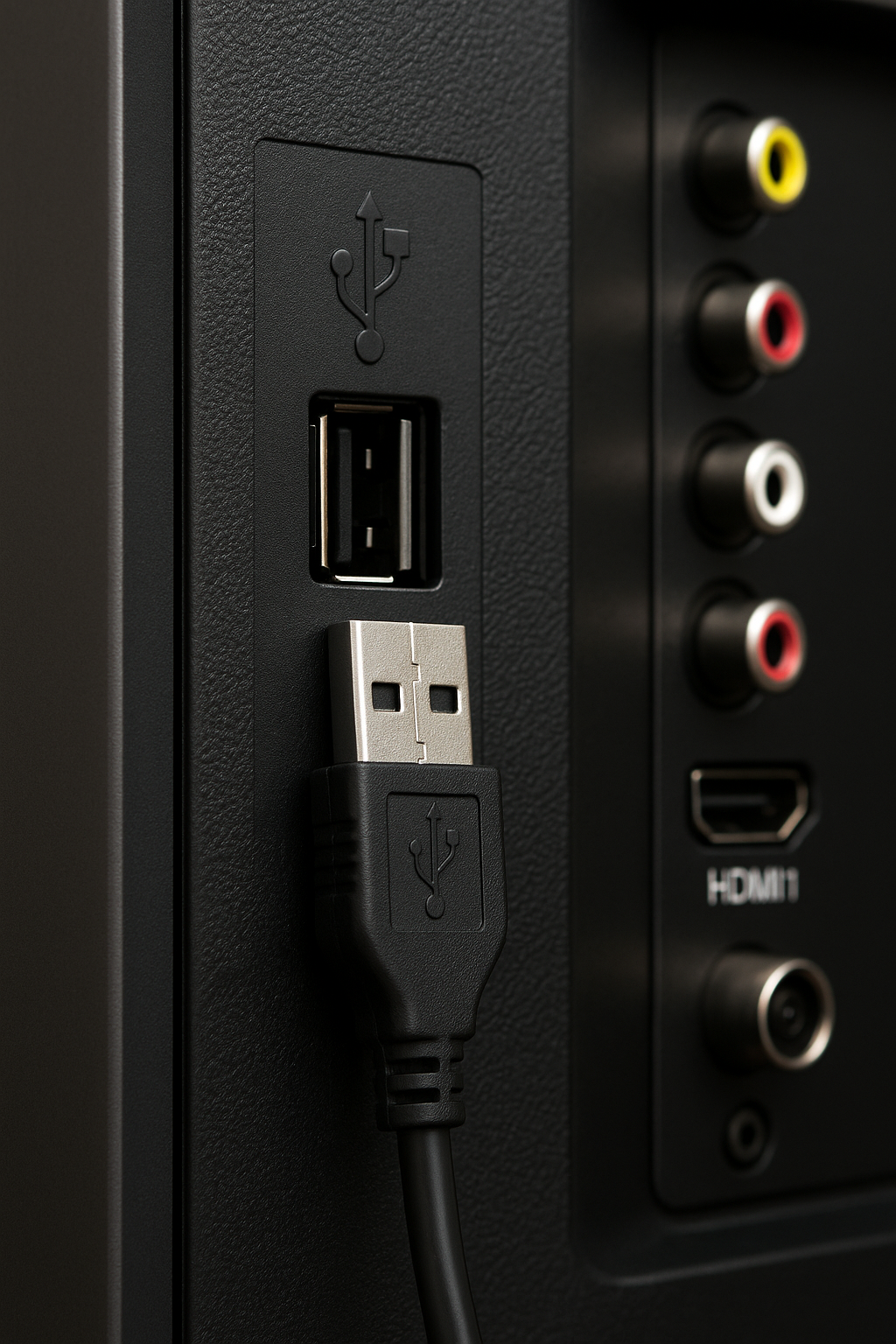
Almost every modern TV has a USB port on the back.
Manufacturers advertise it as:
- “For media playback”
- “For powering streaming sticks”
- “For convenient charging”
So people plug in:
- phones,
- tablets,
- LED strips,
- Bluetooth speakers,
- streaming devices,
- Raspberry Pi boards.
Then they notice:
It charges incredibly slowly.
Sometimes it doesn’t charge at all.
Sometimes it disconnects.
Sometimes it damages the cable.
Sometimes the device reboots randomly.
Why is the USB port on your TV so weak?
Because that USB port was never designed to be a real charger — and in most TVs, the electronics behind it are shockingly underpowered.
Today, Amp Nerd breaks down:
- why TV USB ports are so limited,
- how they’re engineered internally,
- why their voltage fluctuates,
- why they can even kill devices,
- and what they were actually designed to do.
Let’s dive deep.
⚡ The First Truth: TV USB Ports Are Data Ports, Not Power Supplies
TV USB ports were originally added for:
- photo viewing,
- video playback via USB drives,
- firmware updates,
- service mode access.
They were never meant to be chargers.
So manufacturers minimize cost:
- weak 5V regulators,
- low-current output stages,
- minimal filtering,
- shared power rails with the TV mainboard.
The result:
✔ very low current (0.3–0.5A on many TVs)
✔ unstable voltage
✔ no fast-charging protocol support
✔ no safety circuitry
✔ no thermal management
Your TV USB port is closer to a “toy power source” than a real charger.
⚡ Reason #1: Most TVs Output Only 5V at 500mA (USB 2.0 Standard)
USB 2.0 provides:
- 5 volts
- 500 mA max
That’s 2.5 watts.
A phone charger typically provides 20W+ today.
Many TVs do not even reach a stable 500mA.
Some output:
- 300–400mA,
- with voltage droop under load,
- causing charge cycles to fail.
Your phone sees low voltage → reduces charging speed → sometimes refuses to charge at all.
⚡ Reason #2: TV USB Ports Cannot Negotiate Fast Charging
Modern devices need handshake protocols for fast charging:
- USB-C PD
- Quick Charge (QC)
- Adaptive Fast Charging
- VOOC
- SuperCharge
- Samsung AFC
- Apple 2.4A
TV USB ports support NONE of these.
Your phone plugs in and sees:
“Default USB 5V 500mA.”
This forces the device into trickle charging mode, often below 2–3W.
A TV USB port will never fast charge:
- iPhones
- Android phones
- tablets
- power banks
- speakers
- GoPros
It’s simply not designed for it.
⚡ Reason #3: TV USB Ports Share Power With All Other TV Electronics
Inside your TV, the USB power rail is shared with:
- tuner board
- system-on-chip (SoC)
- LED driver circuitry (sometimes)
- HDMI interface chips
- mainboard regulators
This means:
- voltage sags when the TV loads spike
- current drops when the backlight ramps up
- noise from digital circuits pollutes the 5V line
- the USB port becomes unstable under load
This causes:
- random device resets
- slow charging
- disconnect sounds
- damaged USB drives
- corrupted media files
⚡ Reason #4: The TV’s Power Supply Is Optimized for Cost, Not USB Stability
TV SMPS (switching power supplies) are optimized for:
- backlight power
- processor power
- display timing ICs
- HDMI handshake logic
- standby mode efficiency
They are not optimized for:
- clean 5V rail output
- high surge current
- low ripple voltage
- device charging stability
Most TV USB ports have:
- minimal filtering capacitors
- weak linear regulators
- cheap USB power controller ICs
- no isolation
Ripple voltage can reach:
- 150–200 mV,
compared to 10–20 mV in a good phone charger.
This ripple makes chargers unstable and slow.
⚡ Reason #5: Many TVs Turn USB Power Off or Reduce It in Standby Mode
Different manufacturers do different things:
- Samsung: often kills USB power in standby
- LG: may provide low power mode (100–200mA)
- Sony: fluctuates USB voltage based on firmware
- TCL / Hisense: USB unstable during boot and shutdown
This causes:
- interrupted charging
- corrupted USB drives
- devices turning on/off repeatedly
- WiFi adapters disconnecting
The USB port behavior is inconsistent — because it is not a dedicated charger.
⚡ Reason #6: TV USB Ports Cannot Handle Surges or Backfeed
If you plug a device with significant inrush current (e.g., Raspberry Pi):
- the TV port voltage drops
- TV firmware may disable the port
- the device may crash
- power negotiation fails
- USB controller overheats
Some devices (like certain hubs or power banks) can even backfeed power into the TV USB rail.
This is dangerous.
It can:
- overheat the USB controller
- cause the TV to turn on unexpectedly
- damage the TV mainboard
Your TV was never meant to receive power — only supply it.
⚡ Reason #7: Some TV USB Ports Are Limited to 0.1–0.3A for Safety
In many cheap TVs, the USB port is intentionally weak to avoid:
- overheating
- cable melting
- overload
- short-circuit risk
They use:
- polyfuse limiters
- weak regulators
- low-output USB controllers
It is common to see:
- 100 mA max
- 200 mA max
- 300 mA max
This is fine for:
- USB sticks
- low-power LED strips
Not okay for:
- phones
- tablets
- streaming sticks
- cameras
- external drives
⚡ When a TV USB Port Is Unsafe (Stop Using It)
Symptoms:
- port gets warm
- plugged device restarts
- TV flickers or glitches
- USB stick corrupts
- charging disconnect sound
- TV randomly turns ON
- TV lags with USB device attached
These indicate:
- unstable voltage
- USB controller overload
- dirty power rail
Use an external charger instead.
⭐ Amp Nerd Fun Facts
- Many TV USB ports output less than 0.3A, even though USB 2.0 allows 0.5A.
- A Raspberry Pi will crash instantly when powered from most TVs.
- Phone “fast charging” requires 9–20V — TV ports only provide 5V.
- Some TVs disable USB power during commercials to reduce heat load (yes, really).
- Smart TVs often route USB power through tiny 6-pin regulators barely the size of a grain of rice.
- Voltage ripple on TV USB ports is sometimes 15× higher than a good phone charger.
- No TV manufacturer guarantees stable charging — not in any manual.
⚡ Amp Nerd Summary
USB ports on TVs are weak because:
- they weren’t designed for charging,
- they provide very low current,
- they cannot negotiate fast-charging protocols,
- they share power with sensitive TV electronics,
- they produce high ripple voltage,
- they fluctuate in standby mode,
- they cannot handle surge loads,
- they use cheap regulators.
TV USB ports are great for USB drives.
Terrible for charging devices.