
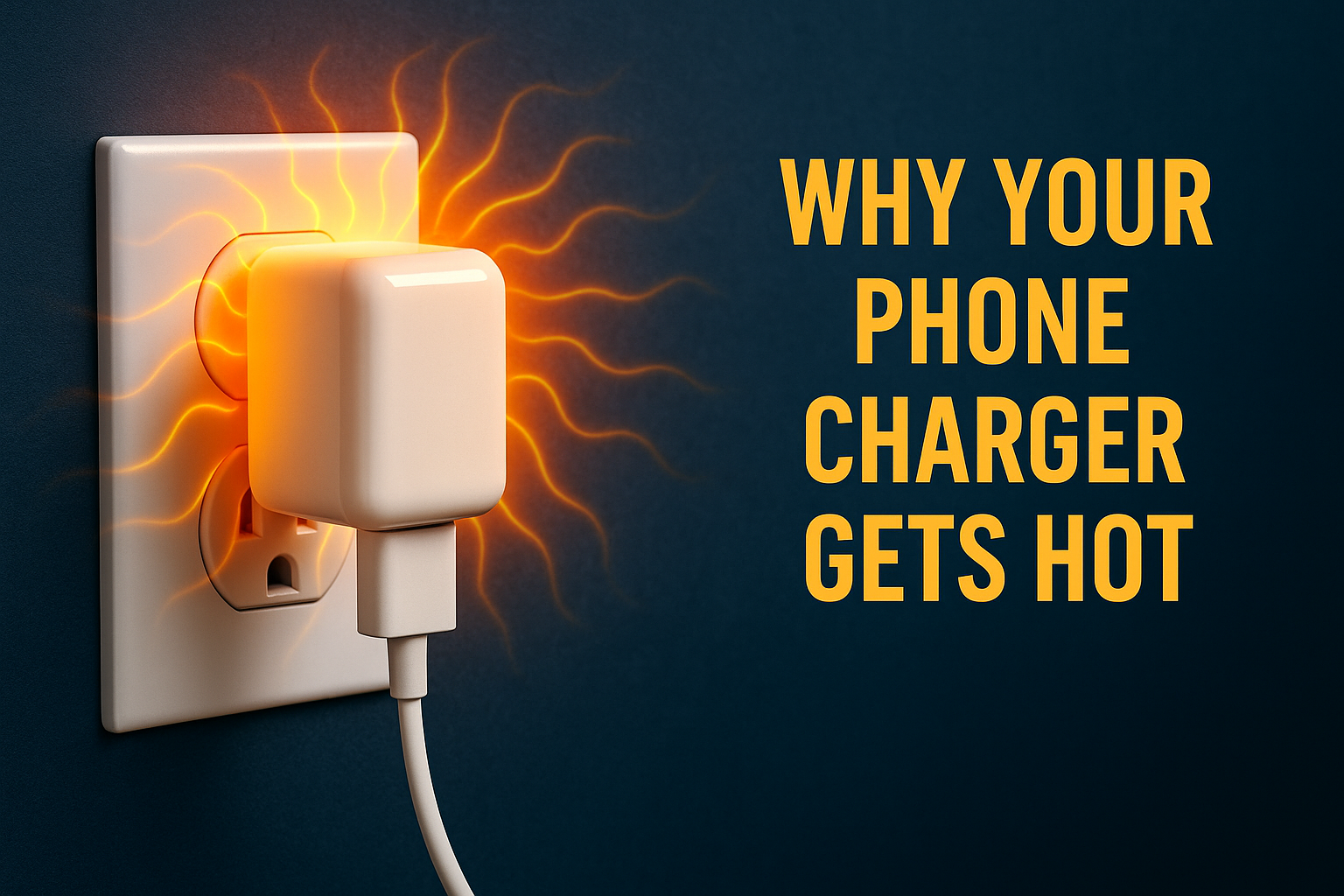
Every smartphone owner has experienced this:
You unplug your phone, leave the charger in the wall, come back hours later…
and the charger is warm — sometimes even hot.
People assume:
- “It must be broken.”
- “It’s wasting electricity.”
- “This is normal, right?”
- “Should I be worried?”
Here’s the truth:
Modern phone chargers are tiny switching power supplies with constant internal activity — even when nothing is connected.
And yes, they absolutely can heat up, sometimes to worrying levels.
Today we break down exactly why chargers get hot at idle, what’s happening inside them, and when you should be concerned.
Let’s get into the engineering behind it.
⚡ The First Truth: Your Charger Is Never Truly “Off”
Even with nothing plugged in, the charger must still:
- energize part of the transformer,
- run the switching controller,
- check for device connection,
- provide a tiny 5V “handshake” signal,
- maintain internal voltage rails,
- keep itself ready for fast-charging negotiation.
This is called standby power or no-load power consumption.
Typical standby draw:
- high-quality chargers: 20–50 mW
- mid-range chargers: 50–200 mW
- cheap no-name chargers: 200–1000 mW
That power becomes:
- heat inside the charger
- wasted electricity
Even in idle mode, there is constant switching activity.
⚡ Reason #1: Switching MOSFETs Leak Current by Design
Inside your charger is a MOSFET switching at:
- 20 kHz
- 60 kHz
- sometimes 100–150 kHz
Even when idle, the MOSFET experiences:
- leakage currents
- gate charge loss
- off-state dissipation
Leakage increases with:
- voltage,
- temperature,
- poor semiconductor quality,
- moisture and age,
- manufacturing imperfections.
Cheap chargers use low-cost MOSFETs with high leakage, contributing to heat even without a load.
⚡ Reason #2: The Transformer Is Still Magnetizing
Your charger includes a high-frequency transformer.
Even when idle, the primary coil still experiences:
- magnetization current,
- hysteresis losses,
- eddy current losses.
This means energy is constantly being:
- magnetized,
- demagnetized,
- dissipated as heat.
These iron-loss mechanisms never fully go to zero.
Cheap chargers with poor transformer design can burn 1–2 watts doing nothing.
⚡ Reason #3: The Control Chip Runs 24/7 (No Sleep Mode in Cheap Chargers)
High-quality chargers from Apple, Samsung, Anker, and Baseus include:
- low-power controllers,
- sleep/standby modes,
- ultra-low quiescent current circuits.
But budget chargers skip these features.
Their controller IC:
- never sleeps,
- runs the switching loop continuously,
- wastes energy stabilizing output rails.
This alone can make a charger warm to the touch.
⚡ Reason #4: Heat Has Nowhere to Go — Plastic Is a Terrible Heat Sink
Chargers are:
- sealed plastic boxes,
- no ventilation holes,
- minimal copper for thermal dissipation,
- small components tightly packed.
Heat generated inside has to:
- radiate through the PCB,
- convect through trapped air,
- conduct through the plastic shell.
Plastic is a thermal insulator, so heat builds up easily.
This is why some chargers feel hotter than laptop power bricks —
they have nowhere to shed heat.
⚡ Reason #5: Cheap Chargers Use Low-Efficiency Designs
High-end chargers are typically ~85–90% efficient.
Cheap ones?
60–75% efficient.
Lower efficiency means:
- more power wasted as heat,
- hotter components,
- shorter lifespan,
- higher fire risk.
Heat accelerates capacitor aging, MOSFET leakage, and overall degradation.
⚡ Reason #6: Fast-Charging Circuits Remain “On Standby”
PD (Power Delivery) and QC (Quick Charge) chargers must keep:
- communication lines alive,
- voltage negotiation active,
- microcontroller awake,
- USB-C configuration channels powered.
They cannot fully shut down.
USB-C PD spec requires:
- constant Vbus detection,
- CC channel monitoring,
- droop compensation circuits ready to activate.
This draws idle current → idle heat.
⚡ Reason #7: Aging Components Make Chargers Hotter Over Time
As chargers age:
- capacitors dry and increase ESR,
- MOSFETs leak more,
- solder joints add resistance,
- transformer insulation weakens,
- thermal pads degrade.
A charger that once ran cool may begin to run warm or hot even without a load.
This is why many chargers fail at year 2–3.
⚡ Reason #8: Cheap Chargers Skip Safety Components That Reduce Heat
Missing or low-quality components include:
- optocouplers,
- snubber circuits,
- EMI filters,
- efficient rectifiers,
- high-temp capacitors,
- proper heat sinks.
Without these, the charger:
- switches less efficiently,
- dumps more heat into the transformer,
- experiences voltage spikes,
- wastes power continuously.
Brand-name chargers rarely overheat at idle —
cheap ones often do.
⚡ When Is Heat Normal — and When Is It Dangerous?
Normal Warmth
✔ Slightly warm to touch
✔ Temperature below ~40°C
✔ Even heat distribution
✔ No noise or smell
✔ Normal operation under load
Warm ≠ dangerous in a quality charger.
⚠ Warning Signs
- hot enough that you pull your hand away
- hot even when unplugged from your phone
- buzzing or whining sounds (coil whine)
- discoloration of USB port
- melted plastic smell
- clicking noises
- intermittent charging
These indicate:
- failing capacitors,
- poor MOSFET control,
- internal arcing,
- runaway thermal conditions.
Such chargers should not be used.
⚡ How to Keep Chargers Cooler and Extend Their Lifespan
✔ unplug when not needed
reduces heat, fire risk, and standby waste.
✔ avoid covering chargers
allow airflow.
✔ do not use in hot climates or on beds/sofas
soft surfaces trap heat.
✔ avoid cheap no-name chargers
they use the worst components.
✔ replace chargers every 2–3 years
especially budget ones.
✔ use shorter cables
long cables increase load on charger.
⚡ Amp Nerd Fun Facts
- Some Apple chargers draw only 0.03W at idle — almost nothing.
- Cheap knockoff chargers can waste more energy doing nothing than charging your phone.
- USB-C PD chargers perform hundreds of micro-negotiations per second.
- Heat is the #1 reason USB chargers die early — not “overuse.”
- A charger running 10°C hotter can fail twice as fast.
- Many fake chargers output wildly fluctuating voltage even when idle.
⚡ Amp Nerd Summary
Phone chargers get hot at idle because:
- MOSFET leakage,
- transformer magnetization,
- active control chips,
- USB-C negotiation channels,
- low efficiency,
- cheap materials,
- poor heat dissipation.
A warm charger is normal.
A hot charger is a red flag.
High heat always means:
- wasted energy,
- aging components,
- reduced lifespan,
- increased failure risk.