
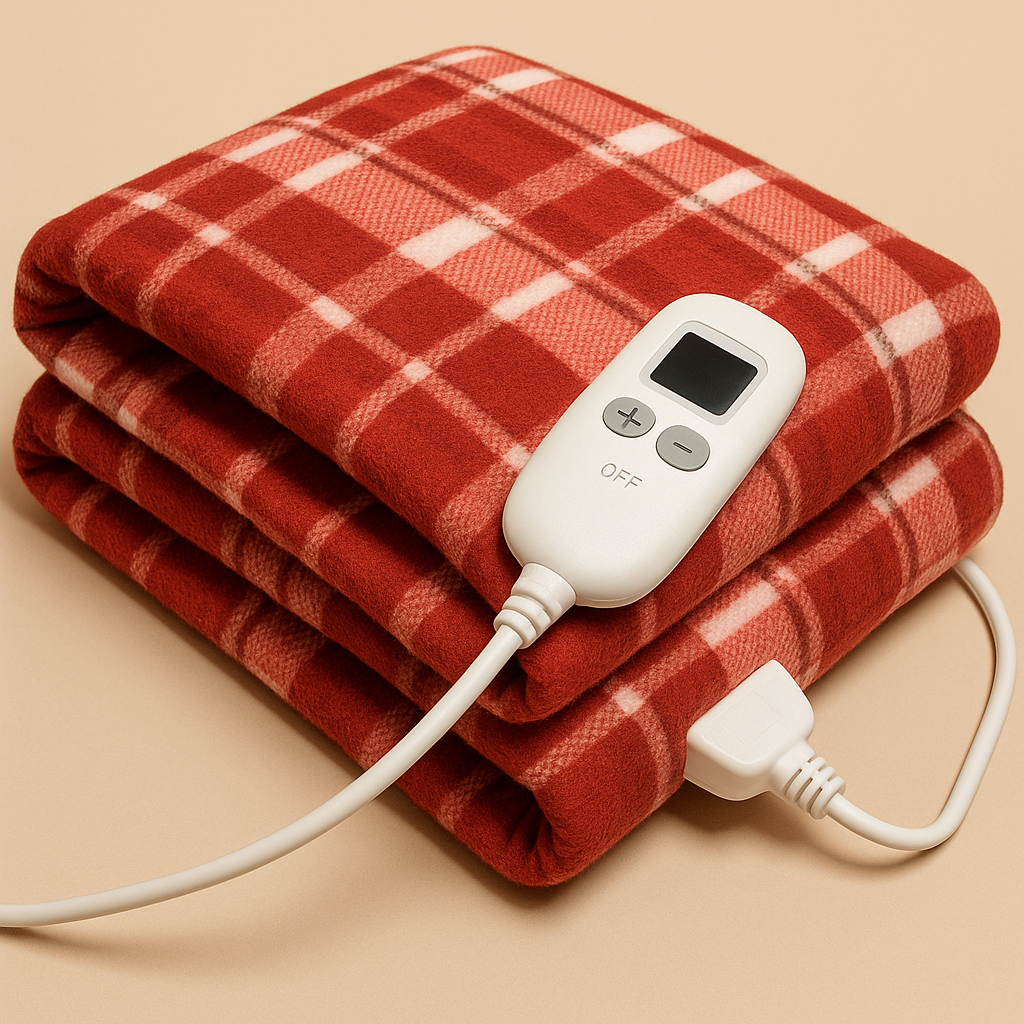
Electric blankets look harmless — soft fabric, gentle warmth, low wattage, cozy winter nights.
People treat them like a low-risk household accessory.
But behind the comfort is a surprisingly fragile piece of electrical engineering.
The truth is:
Electric blankets fail constantly, often dangerously, and for reasons most consumers never see.
Heating wires break.
Thermostats stick.
Sensors fail.
Connectors melt.
Insulation cracks.
Hotspots form.
Fire risks increase with age.
Thermal protection circuitry degrades.
And the fabric itself traps heat in ways that make failures worse.
Today we break down the REAL technical reasons electric blankets fail, why most last only a few years, and why old ones (10+ years) quietly become serious fire hazards.
⚡ The First Truth: Electric Blankets Are Literally “Flexible Heating Elements” — And Flexing = Metal Fatigue
Inside every electric blanket is a thin resistive heating wire, typically made from:
- nichrome
- stainless steel alloy
- copper-nickel
- or copper wire with resistive elements
This wire snakes through the blanket in a looping pattern.
The problem?
Heating wires are NOT meant to be bent repeatedly.
But electric blankets are:
- folded
- rolled
- slept on
- tugged
- washed
- squeezed under mattresses
- sat on
- twisted in storage
- kinked by pets
- stepped on
This repetitive flexing causes metal fatigue, a guaranteed failure mechanism.
Every fold = stress
Every bend = micro-crack
Every night of rolling around = accelerated failure
Eventually:
- the wire breaks
- the resistance changes
- hotspots develop
- the thermostat misreads temperature
- insulation wears through
- arcing becomes possible
Flexible heating elements are fundamentally fragile.
⚡ Reason #1: Repeated Heating Cycles Destroy the Internal Wire
Every time you turn the blanket on:
- The wire heats up
- The metal expands
- The insulation softens
- The fabric changes shape
Every time you turn it off:
- The wire cools
- The metal contracts
- Insulation stiffens
- Stress accumulates
This thermal cycling causes:
- micro-fractures in the wire
- embrittlement
- changes in resistivity
- weakening of solder joints
- deterioration of internal connections
The result?
Electric blankets slowly cook themselves from inside out.
Even high-quality blankets degrade from thermal cycling alone.
⚡ Reason #2: The Overheat Sensor Is the Weak Point (And It Fails Early)
Inside the blanket is usually one of:
- a thermal fuse
- a thermistor
- a bi-metal thermostat
- a temperature-sensitive switch
These are meant to shut off the blanket if a hotspot forms.
But here’s the problem:
These sensors are the FIRST components to wear out.
Why?
- They are exposed to heat constantly
- They drift out of calibration
- They oxidize
- Mechanical thermostats lose spring tension
- Thermistors degrade and read incorrectly
- Thermal fuses weaken over repeated heating cycles
When the sensor drifts high:
- the blanket won’t heat
- people think the blanket “stopped working”
When the sensor drifts low:
- the blanket overheats
Overheat sensors rarely fail open (safe).
They often fail intermittently, causing:
- uneven heating
- hot patches
- controller faults
- ticking noises
- melting connectors
This is why older blankets are extremely dangerous.
⚡ Reason #3: The Controller Electronics Are Cheap and Poorly Cooled
Most electric blanket controllers contain:
- a triac or relay
- a small SMPS
- a simple microcontroller
- a few resistors and caps
They are enclosed in a tiny plastic module with:
- no ventilation
- no heatsink
- no airflow
- no thermal padding
Triacs running at even 100W loads get hot.
Cheap caps fail.
Plastic housings trap heat.
MOSFETs run at borderline temperatures.
After a few years:
- capacitors dry
- relays weld shut
- solder joints crack
- connectors oxidize
- the control PCB overheats
This leads to:
- blanket not turning on
- inconsistent heating
- controller overheating smell
- buzzing or humming noises
In extreme cases:
stuck relays keep the blanket heating at full power permanently.
That’s how fires start.
⚡ Reason #4: Connectors Melt More Often Than People Realize
Most blankets have a detachable connector:
- a multi-pin plastic plug
- often with poor contact plating
- sometimes using thin spring contacts
Over time:
- oxidation increases resistance
- higher resistance generates heat
- heat softens plastic
- plastic loosens
- loosened contacts arc
- arcing carbonizes the connector
- carbon conducts → more arcing
- plug melts
These failures often occur silently under the bed.
If you’ve ever seen a burnt blanket plug:
That’s exactly what happened.
⚡ Reason #5: Fabric Traps Heat and Prevents Safe Heat Dissipation
Electric blankets work by converting electrical energy into heat.
But unlike other appliances:
- the heat cannot escape easily
- fabric layers insulate the heating wire
- blankets trap heat near the body
This creates:
- hotspots
- uneven thermal zones
- heat buildup around connectors
- trapped moisture from sweat
- unpredictable thermal behavior
Fabric also absorbs:
- skin oils
- detergent residue
- lint
- dust
- pet hair
All of which can carbonize when heated.
Carbonized textile behaves like:
- an insulator
- or worse: a conductor
This can lead to localized overheating or arcing.
⚡ Reason #6: Washing Electric Blankets Leads to Slow Death
Manufacturers advertise “washable electric blankets.”
But engineering reality says otherwise.
Washing (even gentle cycle):
- flexes internal wires
- strains controller connectors
- breaks internal solder joints
- forces water into insulation
- damages thermistors
- washes away protective coating
- accelerates oxidation
- causes internal corrosion
Blankets usually survive a few washes.
But long-term?
Washing kills electric blankets, period.
⚡ Reason #7: Fire Risk Comes from Aging, Not Instant Failure
Electric blankets rarely catch fire when NEW.
Failures become dangerous after:
- 5 years
- 8 years
- 10+ years (highest risk)
Why?
Because older blankets have:
- worn insulation
- brittle wires
- drifting thermostats
- oxidized connectors
- cracked internal heating filaments
- overheated solder joints
- degraded plastic controllers
This creates the perfect fire recipe:
- Break or high-resistance joint
- Localized heating
- Fabric insulation traps heat
- Thermal fuse fails to trip
- Hotspot ignites blanket
This happens most often:
- overnight
- under bedding
- with pets
- when folded
- during winter (long run times)
Fire departments recommend replacing electric blankets every 3–5 years for this reason.
⚡ Reason #8: Improvements in Safety Exist — But Only in Higher-End Models
Modern premium blankets use:
- dual overheat sensors
- digital temperature feedback
- multiple independent thermostats
- self-regulating heating wires
- lower voltage (12–24V) systems
- insulated multi-strand filaments
- GFCI integrated plugs
But budget blankets (the majority sold):
- skip extra safety circuits
- use single thermal cutoff devices
- use cheap connectors
- use thin resistive wires
- use simple mechanical thermostats
And those budget models are the ones that fail early (and dangerously).
⚡ Reason #9: People Use Electric Blankets Incorrectly — And Don’t Realize It
Electric blankets should NOT be:
- folded
- bunched
- placed under heavy weight
- tucked tightly
- used with pets that knead/claw
- used by people who sleep face-down
- placed between mattress/pillow layers
- stored rolled tightly
- used with memory-foam (heat buildup!)
- left on all night (despite what ads say)
But people do ALL of this.
Incorrect use dramatically accelerates wire fatigue and hotspot formation.
⚡ Reason #10: Old Electric Blankets Should Be Retired, Not Repaired
Unlike many appliances:
- you cannot safely repair the internal wiring
- you cannot re-solder thermal sensors
- you cannot safely replace the controller
- you cannot replace heating filaments
If a blanket fails:
- inconsistent heating
- hot patches
- controller faults
- visible wear
- flickering power
- connector melting
- burnt smell
…it should be discarded immediately, not “fixed.”
Electric blankets are consumables, not durable goods.
⚡ Amp Nerd Summary
Electric blankets fail because:
- heating wires fatigue and break
- thermal sensors drift or fail
- controllers overheat
- connectors oxidize and arc
- fabrics trap heat
- washing introduces mechanical damage
- insulation degrades
- repeated thermal cycles wear components
They are fragile devices operating in a harsh environment:
- heat
- moisture
- movement
- pressure
- aging
Older blankets are significantly more dangerous than new ones.
⚡ Final Thought
Electric blankets can be safe when used carefully and replaced regularly — but they’re not “lifetime” appliances.
The combination of heat, fabric, bending, and aging makes them one of the most failure-prone electrical items in a home.
Tomorrow :
“Why Plug Adapters Fail (And How They Quietly Create Fire Hazards).”