
If you’ve ever repaired electronics…
If you’ve ever opened a dead TV…
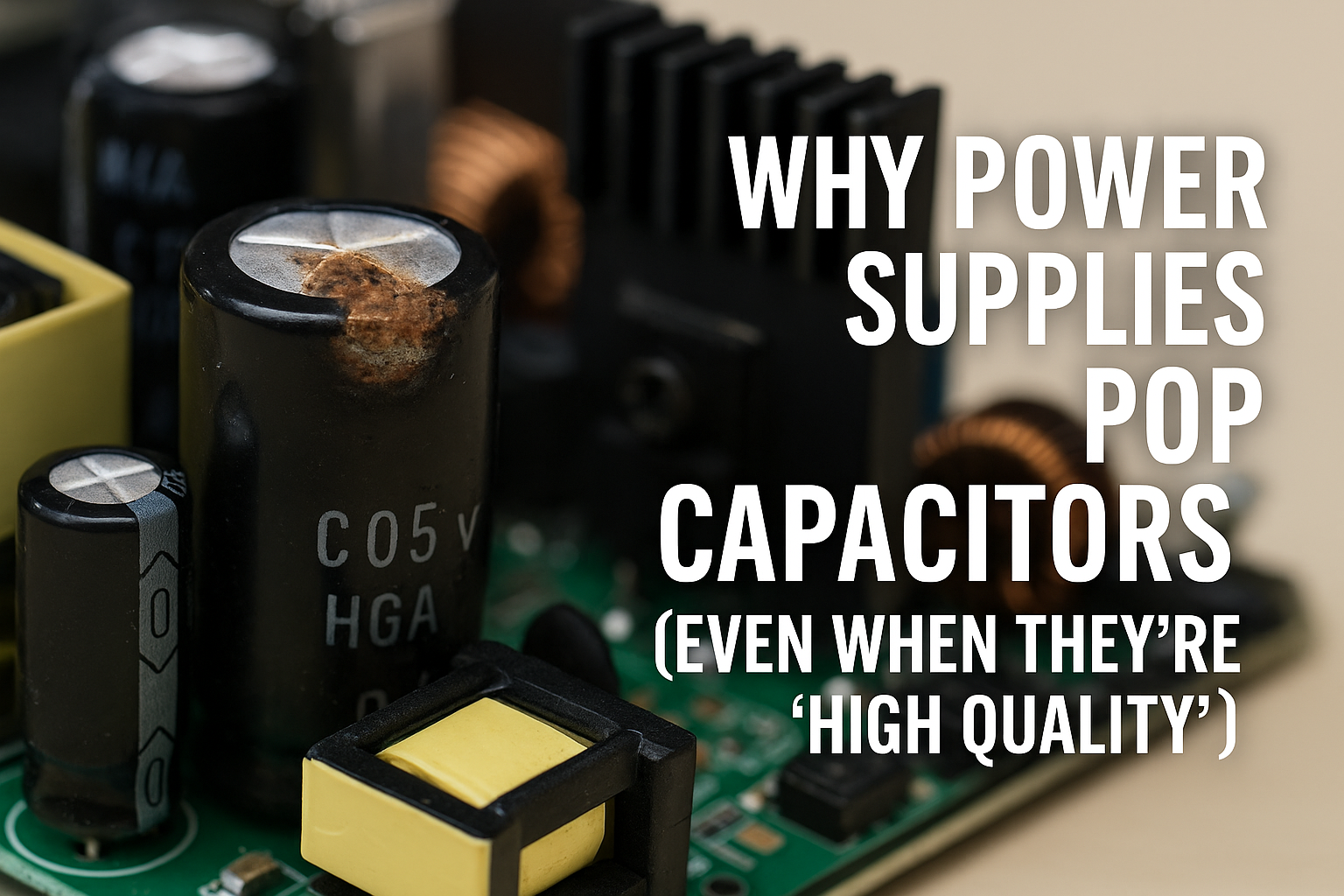
If you’ve ever heard a pop, smelled burnt electrolyte, or found a swollen capacitor on a motherboard…
Then you know the universal failure point of modern electronics:
Electrolytic capacitors.
They bulge.
They leak.
They vent.
They explode.
They die silently.
They take out entire power supplies with them.
And here’s the crazy part:
Capacitors fail even in “premium,” “high-end,” or “80+ certified” power supplies.
Today, Amp Nerd explains exactly why capacitors fail — the electrical, thermal, chemical, and mechanical reasons behind the most common failure in all power electronics.
Let’s break it down properly.
⚡ The First Truth: Capacitors Don’t Fail Randomly — They Fail Predictably
Electrolytic capacitors fail for five primary reasons:
- Heat
- Ripple current
- Voltage stress
- Aging of the electrolyte
- Manufacturing defects / bad formulas
Every capacitor failure is one or more of these.
And many power supplies operate in the worst possible environment for electrolytics.
⚡ Reason #1: Heat — The #1 Capacitor Killer
Capacitors are rated for a maximum temperature, typically:
- 85°C
- 105°C (for better ones)
Here’s the rule engineers know by heart:
Every 10°C increase in temperature cuts capacitor life in half.
So:
- A 105°C capacitor at 95°C lasts ~5,000 hours
- At 105°C? ~2,500 hours
- At 115°C? ~1,250 hours
- At 125°C? <700 hours
Power supplies (especially in PCs, TVs, LED drivers, chargers) routinely run at:
- 80–110°C near the primary capacitor
- 90–130°C in cheap units
In many power supplies, the capacitors sit directly next to:
- hot MOSFETs
- inductors
- heatsinks
- switching transformers
The heat cooks the electrolyte.
The electrolyte evaporates.
Pressure builds.
The capacitor vents or bulges.
Even high-quality capacitors die early if the PSU design is thermally poor.
⚡ Reason #2: Ripple Current — The Silent Destroyer
Ripple current is the AC component flowing through a capacitor when it’s used to smooth DC.
Ripple current causes:
- internal heating
- increased ESR
- electrolyte evaporation
- breakdown of oxide layers
High ripple current = rapid death.
Cheap capacitors often have:
- low ripple ratings
- high ESR
- thin oxide layers
High-quality capacitors (Nichicon, Rubycon, Panasonic, Nippon Chemi-Con) handle ripple better — but even they fail if the PSU is under-designed.
⚡ Reason #3: Voltage Stress — Capacitors Hate Being Near Their Limit
A capacitor rated for:
- 16V should not run at 15V
- 25V should not run at 24V
- 35V should not run at 33V
But many cheap power supplies run capacitors:
- too close to their voltage rating
- with no headroom for transient spikes
When the capacitor’s oxide layer degrades:
- leakage current increases
- heat increases
- the electrolyte breaks down
- internal pressure rises
- the cap pops
Good PSU designers derate capacitors by:
- 50% in high-ripple areas
- 20–30% in low-stress areas
Cheap PSUs derate by:
- 0%
They run capacitors right at the edge.
⚡ Reason #4: Aging — All Electrolytic Capacitors Are Consumables
Electrolytic capacitors aren’t permanent components.
They age because:
- the electrolyte dries
- the oxide layer thins
- internal ESR rises
- internal resistance generates more heat
- which accelerates more aging
This creates a feedback loop:
- aging → more ESR → more heat → faster aging → failure
Even premium capacitors eventually degrade.
But cheap capacitors degrade fast:
- 1–3 years in hot environments
- sometimes months in LED drivers
- weeks in terrible “no-name” power supplies
⚡ Reason #5: Manufacturing Defects — “Capacitor Plague” Still Happens
In the early 2000s, millions of devices failed due to:
- stolen capacitor formulas
- incorrect electrolyte chemistry
- hydrogen gas buildup
- catastrophic bulging and leaking
This was known as the Capacitor Plague.
But here’s the part most people don’t know:
Cheap capacitors STILL suffer from poor electrolyte formulations.
This includes brands like:
- CapXon
- JunFu
- Teapo
- Lelon
- ChengX
- Samxon
- OST
- Fuhjyyu
These brands often populate:
- budget PC PSUs
- TVs
- routers
- LED drivers
- appliances
- chargers
They look fine at first…
but fail quickly under heat or ripple current.
⚡ Why Do Power Supplies Destroy Capacitors Faster Than Other Circuits?
Because power supplies are:
- hot
- high-frequency
- high-ripple
- high-stress
- compact
- thermally cramped
Switch-mode power supplies (SMPS) operate at:
- 20 kHz
- 50 kHz
- 100 kHz
- sometimes MHz
At these frequencies:
- ripple stresses capacitors more
- voltage spikes are common
- switching noise heats components
- high current pulses travel through the output caps
These conditions are brutal for electrolytics.
⚡ Why High-End Power Supplies Still Pop Capacitors
Even premium power supplies can kill capacitors because:
- they’re still operating near heat sources
- they still rely on electrolytic capacitors (chemistry-bound components)
- they still exist in hot PCs / tight enclosures
- manufacturers sometimes cut corners on secondary-side caps
- capacitor lifespan is finite
Also:
Many “80+ Gold” or “80+ Platinum” PSUs use:
- great primary capacitors
- mediocre or cheap secondary capacitors
because they’re less visible to reviewers.
Those are often the first to fail.
⚡ Why LED Bulbs Blow Capacitors Quickly
LED bulbs are notorious for capacitor failure because:
- they run extremely hot
- driver circuits are cramped
- no airflow exists
- plastic housings trap heat
- electrolytics are used despite poor thermal conditions
Many LED bulbs run at 80–120°C internally.
Electrolytics hate that.
Thus cheap LED drivers fail in months.
⚡ Why TV Power Supplies Fail So Much
TVs pack power supplies into:
- tiny enclosures
- heat-trapping environments
- with minimal ventilation
When electrolytics dry:
- standby circuits fail
- PFC circuits glitch
- backlights flicker
- TVs refuse to turn on
Result:
the classic bulging cap TV failure.
⚡ Why Motherboards Pop Capacitors
Motherboard VRMs used to rely heavily on electrolytics.
When they dried out:
- CPUs crashed
- systems rebooted
- boards refused to POST
- catastrophic failures occurred
Modern boards now use:
- polymer capacitors
- ceramic capacitors
because of their longevity.
But budget boards still use electrolytics in non-VRM areas.
⚡ Why Laptop Chargers Fail
Laptop bricks run:
- hot
- sealed
- ventilation-free
- at high ripple
They have the perfect recipe for capacitor death.
The primary capacitor often bulges first.
⚡ How Engineers Prevent Capacitor Failure
Here’s what GOOD designs do:
✔ Use 105°C-rated capacitors
85°C caps have no place in modern PSUs.
✔ Derate voltage by 30–50%
NEVER run a cap near its limit.
✔ Use low-ESR capacitors
Reduces heat from ripple.
✔ Place capacitors away from heat sources
Not next to MOSFETs or transformers.
✔ Use polymer capacitors where possible
Polymers:
- don’t dry out
- handle ripple better
- have lower ESR
- last decades
Their only weakness: cost.
✔ Improve airflow
Even small ventilation improvements extend life dramatically.
✔ Choose reputable capacitor brands
Nichicon, Rubycon, Panasonic, Nippon Chemi-Con, and United Chemi-Con.
Avoid the “bad cap” brands entirely.
⚡ Signs Your Capacitors Are Dying
✔ Bulging top
✔ Crusty or leaking electrolyte
✔ Device won’t power on
✔ Random shutdowns
✔ Flickering LEDs
✔ PSU making chirping or ticking noises
✔ Device runs hotter than before
✔ Fans pulsing or oscillating
All of these mean:
the power supply is dying — not the device.
⚡ Amp Nerd Summary
Power supplies pop capacitors because of:
- heat
- ripple
- voltage stress
- aging
- bad electrolyte formulas
Most consumer electronics run electrolytic capacitors:
- too hot
- too close to rated voltage
- under high ripple
- in cramped enclosures
Even high-quality devices fail early if designs don’t respect capacitor physics.
Electrolytic capacitors are consumables, not permanent components.
⚡ Final Thought
Capacitors are the Achilles’ heel of modern electronics.
If manufacturers spent just a few euros more using high-quality components and better thermal design, millions of devices would last 5–10× longer.
But cheap design, heat, and physics always win.
Tomorrow :
“Why Electric Blankets Fail (And the Hidden Electrical Risks Nobody Talks About).”