
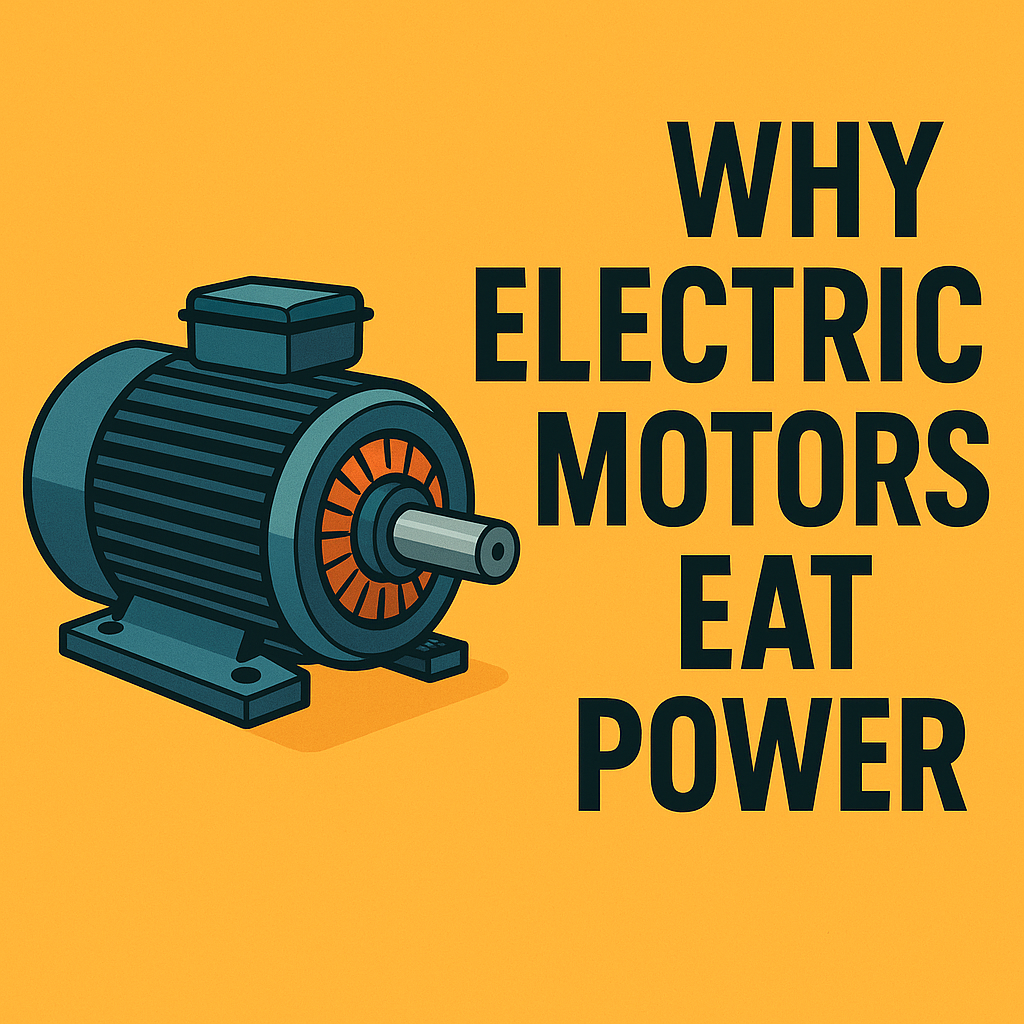
Electric motors are everywhere — in your fridge, HVAC system, washing machine, power tools, EV, factory equipment, and even tiny devices like toothbrushes and drones.
Electric motors consume over 45% of the world’s electricity, making them one of the single largest loads on the planet.
Most people think motors are simple:
“Give them electricity, and they spin.”
But behind every spinning motor is a complex cocktail of magnetic behavior, mechanical losses, resistance heating, harmonics, and efficiency tradeoffs that engineers fight constantly.
Here’s the uncomfortable truth:
Electric motors waste far more power than people realize — and the reasons are deeper than friction or heat.
Today, we’re breaking down the real engineering behind why motors consume so much power, and how engineers squeeze every possible percentage of efficiency out of them.
Let’s dive deep.
⚡ The First Truth: Motors Don’t “Use Electricity” — They Convert It (Poorly)
A perfect motor would:
- take electrical power in
- convert 100% into mechanical torque
But real motors are imperfect.
There are five major loss categories:
- Copper losses
- Core (iron) losses
- Mechanical losses
- Stray load losses
- Drive/Control losses (for VFD and BLDC motors)
Understanding these explains almost every efficiency problem.
⚡ Reason #1: Copper Losses — The Biggest Culprit
Copper losses are the power lost in motor windings: Pcu=I2RP_{cu} = I^2 RPcu=I2R
This means:
- high current → exponentially higher losses
- long run times → constant heating
- poor wiring → additional losses
Why it matters:
- heat reduces magnet strength
- heat ages insulation
- heat increases resistance (worsening the problem)
- heat must be removed (fans waste more energy)
For large industrial motors, copper losses can easily reach 2–4% of rated power — massive when you’re talking about 50 kW, 100 kW, or larger motors.
Cheap motors? Even worse.
⚡ Reason #2: Core (Iron) Losses — Magnetics Aren’t Free
Iron losses consist of:
- Hysteresis losses
- Eddy current losses
✔ Hysteresis losses
Every AC cycle requires flipping the magnetic domains inside the iron core.
That flip consumes energy, generating heat.
Higher frequencies = more loss.
✔ Eddy current losses
Changing magnetic fields induce circulating currents in the iron, which:
- generate heat
- waste power
To fight this, engineers use:
- laminated cores
- special low-loss alloys
- better metallurgy
- powder iron or ferrite cores for high-frequency motors
Without these, motors run hot and inefficiently.
⚡ Reason #3: Mechanical Losses — Friction Is a Silent Thief
Mechanical losses come from:
- bearings
- lubrication
- seals
- windage (air drag inside the motor)
Even with precision bearings, mechanical losses can eat:
- 1–2% of efficiency in large motors
- up to 10% in small, cheap motors
- much more in worn-out or poorly maintained motors
If a motor sounds rough — it’s not just louder, it’s wasting real power.
⚡ Reason #4: Stray Load Losses — The Weird Stuff Engineers Hate
Stray load losses come from:
- imperfect magnetic fields
- slot harmonics
- leakage flux
- small asymmetries
- non-linearities in the steel
They’re incredibly hard to model and measure.
Most engineers estimate them at ~1%, but they can spike much higher in:
- badly designed motors
- motors running far from rated load
- motors connected to dirty power
This is one reason high-end motors outperform cheap ones dramatically.
⚡ Reason #5: Drive/Control Losses — VFDs and BLDC Controllers Aren’t Free
A modern motor often uses:
- VFD (Variable Frequency Drive)
- BLDC controller
- Inverter stage
These introduce:
- switching losses
- heat in MOSFET/IGBT
- harmonic distortion
- PWM ripple
- filtering losses
A high-quality controller can achieve 98–99% efficiency.
A cheap one? 75–90%, with nasty harmonics that heat the motor too.
⚡ Let’s Break Down Each Motor Type (And Why They Waste Power)
Different motors lose power in different ways.
⚡ 1. Induction Motors — The Workhorse with Hidden Inefficiencies
Induction motors lose power because:
- they need slip (difference between electrical and mechanical speed)
- slip creates rotor current
- rotor current creates heat
Slip = inefficiency.
A typical induction motor’s efficiency:
- cheap/low-end: 70–85%
- industrial-grade: 88–93%
- premium-efficiency (IE3/IE4): 94–96%
In massive industrial facilities, even a 1% improvement saves thousands of euros per year.
⚡ 2. Brushed DC Motors — Sparks, Heat, and Wear
These motors waste power because:
- brushes create friction
- brushes arc
- commutators heat up
- copper losses are large
- magnetic fields are weak
Typical efficiency:
40–70%
Terrible for energy use, but still common in cheap tools and toys.
⚡ 3. Brushless DC (BLDC) Motors — More Efficient, But Not Magic
BLDC motors eliminate brushes, reducing:
- friction
- electrical arcing
- commutator heating
But they still have:
- switching losses
- inverter losses
- sensor feedback losses
- PWM ripple heating
Typical efficiency:
80–95%
Why EVs love them.
⚡ 4. Synchronous Reluctance & PMSM — The Kings of Modern Efficiency
These motors deliver:
- high torque
- low rotor losses
- very high efficiency
- excellent performance with VFDs
- reduced heating
Premium PMSM motors reach:
96–98% efficiency
That’s why they’re used in:
- Tesla EVs
- industrial high-efficiency systems
- robotics
- HVAC premium systems
But they require expensive materials and complex control electronics.
⚡ Where Does All the Wasted Power Go? Heat.
Every lost watt becomes heat.
That heat:
- reduces magnet strength
- destroys bearings
- accelerates insulation decay
- limits lifespan
- increases cooling requirements
Cooling systems themselves consume energy:
- fans
- blowers
- forced ventilation
- increased friction
Thus, inefficiency breeds more inefficiency.
⚡ Why Do Motors Eat More Power When Loaded Improperly?
Motors are happiest at:
- 70–90% load for induction
- 20–100% load for BLDC
- varies for reluctance motors
Underloaded motors:
- waste energy in core losses
- have poor power factor
- run less efficiently
Overloaded motors:
- overheat
- saturate magnetically
- cause winding resistance to skyrocket
- reduce lifespan
- dramatically waste power
This is why right-sizing motors is a huge industry.
⚡ Why Do Old Motors Waste WAY More Electricity?
Aging motors suffer from:
- worn bearings
- degraded insulation
- weakened magnets (in BLDC/PMSM)
- corroded laminations
- contamination
- mechanical misalignment
Each of these adds:
- friction
- heat
- resistance
- magnetic loss
An old motor may lose 5–15% efficiency compared to when it was new.
Multiply that by thousands of hours per year → massive cost.
⚡ How Engineers Improve Motor Efficiency (The Real Tricks)
Here are the actual engineering methods that improve efficiency — not the marketing fluff.
✔ 1. Better Copper (Bigger, Thicker, Cooler)
- thicker windings
- lower resistance
- higher purity copper
- better cooling paths
Reduces copper losses dramatically.
✔ 2. Premium Steel Alloys in the Core
Better steel reduces:
- hysteresis
- eddy currents
- core heating
IE3/IE4 motors use optimized alloys.
✔ 3. Laminated Steel Stacks
Thinner laminations = less eddy current loss.
Modern motors use lamination stacks as thin as 0.3 mm.
✔ 4. Rotor Optimization
Engineers adjust:
- slot shape
- magnet layout
- skew angles
- air gap precision
Microscopically small geometry changes improve:
- torque ripple
- stray losses
- harmonics
- power factor
✔ 5. Better Bearings
Low-friction, sealed, precision bearings reduce mechanical loss.
Ceramic hybrids in high-end motors reduce even more.
✔ 6. Advanced Controllers
VFDs and BLDC controllers fine-tune:
- voltage
- frequency
- torque
- current
- startup curves
Smart control reduces:
- inrush
- heating
- slip
- magnetization loss
✔ 7. Cooling Systems
Engineers rely on:
- forced-air cooling
- liquid cooling (EV motors)
- thermal pads
- optimized airflow channels
Cooler motors = more efficient motors.
⚡ The Biggest Secret: Power Factor Is a Huge Part of Motor “Power Eating”
People don’t realize:
- power factor affects current draw
- low PF means more current for same mechanical load
- more current = more copper loss
Induction motors naturally have PF of:
- 0.65–0.75 (bad)
With VFD control:
- PF approaches 1.0 (great!)
Less wasted power = less heating.
⚡ Amp Nerd Summary
Electric motors “eat power” because of:
- copper losses
- core losses
- friction
- heat
- harmonics
- stray load losses
- drive/controller inefficiencies
- poor cooling
- improper loading
Engineers boost efficiency using:
- better copper and steel
- better geometry
- better electronics
- better bearings
- better cooling
- better power factor correction
Motor efficiency isn’t magic — it’s physics, metallurgy, magnetism, and thousands of tiny design optimizations.
⚡ Final Thought
Electric motors silently run our world — but behind that simplicity is a war against heat, friction, and magnetic inefficiency.
Every percent of efficiency gained at scale saves millions.
Tomorrow:
“Why Power Supplies Pop Capacitors (Even When They’re ‘High Quality’).”